Brief Report - (2025) Volume 14, Issue 2
Received: 01-Apr-2025, Manuscript No. jsp-26-182232;
Editor assigned: 03-Apr-2025, Pre QC No. P-182232;
Reviewed: 17-Apr-2025, QC No. Q-182232;
Revised: 22-Apr-2025, Manuscript No. R-182232;
Published:
29-Apr-2025
, DOI: 10.37421/2165-7939.2025.14.711
Citation: Nair, Meera K.. ”Advances In Lumbar Disc Herniation Diagnosis And Management.” J Spine 14 (2025):711.
Copyright: © 2025 Nair K. Meera This is an open-access article distributed under the terms of the Creative Commons Attribution License, which permits unrestricted use, distribution and reproduction in any medium, provided the original author and source are credited.
Recent advancements in the diagnosis and management of lumbar disc herniation are significantly refining patient care. Enhanced imaging techniques, such as advanced MRI sequences, are providing unprecedented detail in visualizing the affected spinal structures. This improved diagnostic capability is complemented by a deeper understanding of the complex pain mechanisms underlying this condition. These insights are paving the way for more targeted and effective therapeutic strategies. Furthermore, surgical approaches are becoming increasingly sophisticated, with a notable shift towards minimally invasive techniques. Endoscopic discectomy, for example, offers a less disruptive alternative to traditional open surgery, potentially leading to faster recovery times and reduced complications. High-resolution magnetic resonance imaging (MRI) plays a pivotal role in the evolving diagnostic landscape of lumbar disc herniation. Beyond simply identifying the herniated disc, advanced MRI sequences are now capable of characterizing subtle pathological changes. This includes the precise assessment of annular tears, which are often a precursor to or co-existing with disc herniation, and the detection of inflammatory changes within the disc and surrounding tissues. Such detailed information is crucial for accurately staging the condition and predicting its prognosis. The integration of these advanced imaging modalities holds promise for predicting treatment outcomes, allowing clinicians to better manage patient expectations and tailor interventions accordingly. The understanding of pain mechanisms in lumbar disc herniation has undergone significant refinement. Current research delves into the intricate nociceptive pathways involved, identifying specific molecular and cellular processes that contribute to radicular pain and neuroinflammation. This detailed comprehension of pain generation is essential for developing effective management strategies. The emphasis is increasingly on a multimodal approach to pain management, recognizing that a single therapeutic modality may not suffice for all patients. Pharmacological agents and targeted interventional pain procedures are key components of this integrated strategy. Minimally invasive surgical techniques have emerged as a significant area of progress in the treatment of lumbar disc herniation. Procedures such as endoscopic discectomy and microdiscectomy are gaining traction due to their focus on preserving spinal anatomy and minimizing tissue disruption. These techniques aim to achieve comparable or superior efficacy to traditional open procedures while offering improved safety profiles. Extensive research is being conducted to evaluate their effectiveness, assess their safety profiles rigorously, and compare patient outcomes, thereby establishing their place in the surgical armamentarium. Personalized rehabilitation programs represent a paradigm shift in the conservative management of lumbar disc herniation. Recognizing that each patient's presentation and recovery trajectory is unique, these programs are tailored to individual needs, functional limitations, and specific goals. The role of physiotherapists is paramount in guiding patients through these personalized programs, ensuring optimal recovery and actively working to prevent recurrence of the herniation. This individualized approach acknowledges the multifactorial nature of recovery and the importance of patient engagement. Epidural steroid injections continue to be a valuable tool in the management of radicular pain associated with lumbar disc herniation. While their efficacy has been established, ongoing research aims to optimize their application. This includes exploring different injection techniques to enhance delivery and targeting, as well as refining patient selection criteria to ensure that those most likely to benefit receive the intervention. Such efforts are crucial for maximizing the therapeutic benefits while minimizing potential risks. The diagnostic utility of dynamic MRI in assessing lumbar disc herniation is an area of growing interest. While conventional static MRI provides a snapshot of the spine, dynamic MRI captures images during various functional positions or maneuvers. This allows for the assessment of disc instability and dynamic compression, which may not be apparent on static imaging. In cases where conventional MRI is inconclusive, dynamic MRI can offer crucial information for diagnosis and treatment planning, particularly in identifying dynamic instability. The management of recurrent lumbar disc herniation presents unique challenges. Re-herniation after initial treatment can be a source of frustration for patients and clinicians alike. Current research is exploring various surgical options specifically tailored for recurrent herniations, aiming to address the underlying causes and improve outcomes. Factors influencing re-herniation rates are also being investigated to better predict risk and implement preventive measures. The debate surrounding surgical intervention for lumbar disc herniation continues to evolve, with a focus on refining indications and timing. Evidence-based guidelines are crucial for ensuring that surgery is reserved for appropriate cases. Current reviews are critically examining the evidence for and against surgical intervention, carefully considering the clinical presentation and diagnostic findings to determine when surgery is most likely to yield optimal results. This ensures that patients undergo surgical procedures only when indicated and when the potential benefits outweigh the risks. The biomechanics of the lumbar spine play a fundamental role in understanding and managing disc herniation. The intricate interplay of bony structures, intervertebral discs, ligaments, and muscles influences spinal stability and load distribution. An improved understanding of these biomechanical principles is crucial for accurately diagnosing the cause and extent of disc herniation and for developing effective conservative management strategies that aim to restore optimal spinal function and reduce stress on the affected disc.
The diagnosis and management of lumbar disc herniation have seen substantial advancements, with a particular emphasis on sophisticated imaging modalities. Advanced MRI sequences are now integral, offering detailed characterization of disc pathology beyond simple herniation detection. These techniques enable the identification of annular tears and inflammatory changes, which are critical for guiding treatment decisions and predicting outcomes. The integration of these advanced imaging tools represents a significant step forward in personalizing patient care pathways. Complementing advanced imaging, the understanding of pain mechanisms associated with lumbar disc herniation has deepened considerably. Research now thoroughly explores the nociceptive pathways and the role of neuroinflammation in generating radicular pain. This advanced knowledge underpins the move towards a multimodal approach to pain management. This strategy often incorporates a combination of pharmacological interventions and targeted interventional pain procedures to address the complex nature of discogenic pain and provide comprehensive relief. In the realm of surgical interventions, minimally invasive techniques are revolutionizing the treatment of lumbar disc herniation. Procedures such as endoscopic discectomy and microdiscectomy are gaining prominence as they offer less invasive alternatives to traditional open surgeries. These methods aim to minimize collateral damage to surrounding tissues, potentially leading to reduced postoperative pain, shorter hospital stays, and faster return to daily activities. Their efficacy and safety profiles are continuously being refined and validated through ongoing research. Conservative management strategies are also experiencing a notable evolution, with a strong focus on personalized rehabilitation programs. Recognizing that each patient's journey to recovery is unique, these programs are designed to address individual needs, functional deficits, and specific goals. Physiotherapists play a crucial role in developing and implementing these tailored plans, ensuring that patients receive the most effective guidance for their recovery and are equipped with strategies to prevent future episodes of herniation. Epidural steroid injections remain a cornerstone in the management of radicular pain caused by lumbar disc herniation. Current research efforts are directed towards optimizing the use of these injections by exploring various techniques to enhance drug delivery and improve patient selection criteria. This focus on precision aims to maximize the therapeutic benefits for appropriate candidates while minimizing any potential adverse effects, thereby ensuring their continued relevance in pain management protocols. Dynamic MRI is emerging as a valuable diagnostic tool for assessing lumbar disc herniation, particularly in complex cases. Unlike static MRI, which provides a single view, dynamic MRI captures images during functional movements. This allows for the evaluation of disc instability and dynamic compression, which may not be evident on conventional scans. This advanced imaging capability can provide crucial insights for diagnosis and help in formulating more effective treatment strategies. The management of recurrent lumbar disc herniation requires careful consideration of the underlying factors contributing to re-herniation. Ongoing research is focused on identifying these factors and exploring specialized surgical options designed to address recurrent disc pathology effectively. This includes investigating techniques that can reduce the risk of future herniations and improve long-term outcomes for patients who experience this complication. The decision-making process regarding surgical intervention for lumbar disc herniation is becoming increasingly evidence-based. Current reviews meticulously examine the data supporting or refuting surgical treatment, taking into account the patient's clinical presentation, neurological deficits, and imaging findings. This rigorous evaluation helps in determining the optimal timing and indications for surgery, ensuring that operative intervention is pursued only when conservative measures have failed or are unlikely to succeed. Understanding the biomechanics of the lumbar spine is fundamental to comprehending the etiology and progression of disc herniation. The way forces are distributed across the spine, the integrity of the intervertebral discs, and the interplay of supporting structures all influence the development and severity of herniation. This biomechanical perspective informs both diagnostic approaches and the development of effective conservative management strategies aimed at restoring spinal health and function. Pharmacotherapy and interventional pain procedures are essential components of a comprehensive pain management strategy for lumbar disc herniation. The judicious use of analgesics, anti-inflammatory medications, and targeted injections, such as epidural steroid injections, can provide significant relief from radicular pain. These interventions, when used appropriately and in conjunction with other therapeutic modalities, contribute to improved patient outcomes and quality of life.
Recent advancements in lumbar disc herniation diagnosis and management include enhanced MRI techniques for better imaging, a deeper understanding of pain mechanisms, and refined surgical approaches like minimally invasive procedures and endoscopic discectomy. Non-operative strategies are evolving with a focus on personalized rehabilitation programs, judicious pharmacotherapy, and interventional pain procedures. High-resolution MRI helps characterize annular tears and inflammatory changes, guiding treatment and predicting outcomes. Pain management emphasizes a multimodal approach addressing nociceptive pathways and neuroinflammation. Minimally invasive surgeries offer effective and safe alternatives. Personalized rehabilitation programs tailor recovery to individual needs, with physiotherapy playing a key role. Epidural steroid injections are optimized for radicular pain, and dynamic MRI aids in diagnosing instability. Management of recurrent herniation and surgical indications are also subjects of ongoing research, emphasizing evidence-based decision-making and understanding spinal biomechanics for effective conservative care.
None
None
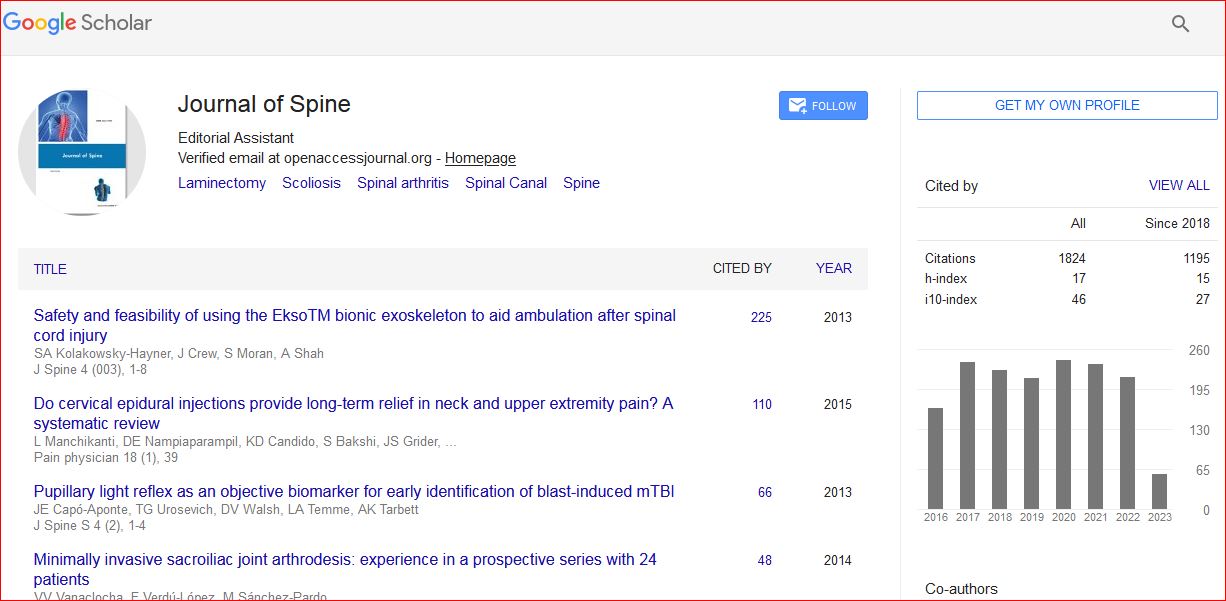
Journal of Spine received 2022 citations as per Google Scholar report