Commentary - (2025) Volume 9, Issue 3
Received: 01-May-2025, Manuscript No. hps-26-184450;
Editor assigned: 05-May-2025, Pre QC No. P-184450;
Reviewed: 19-May-2025, QC No. Q-184450;
Revised: 22-May-2025, Manuscript No. R-184450;
Published:
29-May-2025
, DOI: 10.37421/2573-4563.2025.9.344
Citation: Johansson, Sarah K.. "Advances in Hepatocellular Carcinoma Treatment." J Hepatol Pancreat Sci 09 (2025):344.
Copyright: © 2025 Johansson K. Sarah This is an open-access article distributed under the terms of the Creative Commons Attribution License, which permits unrestricted use, distribution and reproduction in any medium, provided the original author and source are credited.
Hepatocellular carcinoma (HCC) treatment is undergoing a rapid transformation, driven by significant advancements in targeted therapies and immunotherapy. Recent research underscores the effectiveness of multi-kinase inhibitors and novel immunotherapeutic agents, particularly immune checkpoint inhibitors, in improving patient outcomes. The integration of these therapeutic modalities, coupled with a more profound understanding of HCC's molecular subtypes, is instrumental in developing more personalized and effective treatment strategies. Crucially, biomarker discovery remains a pivotal element for patient selection and for predicting the response to these advanced therapeutic interventions [1].
Immunotherapy, especially the use of PD-1/PD-L1 inhibitors, has profoundly reshaped the landscape of HCC treatment, demonstrating encouraging survival benefits. Combination therapies, such as the regimen of atezolizumab and bevacizumab, have now emerged as a new standard of care for patients with unresectable HCC. A comprehensive understanding of the tumor microenvironment and the mechanisms underlying treatment resistance is paramount for optimizing immunotherapy efficacy and overcoming existing therapeutic limitations [2].
Targeted therapies, including well-established agents like sorafenib and lenvatinib, continue to hold significant importance as treatment options for advanced HCC. Ongoing research efforts are actively exploring novel therapeutic agents and combination strategies aimed at improving response rates and effectively managing the challenge of drug resistance. The development of predictive biomarkers to stratify patients and guide the selection of appropriate targeted agents represents a dynamic and active area of clinical investigation [3].
A thorough comprehension of the genomic landscape of HCC is absolutely essential for the development of highly effective targeted therapies. Frequent observations of mutations within critical signaling pathways, such as the Wnt/β-catenin pathway, TP53, and telomere maintenance mechanisms, highlight these as promising targets for the design of novel drug development programs [4].
The emergence of resistance to targeted therapies presents a substantial hurdle in the effective management of HCC. Current research is intensely focused on elucidating the intricate mechanisms of resistance, including the activation of alternative signaling pathways or alterations within the tumor microenvironment. This understanding is vital for devising strategies to circumvent or prevent the development of such resistance [5].
The synergistic combination of targeted therapies with immunotherapy is emerging as a promising strategy to substantially enhance treatment efficacy in HCC. Both preclinical investigations and ongoing clinical studies are exploring the potential synergistic effects of combining therapeutic agents that target distinct pathways implicated in tumor proliferation and immune evasion mechanisms [6].
Neoantigen-based cancer vaccines represent a particularly promising avenue within immunotherapy for HCC. The accurate identification of patient-specific neoantigens holds the potential to elicit a potent anti-tumor immune response, which could ultimately lead to durable treatment responses and improved long-term survival rates [7].
Analysis of circulating tumor DNA (ctDNA) is rapidly establishing itself as a powerful tool for the precise monitoring of treatment response and the early detection of minimal residual disease in HCC patients. This non-invasive approach offers significant potential for guiding therapeutic decisions and accurately predicting patient prognosis [8].
Radiotherapy, particularly when administered in conjunction with systemic therapies, is undergoing a re-evaluation of its role in the comprehensive management of HCC, especially in the context of unresectable disease. Stereotactic body radiation therapy (SBRT) has demonstrated considerable promise in effectively controlling tumor growth and enhancing local disease control [9].
The identification of reliable predictive biomarkers for immunotherapy response in HCC continues to be a significant unmet clinical need. Current research is actively investigating various factors, including immune cell infiltration patterns, specific gene expression profiles, and the composition of the gut microbiome, to pinpoint patients most likely to benefit from immune checkpoint inhibitor therapy [10].
Hepatocellular carcinoma (HCC) treatment is undergoing a rapid transformation, driven by significant advancements in targeted therapies and immunotherapy. Recent research underscores the effectiveness of multi-kinase inhibitors and novel immunotherapeutic agents, particularly immune checkpoint inhibitors, in improving patient outcomes. The integration of these therapeutic modalities, coupled with a more profound understanding of HCC's molecular subtypes, is instrumental in developing more personalized and effective treatment strategies. Crucially, biomarker discovery remains a pivotal element for patient selection and for predicting the response to these advanced therapeutic interventions [1].
Immunotherapy, especially the use of PD-1/PD-L1 inhibitors, has profoundly reshaped the landscape of HCC treatment, demonstrating encouraging survival benefits. Combination therapies, such as the regimen of atezolizumab and bevacizumab, have now emerged as a new standard of care for patients with unresectable HCC. A comprehensive understanding of the tumor microenvironment and the mechanisms underlying treatment resistance is paramount for optimizing immunotherapy efficacy and overcoming existing therapeutic limitations [2].
Targeted therapies, including well-established agents like sorafenib and lenvatinib, continue to hold significant importance as treatment options for advanced HCC. Ongoing research efforts are actively exploring novel therapeutic agents and combination strategies aimed at improving response rates and effectively managing the challenge of drug resistance. The development of predictive biomarkers to stratify patients and guide the selection of appropriate targeted agents represents a dynamic and active area of clinical investigation [3].
A thorough comprehension of the genomic landscape of HCC is absolutely essential for the development of highly effective targeted therapies. Frequent observations of mutations within critical signaling pathways, such as the Wnt/β-catenin pathway, TP53, and telomere maintenance mechanisms, highlight these as promising targets for the design of novel drug development programs [4].
The emergence of resistance to targeted therapies presents a substantial hurdle in the effective management of HCC. Current research is intensely focused on elucidating the intricate mechanisms of resistance, including the activation of alternative signaling pathways or alterations within the tumor microenvironment. This understanding is vital for devising strategies to circumvent or prevent the development of such resistance [5].
The synergistic combination of targeted therapies with immunotherapy is emerging as a promising strategy to substantially enhance treatment efficacy in HCC. Both preclinical investigations and ongoing clinical studies are exploring the potential synergistic effects of combining therapeutic agents that target distinct pathways implicated in tumor proliferation and immune evasion mechanisms [6].
Neoantigen-based cancer vaccines represent a particularly promising avenue within immunotherapy for HCC. The accurate identification of patient-specific neoantigens holds the potential to elicit a potent anti-tumor immune response, which could ultimately lead to durable treatment responses and improved long-term survival rates [7].
Analysis of circulating tumor DNA (ctDNA) is rapidly establishing itself as a powerful tool for the precise monitoring of treatment response and the early detection of minimal residual disease in HCC patients. This non-invasive approach offers significant potential for guiding therapeutic decisions and accurately predicting patient prognosis [8].
Radiotherapy, particularly when administered in conjunction with systemic therapies, is undergoing a re-evaluation of its role in the comprehensive management of HCC, especially in the context of unresectable disease. Stereotactic body radiation therapy (SBRT) has demonstrated considerable promise in effectively controlling tumor growth and enhancing local disease control [9].
The identification of reliable predictive biomarkers for immunotherapy response in HCC continues to be a significant unmet clinical need. Current research is actively investigating various factors, including immune cell infiltration patterns, specific gene expression profiles, and the composition of the gut microbiome, to pinpoint patients most likely to benefit from immune checkpoint inhibitor therapy [10].
Hepatocellular carcinoma (HCC) treatment is rapidly advancing with new targeted therapies and immunotherapies, including immune checkpoint inhibitors and multi-kinase inhibitors. Combination therapies like atezolizumab and bevacizumab are becoming standards of care. Understanding HCC's molecular and genomic landscape, tumor microenvironment, and resistance mechanisms is crucial for personalized treatment. Biomarker discovery plays a vital role in patient selection and predicting treatment response. Novel strategies such as neoantigen vaccines and advanced radiotherapy techniques like SBRT are also being explored. Circulating tumor DNA analysis offers a non-invasive method for monitoring treatment and detecting residual disease.
None
None
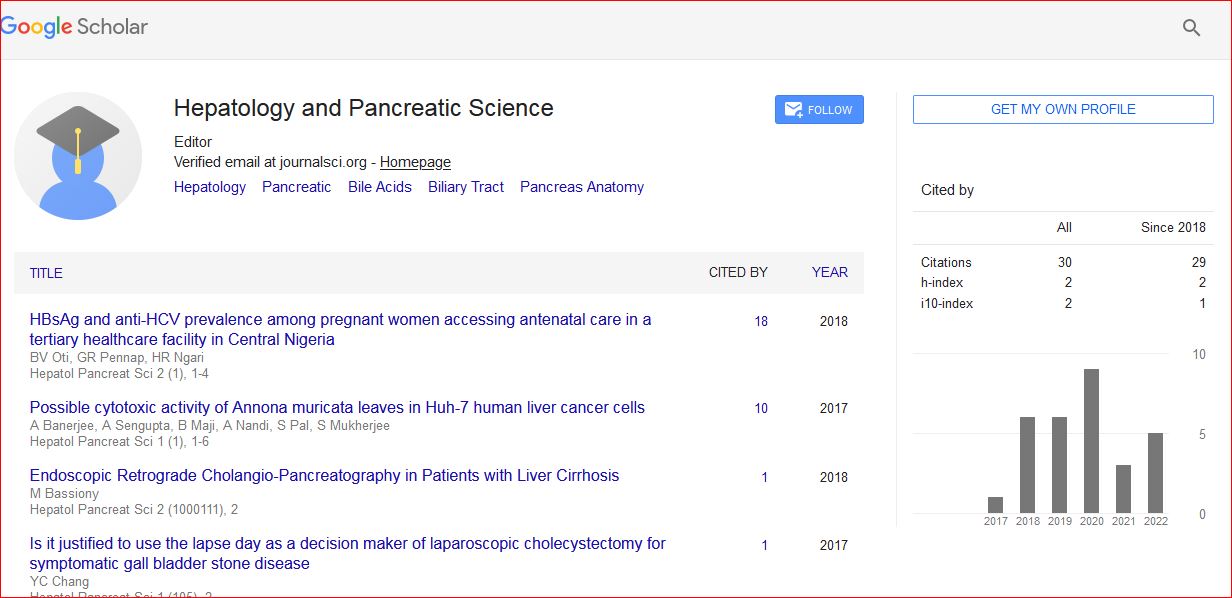
Hepatology and Pancreatic Science received 34 citations as per Google Scholar report