Brief Report - (2026) Volume 16, Issue 1
Received: 01-Jan-2026, Manuscript No. jnt-26-191269;
Editor assigned: 05-Jan-2026, Pre QC No. P-191269;
Reviewed: 19-Jan-2026, QC No. Q-191269;
Revised: 22-Jan-2026, Manuscript No. R-191269;
Published:
29-Jan-2026
, DOI: 10.37421/2161-0959.2026.16.602
Citation: Hartwell, Amelia. ”Advances In Chronic Kidney Disease Management And Therapy.” J Nephrol Ther 16 (2026):602.
Copyright: © 2026 Hartwell A. This is an open-access article distributed under the terms of the Creative Commons Attribution License, which permits unrestricted use, distribution and reproduction in any medium, provided the original author and source are credited.
The intricate landscape of chronic kidney disease (CKD) necessitates a continuous exploration of novel diagnostic and therapeutic strategies. Recent advancements are shedding light on the earliest detection of CKD, moving beyond traditional markers to identify at-risk individuals before irreversible damage ensues. This includes the identification of novel biomarkers that promise a more nuanced understanding of kidney health [1].
The therapeutic arsenal for CKD is also expanding, with a particular focus on interventions that target specific pathological pathways. These new drug classes offer the potential for more precise and effective management of the disease's progression, marking a significant step towards personalized treatment approaches [1].
Among the most impactful therapeutic developments are the sodium-glucose cotransporter 2 (SGLT2) inhibitors. Compelling evidence now demonstrates their renoprotective effects, not only in diabetic kidney disease but also in non-diabetic CKD patients, by reducing albuminuria and slowing the decline of glomerular filtration rate (GFR) [2].
Fibrotic processes are a central driver of CKD progression, and research is actively pursuing novel therapeutic targets to combat this. Emerging agents that modulate the transforming growth factor-beta (TGF-β) signaling pathway and other profibrotic mechanisms hold promise for preventing irreversible kidney damage [3].
Inflammation plays a critical role in the pathogenesis and progression of CKD. Understanding the inflammatory milieu and its correlation with kidney damage is crucial for developing targeted anti-inflammatory and immunomodulatory therapies aimed at preserving kidney function [4].
The advent of precision medicine is revolutionizing CKD management. By integrating genetic profiling and individual patient characteristics, treatment decisions can be tailored to optimize outcomes, especially in complex cases or for those with rare genetic kidney disorders [5].
The evolution of dialysis technologies continues to enhance the quality of life for patients with end-stage renal disease. Innovations in hemodialysis and peritoneal dialysis are focused on reducing treatment burden and improving the efficiency of waste product removal [6].
Dietary interventions represent a cornerstone of CKD management, with evidence supporting the benefits of specific dietary patterns in slowing disease progression. Personalized nutritional counseling is vital for ensuring adherence and maximizing these benefits [7].
Cardiovascular complications are a major concern in CKD. Emerging therapeutic targets are being explored to mitigate cardiovascular risk by addressing factors such as hypertension, dyslipidemia, and inflammation, which are intricately linked to kidney disease [8].
Mineralocorticoid receptor antagonists (MRAs) are gaining prominence in CKD management due to their efficacy in reducing proteinuria and slowing disease progression. Careful patient selection and monitoring are essential for their optimal use [9].
The early detection of chronic kidney disease (CKD) is being significantly advanced by the identification of novel biomarkers that extend beyond traditional measures like creatinine and GFR. These new indicators are crucial for identifying individuals at risk before substantial kidney damage occurs, enabling timely interventions [1].
Concurrently, therapeutic strategies for CKD are undergoing a transformation, with a strong emphasis on novel drug classes that target specific pathological pathways involved in disease progression. This focus on targeted therapies aligns with the growing importance of personalized medicine in managing this complex condition [1].
A significant stride in CKD management comes from the exploration of SGLT2 inhibitors. This class of drugs has demonstrated robust renoprotective effects, effectively reducing albuminuria and slowing the decline in GFR for both diabetic and non-diabetic CKD patients, underscoring their broad applicability [2].
Addressing the fibrotic nature of many kidney diseases, research is actively exploring emerging therapeutic targets. Agents designed to modulate profibrotic mechanisms, such as the TGF-β signaling pathway, are showing promise in preclinical and early clinical studies for their potential to halt irreversible kidney damage [3].
The intricate relationship between inflammation and CKD pathogenesis is a key area of investigation. Understanding the inflammatory markers and their correlation with kidney damage informs the development of anti-inflammatory and immunomodulatory therapies, offering new avenues for preserving kidney function [4].
Precision medicine is ushering in an era of tailored treatment for CKD. By leveraging genetic profiling and a deep understanding of individual patient characteristics, therapies can be customized to optimize outcomes and minimize adverse effects, particularly in challenging cases and rare genetic kidney disorders [5].
Innovations in dialysis technologies are continuously improving the lives of patients with end-stage renal disease. Advances in both hemodialysis and peritoneal dialysis are aimed at enhancing patient quality of life and reducing the burden of treatment [6].
Dietary management remains a critical component of CKD care. Evidence supports the efficacy of specific dietary patterns, like low-protein and potassium-restricted diets, in slowing disease progression, with personalized nutritional counseling playing a vital role in patient adherence [7].
Cardiovascular complications are a significant comorbidity in CKD. Novel therapeutic approaches are being developed to mitigate cardiovascular risk by targeting key contributing factors such as hypertension, dyslipidemia, and inflammation [8].
Mineralocorticoid receptor antagonists (MRAs) are proving to be valuable in CKD management, demonstrating efficacy in reducing proteinuria and slowing disease progression. Strategic patient selection and diligent monitoring are paramount for maximizing their therapeutic benefits and mitigating potential side effects [9].
This collection of research explores advancements in chronic kidney disease (CKD) management, focusing on early detection through novel biomarkers and innovative therapeutic strategies. It highlights the impact of SGLT2 inhibitors and mineralocorticoid receptor antagonists in slowing disease progression, alongside emerging antifibrotic agents. The role of inflammation and the application of precision medicine are discussed for tailored treatment approaches. Furthermore, the importance of dietary interventions and managing cardiovascular risks in CKD patients is emphasized. Advances in dialysis technologies and the potential of artificial intelligence for risk prediction are also presented.
None
None
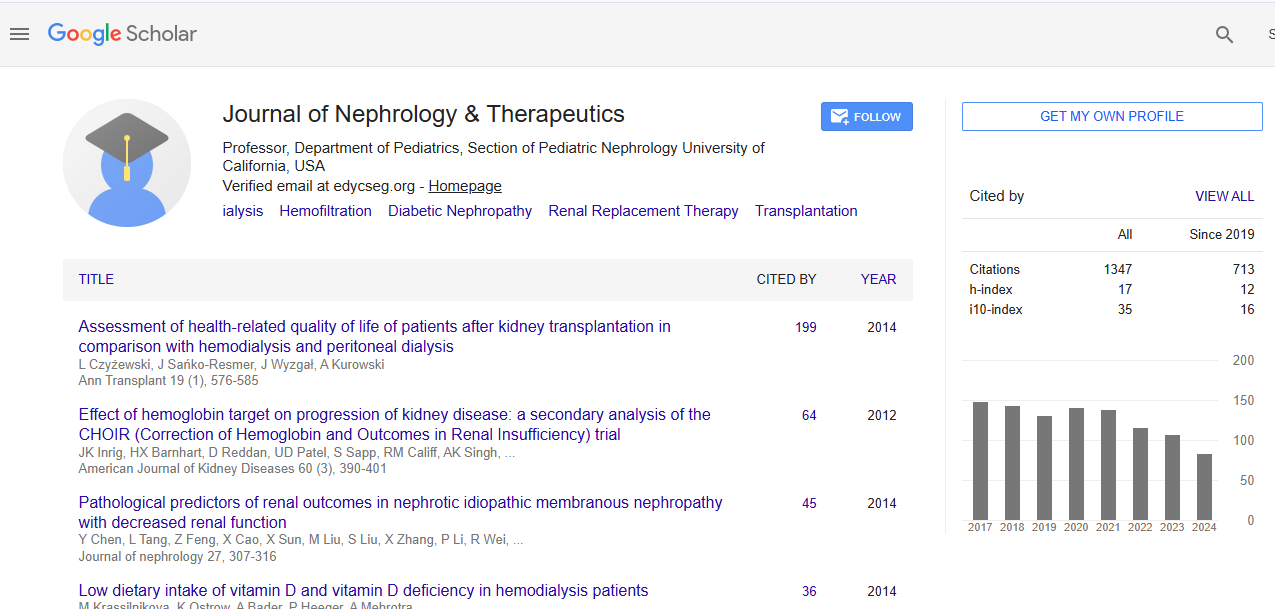
Journal of Nephrology & Therapeutics received 784 citations as per Google Scholar report