Brief Report - (2025) Volume 16, Issue 5
Received: 01-Oct-2025, Manuscript No. jvst-26-188122;
Editor assigned: 03-Oct-2025, Pre QC No. P-188122;
Reviewed: 17-Oct-2025, QC No. Q-188122;
Revised: 22-Oct-2025, Manuscript No. R-188122;
Published:
29-Oct-2025
, DOI: 10.37421/2157-7579.2025.16.317
Citation: Torres, Miguel. ”Advances in Animal Reproductive
Health and Fertility.” J Vet Sci Techno 16 (2025):317.
Copyright: © 2025 Torres M. This is an open-access article distributed under the terms of the Creative Commons Attribution License, which permits unrestricted use, distribution
and reproduction in any medium, provided the original author and source are credited.
The field of veterinary reproductive health is undergoing continuous evolution, driven by the need to enhance animal welfare, genetic improvement, and agricultural productivity. Recent advancements in veterinary reproductive technologies are significantly improving breeding efficiency and genetic selection in both livestock and companion animals. These strategies encompass a wide range of interventions, from sophisticated artificial insemination techniques to sophisticated hormonal therapies designed to optimize reproductive outcomes. Nutritional management also plays a pivotal role in this intricate process, influencing hormonal balance and overall fertility [1].
Diagnostic capabilities in veterinary reproduction have seen remarkable progress, particularly with the integration of advanced imaging modalities. In equine reproduction, for instance, ultrasound has become an indispensable tool for accurate diagnosis and effective management of reproductive disorders. This non-invasive technique allows for detailed ovarian evaluation, precise pregnancy detection, and early identification of uterine abnormalities, thereby guiding timely interventions and improving therapeutic success rates [2].
Understanding the fundamental biological underpinnings of fertility is crucial for developing targeted interventions. Research into the genetic and epigenetic factors influencing reproductive performance is shedding light on the complex mechanisms that govern fertility in important livestock species, such as dairy cattle. Identifying specific gene polymorphisms and understanding the role of epigenetic modifications in early embryonic development offers promising avenues for marker-assisted selection strategies aimed at improving herd fertility [3].
Reproductive diseases pose significant challenges in various animal populations, leading to economic losses and compromising animal health. In small ruminants, diseases like ovine brucellosis and caprine abortion require robust diagnostic and control strategies. The implementation of effective vaccination programs, coupled with stringent biosecurity protocols, is paramount in mitigating the impact of these zoonotic diseases and ensuring herd health [4].
Managing infertility in companion animals, particularly in dogs, necessitates tailored therapeutic approaches. The development of novel hormonal treatments for conditions like repeat-breeder syndrome in dogs is an area of active research. By comparing traditional protocols with new formulations and meticulously evaluating factors such as estrus detection and hormonal profiles, evidence-based recommendations are being formulated to address canine infertility more effectively [5].
The capacity to preserve genetic material is fundamental for long-term conservation efforts and advanced breeding programs. Cryopreservation of gametes and embryos in various animal species remains a critical technology, though challenges persist. Ongoing research focuses on optimizing cryoprotective agents, cooling rates, and thawing protocols to maximize post-cryopreservation viability and developmental potential, thereby enhancing cryosurvival rates [6].
Postpartum recovery and the subsequent return to cyclicity are critical phases in the reproductive cycle of many female animals, particularly in dairy cattle. Understanding the physiological and clinical aspects of postpartum anestrus is essential for maintaining herd productivity. Factors such as nutrition, metabolic status, and uterine health significantly influence the duration of anestrus, and effective management strategies are vital for shortening this period and improving subsequent fertility [7].
Minimally invasive surgical techniques are revolutionizing reproductive tract management in small animals. Laparoscopic surgery offers significant advantages for procedures such as ovariectomy, cyst ablation, and biopsies in cats and dogs. The benefits of reduced pain, faster recovery times, and minimal scarring make laparoscopic approaches highly desirable for treating specific reproductive pathologies and improving surgical outcomes [8].
The intricate interplay between the immune system and reproduction is a fundamental aspect of successful gestation. Reproductive immunology in domestic animals explores the complex maternal-fetal interactions and immune responses that facilitate tolerance and ensure successful pregnancy. Understanding the role of immune cells and cytokines, as well as the impact of immune dysregulation, is opening new avenues for addressing pregnancy complications and improving reproductive outcomes [9].
Environmental factors can exert profound influences on animal reproductive health, with significant implications for both wildlife and livestock populations. Emerging research highlights the impact of environmental contaminants, particularly endocrine-disrupting chemicals, on fertility and reproductive development. Proactive monitoring and the implementation of mitigation strategies are crucial for protecting animal reproductive health from these pervasive threats [10].
Current veterinary strategies for enhancing animal reproductive health are rapidly advancing, focusing on innovative techniques in artificial insemination, estrus synchronization, and assisted reproductive technologies. These methods are instrumental in boosting breeding efficiency, facilitating precise genetic selection, and bolstering disease prevention across a spectrum of animals, from livestock to cherished companion animals. Furthermore, the critical role of optimized nutritional management and targeted hormonal therapies in achieving superior reproductive outcomes is increasingly recognized, underpinning a holistic approach to animal reproduction [1].
In the realm of equine reproduction, diagnostic ultrasonography stands out as a cornerstone for the evaluation and management of reproductive health issues. This technique offers a non-invasive yet highly accurate means to assess ovarian function, confirm pregnancies, and detect uterine abnormalities, thereby enabling veterinarians to implement precise interventions at optimal times for the best possible therapeutic results [2].
The study of genetic and epigenetic influences on fertility in dairy cattle provides deep insights into the biological mechanisms governing reproductive success. By examining specific gene polymorphisms and the effects of epigenetic modifications on early embryonic development, researchers are identifying potential targets for marker-assisted selection, which can be used to enhance overall herd fertility and productivity [3].
Effective management of reproductive diseases in small ruminants, particularly ovine brucellosis and caprine abortion, remains a priority for veterinary public health and the agricultural sector. Comprehensive diagnostic approaches, coupled with strategic vaccination and rigorous control measures, are essential for mitigating the economic impact of these zoonotic diseases and for maintaining animal health through strict biosecurity protocols [4].
For companion animals, specifically dogs experiencing fertility issues, novel hormonal treatments are being investigated to improve pregnancy rates in repeat-breeder cases. This research involves a comparative analysis of established protocols against new formulations, with a keen focus on optimizing estrus detection, insemination timing, and the monitoring of progesterone levels to guide evidence-based interventions for canine infertility [5].
The field of cryopreservation continues to evolve, offering essential tools for the preservation of genetic diversity and for advanced reproductive strategies. Research in cryopreservation of mammalian gametes and embryos aims to improve viability and developmental potential through refinement of cryoprotective agents, cooling rates, and thawing protocols, critically evaluating current strategies to enhance cryosurvival across species [6].
Addressing postpartum anestrus in cattle is crucial for dairy farm profitability and animal welfare. A thorough understanding of the physiological and clinical factors contributing to delayed uterine involution and the resumption of estrous cycles, including nutritional status, metabolic health, and uterine infections, is vital. Management strategies designed to shorten the anestrus period directly correlate with improved subsequent fertility [7].
Surgical interventions for reproductive tract pathologies in small animals are increasingly being performed using minimally invasive techniques. Laparoscopic surgery for procedures such as ovariectomy, cyst ablation, and ovarian biopsies in cats and dogs offers substantial benefits, including reduced patient discomfort, shorter recovery periods, and improved cosmetic outcomes, making it a preferred method for various reproductive conditions [8].
The complex field of reproductive immunology in domestic animals is shedding light on the mechanisms of maternal-fetal tolerance and the immune responses essential for successful gestation. Research into immune cells, cytokines, and the consequences of immune dysregulation during pregnancy is critical for understanding and potentially treating pregnancy complications and improving reproductive health [9].
The impact of environmental contaminants on animal reproductive health is a growing concern, particularly regarding endocrine-disrupting chemicals affecting fertility and reproductive development in wildlife and livestock. This area of study underscores the imperative for continuous monitoring and the development of effective mitigation strategies to safeguard animal populations from these persistent environmental threats [10].
This compilation of research explores critical aspects of animal reproductive health. It covers advancements in veterinary reproductive technologies, including artificial insemination and assisted reproduction, alongside diagnostic tools like ultrasound in equine reproduction. Genetic and epigenetic factors influencing fertility in dairy cattle are examined, as are strategies for managing reproductive diseases in small ruminants. Novel hormonal treatments for canine infertility, cryopreservation of gametes and embryos, and management of postpartum anestrus in cattle are discussed. Furthermore, the review includes the application of laparoscopic surgery in small animals, reproductive immunology, and the impact of environmental contaminants on animal reproduction. These diverse areas highlight the ongoing efforts to improve animal fertility, health, and productivity through scientific innovation.
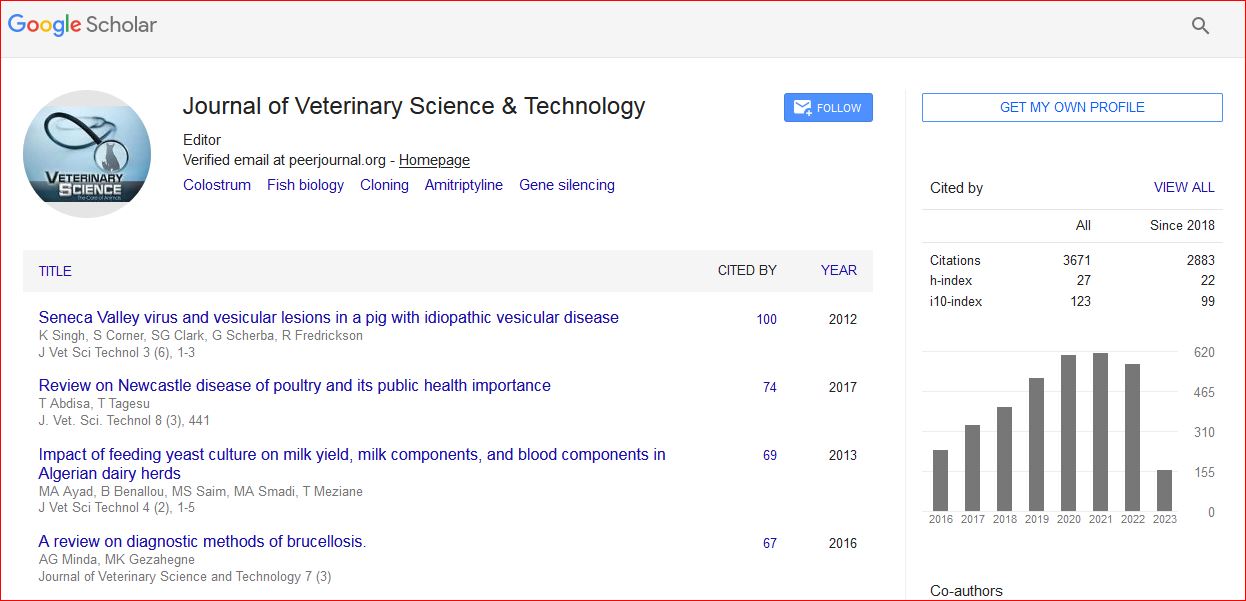
Veterinary Science & Technology received 4472 citations as per Google Scholar report