Opinion - (2025) Volume 12, Issue 3
Received: 01-Jun-2025, Manuscript No. jreac-26-185784;
Editor assigned: 03-Jun-2025, Pre QC No. P-185784;
Reviewed: 17-Jun-2025, QC No. Q-185784;
Revised: 23-Jun-2025, Manuscript No. R-185784;
Published:
30-Jun-2025
, DOI: 10.37421/2380-2391.2025.12.433
Citation: Ndlovu, Thabo. ”Advancements in SPE for Emerging Environmental Contaminants.” J Environ Anal Chem 12 (2025):433.
Copyright: © 2025 Ndlovu T. This is an open-access article distributed under the terms of the Creative Commons Attribution License, which permits unrestricted use, distribution and reproduction in any medium, provided the original author and source are credited.
Solid-phase extraction (SPE) has emerged as a cornerstone technique in environmental analysis, offering unparalleled capabilities for concentrating and purifying trace levels of organic pollutants from complex matrices. Its ability to prepare samples for sensitive detection makes it indispensable for understanding environmental contamination. Recent advancements in SPE sorbent materials and methodologies have significantly expanded its applicability, particularly in the analysis of emerging contaminants such as pesticides, pharmaceuticals, and microplastics in both water and air. These improvements are critical for accurate environmental monitoring and robust risk assessment, ensuring the safety of ecosystems and human health. This review highlights the evolution of SPE sorbent materials, showcasing innovative approaches that enhance adsorption capacity, selectivity, and extraction efficiency. The focus on emerging contaminants underscores the dynamic nature of environmental pollution and the continuous need for sophisticated analytical tools. As pollution profiles shift and new contaminants are identified, the development of advanced SPE techniques becomes paramount. The application of novel sorbent materials, including metal-organic frameworks (MOFs), is revolutionizing SPE. These advanced materials demonstrate superior adsorption capabilities and selectivity compared to traditional sorbents, enabling more efficient preconcentration of target analytes. This progress is vital for achieving lower detection limits and more accurate quantification of recalcitrant pollutants in diverse environmental samples. The integration of established methodologies with novel techniques, such as QuEChERS (Quick, Easy, Cheap, Effective, Rugged, and Safe) combined with SPE, offers a synergistic approach. This integrated strategy significantly reduces sample preparation time and solvent consumption while maintaining high extraction efficiency and recovery rates for multiple analytes, facilitating routine and high-throughput analysis of complex samples like fruits and vegetables. Furthermore, the development of disposable, paper-based SPE devices represents a significant step towards on-site environmental monitoring. These portable and cost-effective solutions, utilizing functionalized cellulose materials, enable rapid screening of pollutants like polycyclic aromatic hydrocarbons (PAHs) in situ, democratizing environmental surveillance and allowing for immediate response to contamination events. The exploration of advanced nanomaterials, such as graphitic carbon nitride (g-C3N4) functionalized magnetic nanocomposites, offers new avenues for SPE. These materials provide rapid extraction and high enrichment factors, which are crucial for detecting endocrine-disrupting compounds like bisphenols and their analogs at very low concentrations, often found in wastewater. Molecularly imprinted polymers (MIPs) are also gaining prominence as highly selective sorbent materials for SPE. By designing MIPs tailored to specific target molecules, such as pharmaceutical residues, researchers can achieve enhanced selectivity and reduced matrix effects. This leads to improved detection limits and more reliable analysis of these persistent environmental contaminants in water samples. Innovative extraction techniques, like microwave-assisted SPE (MA-SPE), are accelerating the process of sample preparation. MA-SPE significantly reduces extraction time and solvent consumption while improving analyte recovery for compounds like organochlorine pesticides in soil. This makes it a valuable and efficient tool for routine environmental analysis, especially when dealing with large sample volumes. The development of solid-phase microextraction (SPME) with novel stationary phases, such as ionic liquids, is expanding the scope of SPE applications. Ionic liquid-based SPME fibers exhibit excellent adsorption capacity and thermal stability for a wide range of volatile organic compounds (VOCs) in air, facilitating their sensitive detection and enabling better air quality monitoring. Finally, the coupling of SPE with advanced analytical instrumentation, like liquid chromatography-high resolution mass spectrometry (LC-HRMS), provides a powerful strategy for comprehensive profiling of polar organic contaminants in surface water. This integrated approach allows for the identification and quantification of a broad spectrum of emerging pollutants, delivering crucial data for effective water quality management and remediation efforts [1].
Solid-phase extraction (SPE) is a powerful technique for concentrating and purifying trace levels of organic pollutants from complex environmental matrices, making them amenable to sensitive detection. This review highlights recent advancements in SPE sorbent materials and methodologies, focusing on their application in the analysis of emerging contaminants such as pesticides, pharmaceuticals, and microplastics in water and air. Effective SPE protocols are crucial for accurate environmental monitoring and risk assessment [1].
This study investigates the effectiveness of a novel metal-organic framework (MOF) based sorbent for solid-phase extraction of per- and polyfluoroalkyl substances (PFAS) from drinking water. The MOF demonstrated superior adsorption capacity and selectivity compared to conventional C18 sorbents, enabling efficient preconcentration for subsequent liquid chromatography-tandem mass spectrometry (LC-MS/MS) analysis. The results indicate promising applications for MOFs in environmental analytical chemistry [2].
The application of QuEChERS (Quick, Easy, Cheap, Effective, Rugged, and Safe) combined with SPE for the simultaneous determination of multiple pesticide residues in fruit and vegetable samples is presented. This integrated approach significantly reduces sample preparation time and solvent consumption while achieving high extraction efficiency and recovery rates for a broad spectrum of pesticides, facilitating routine analysis [3].
This research explores the development of disposable, paper-based solid-phase extraction devices for the on-site preconcentration of polycyclic aromatic hydrocarbons (PAHs) from water samples. These devices, utilizing novel functionalized cellulose materials, offer a cost-effective and portable solution for rapid screening of PAHs, thus enabling decentralized environmental monitoring [4].
A study focusing on the SPE of bisphenols and their analogs from wastewater using a graphitic carbon nitride (g-C3N4) functionalized magnetic nanocomposite is presented. The developed method provides rapid extraction and high enrichment factors, crucial for detecting these endocrine-disrupting compounds at low concentrations using LC-MS/MS [5].
This paper evaluates the performance of molecularly imprinted polymers (MIPs) as selective sorbent materials for the SPE of pharmaceutical residues in environmental water samples. MIPs designed for specific drug molecules offer enhanced selectivity and reduced matrix effects compared to conventional sorbents, leading to improved detection limits [6].
The development of microwave-assisted solid-phase extraction (MA-SPE) for the rapid and efficient extraction of organochlorine pesticides from soil samples is discussed. MA-SPE significantly reduces extraction time and solvent consumption while improving analyte recovery, making it a valuable tool for environmental analysis [7].
This work presents an investigation into the use of ionic liquids as stationary phases in solid-phase microextraction (SPME) for the determination of volatile organic compounds (VOCs) in air. The ionic liquid-based SPME fibers exhibited excellent adsorption capacity and thermal stability for a wide range of VOCs, facilitating their sensitive detection by gas chromatography [8].
The efficiency of SPE coupled with LC-HRMS for the comprehensive profiling of polar organic contaminants in surface water is explored. This advanced analytical strategy allows for the identification and quantification of a wide array of emerging pollutants, providing crucial data for water quality management [9].
This study investigates the solid-phase extraction of microplastics from different environmental matrices, including water and sediment. The method focuses on achieving efficient extraction and recovery of microplastic particles for subsequent identification and characterization using spectroscopic techniques, addressing a growing environmental concern [10].
Solid-phase extraction (SPE) remains a pivotal technique for the preconcentration and purification of organic pollutants from complex environmental samples, a crucial step for sensitive analytical detection. The ongoing refinement of SPE sorbent materials and methodologies has led to significant advancements, particularly in the analysis of emerging contaminants such as pesticides, pharmaceuticals, and microplastics found in water and air. The establishment of effective SPE protocols is therefore fundamental for accurate environmental monitoring and comprehensive risk assessment, safeguarding both ecological integrity and public health. Recent progress in SPE sorbent materials has introduced innovative approaches aimed at enhancing adsorption capacity, selectivity, and overall extraction efficiency. These developments are particularly relevant for addressing the challenges posed by emerging contaminants, reflecting the evolving landscape of environmental pollution and the persistent demand for sophisticated analytical tools to identify and quantify them. The incorporation of novel sorbent materials, including metal-organic frameworks (MOFs), represents a significant leap forward in SPE technology. These advanced materials typically exhibit superior adsorption characteristics and enhanced selectivity when contrasted with conventional sorbents, thereby facilitating more efficient preconcentration of target analytes and improving the analytical outcomes. The synergy achieved through the integration of well-established analytical approaches, such as QuEChERS, with SPE techniques has yielded significant benefits. This combined strategy effectively minimizes sample preparation time and reduces solvent usage while upholding high standards of extraction efficiency and analyte recovery, thereby streamlining the analysis of diverse sample types like fruits and vegetables. In parallel, the advent of disposable, paper-based SPE devices marks a considerable advancement in the field of on-site environmental analysis. These devices, characterized by their portability and cost-effectiveness, leverage functionalized cellulose materials to enable rapid screening of pollutants such as polycyclic aromatic hydrocarbons (PAHs) directly at the sampling location, thereby facilitating decentralized environmental surveillance. The utilization of advanced nanomaterials, such as magnetic nanocomposites functionalized with graphitic carbon nitride (g-C3N4), presents novel opportunities for SPE applications. These materials are known to facilitate rapid extraction processes and achieve high enrichment factors, which are essential for the detection of endocrine-disrupting compounds, including bisphenols and their related analogs, often present in wastewater at trace levels. Moreover, molecularly imprinted polymers (MIPs) are increasingly being recognized for their utility as highly selective sorbent materials in SPE. The design of MIPs tailored to specific target analytes, such as pharmaceutical residues, allows for improved selectivity and a reduction in matrix interference, leading to more accurate and sensitive detection in environmental water samples. Innovations in extraction methodologies, including microwave-assisted solid-phase extraction (MA-SPE), are contributing to faster and more efficient sample preparation procedures. MA-SPE is recognized for its ability to significantly shorten extraction times and minimize solvent consumption while simultaneously enhancing analyte recovery, particularly for compounds like organochlorine pesticides in soil matrices. The evolution of solid-phase microextraction (SPME) through the incorporation of novel stationary phases, such as ionic liquids, is broadening the applicability of SPE. Ionic liquid-based SPME fibers demonstrate robust adsorption capabilities and thermal stability for a wide spectrum of volatile organic compounds (VOCs) present in air, thereby enabling their sensitive detection and contributing to improved air quality assessment. Finally, the synergistic combination of SPE with sophisticated analytical instrumentation, specifically liquid chromatography-high resolution mass spectrometry (LC-HRMS), offers a potent strategy for the comprehensive profiling of polar organic contaminants within surface water. This integrated analytical framework facilitates the precise identification and quantification of a broad range of emerging pollutants, providing indispensable data for effective water quality management and the implementation of appropriate remediation measures [1].
Solid-phase extraction (SPE) is a vital technique for analyzing organic pollutants in environmental samples, with recent advancements focusing on new sorbent materials and methodologies for emerging contaminants like pesticides, pharmaceuticals, and microplastics. Novel materials such as metal-organic frameworks (MOFs), graphitic carbon nitride nanocomposites, and molecularly imprinted polymers (MIPs) offer improved selectivity and efficiency. Integrated approaches like QuEChERS-SPE and techniques like microwave-assisted SPE (MA-SPE) reduce preparation time and solvent use. Disposable paper-based SPE devices enable on-site analysis, while ionic liquid-based SPME enhances VOC detection. Coupling SPE with advanced chromatography-mass spectrometry techniques like LC-HRMS provides comprehensive contaminant profiling, crucial for environmental monitoring and risk assessment.
None
None
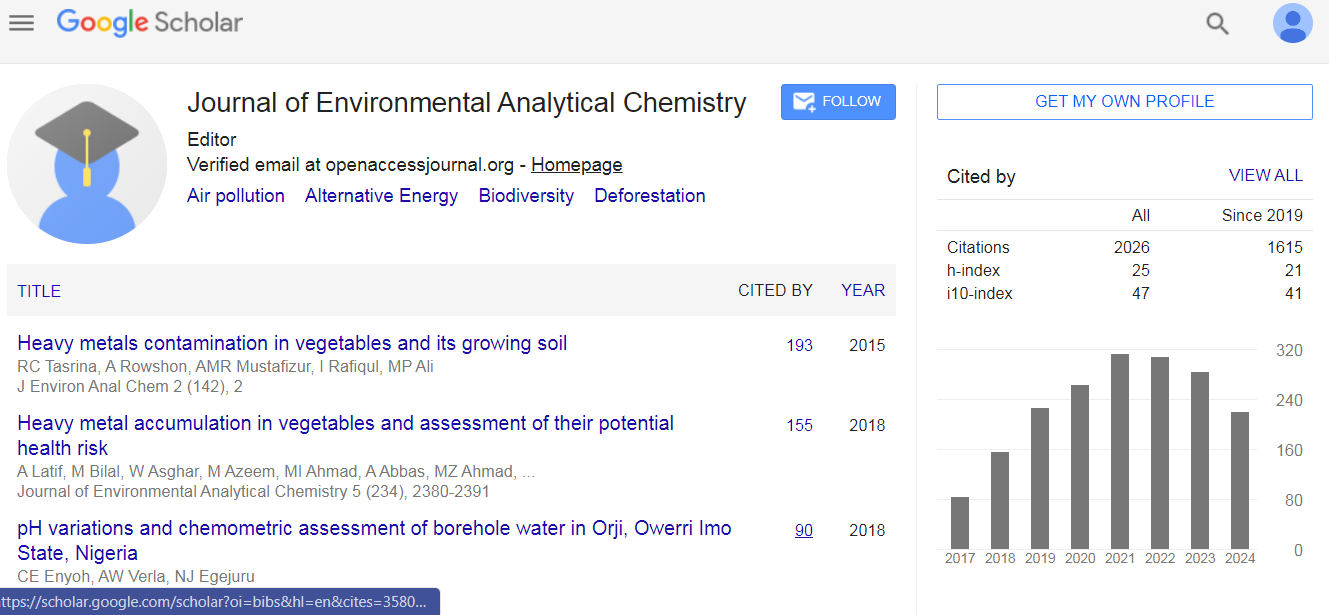
Journal of Environmental Analytical Chemistry received 1781 citations as per Google Scholar report