Short Communication - (2025) Volume 11, Issue 5
Received: 01-Oct-2025, Manuscript No. jssc-26-188316;
Editor assigned: 03-Oct-2025, Pre QC No. P-188316;
Reviewed: 17-Oct-2025, QC No. Q-188316;
Revised: 22-Oct-2025, Manuscript No. R-188316;
Published:
29-Oct-2025
, DOI: 10.37421/2472-0437.2025.11.324
Citation: Larsen, Ingrid. ”Advancements in Seismic Retrofitting
of Steel Structures.” J Steel Struct Constr 11 (2025):324.
Copyright: © 2025 Larsen I. This is an open-access article distributed under the terms of the Creative Commons Attribution License, which permits unrestricted use, distribution
and reproduction in any medium, provided the original author and source are credited.
The seismic retrofitting of steel structures has garnered significant attention in recent years, driven by the need to enhance the resilience of existing infrastructure against seismic events. A prominent area of research involves advanced techniques for steel structures, incorporating performance-based design and innovative damping systems [1].
Among these innovations, hysteretic dampers such as buckling restrained braces (BRBs) and viscous dampers are increasingly adopted, alongside the integration of smart materials to bolster seismic resilience [1].
Furthermore, the seismic performance of steel moment resisting frames can be substantially improved through the use of novel self-centering viscous dampers, which effectively reduce story drifts and residual displacements while enhancing energy dissipation [2].
Buckling Restrained Braces (BRBs) have emerged as a highly effective solution, demonstrating consistent hysteretic behavior and substantial energy dissipation without premature buckling, a finding supported by both experimental and numerical investigations [3].
The field also explores the application of seismic isolation bearings as a retrofitting strategy for existing steel buildings. These bearings are shown to significantly reduce the seismic forces transmitted to the structure, thereby minimizing damage [4].
Metallic yielding damper systems represent another avenue, capable of absorbing seismic energy and limiting structural damage through controlled yielding of specific components, as validated by analytical modeling and shake table tests [5].
For tall steel buildings, viscous wall dampers have proven effective in reducing inter-story drifts and accelerations, contributing to improved seismic response and a reduction in non-structural damage [6].
Fiber-reinforced polymer (FRP) composites are also being investigated for their potential to enhance the shear strength and ductility of steel columns and beams, offering a lightweight and durable retrofitting solution [7].
In the context of steel bridges, base isolation and damping systems are evaluated for their effectiveness in reducing seismic demands, thereby extending service life and enhancing safety [8].
Hybrid approaches combining passive dampers with supplemental bracing have shown potential to achieve superior seismic performance compared to individual techniques, optimizing the selection and placement of retrofitting elements [9].
Lastly, shape memory alloys (SMAs) are being explored for their ability to provide significant seismic energy dissipation and self-centering capabilities in steel connections, leading to enhanced seismic resilience [10].
Recent advancements in the seismic retrofitting of steel structures emphasize the adoption of performance-based design methodologies and the incorporation of innovative hysteretic dampers, including buckling restrained braces (BRBs) and viscous dampers [1].
The integration of smart materials further contributes to enhanced seismic resilience in these structures [1].
Research on steel moment resisting frames highlights the efficacy of novel self-centering viscous dampers in improving seismic performance by reducing story drifts and residual displacements, thereby boosting energy dissipation capacity and self-centering ability [2].
This leads to more efficient and economical retrofitting solutions for existing steel buildings [2].
Buckling Restrained Braces (BRBs) have been extensively studied for their effectiveness in seismic retrofitting. Experimental and numerical investigations confirm that BRBs significantly enhance seismic performance by providing consistent hysteretic behavior and substantial energy dissipation without premature buckling. These studies also validate analytical models crucial for the design and assessment of retrofitted structures [3].
Another significant approach involves the use of seismic isolation bearings for retrofitting existing steel buildings. This method effectively reduces the seismic forces transmitted to the structure, leading to a substantial decrease in damage, though long-term performance and maintenance are critical considerations [4].
Metallic yielding damper systems are explored as a retrofitting strategy for steel structures, demonstrating through analytical modeling and shake table tests their capacity to absorb seismic energy and limit damage via controlled yielding of specific components, with design guidelines provided for integration [5].
For tall steel buildings, viscous wall dampers are examined for their ability to reduce inter-story drifts and accelerations, thus improving seismic response and minimizing non-structural damage, offering reliability and minimal maintenance [6].
Fiber-reinforced polymer (FRP) composites are also a focus, with studies indicating their ability to enhance the shear strength and ductility of steel columns and beams, presenting a lightweight and durable retrofitting option, while acknowledging bonding and durability challenges [7].
Seismic retrofitting of steel bridges utilizes base isolation and damping systems to reduce seismic demands, extending service life and improving safety, with considerations for economic feasibility and implementation challenges [8].
Hybrid approaches combining passive dampers with supplemental bracing are shown to yield superior seismic performance compared to individual methods, offering insights into optimizing retrofitting element selection and placement [9].
Finally, the application of shape memory alloys (SMAs) in seismic retrofitting of steel connections demonstrates their potential for significant seismic energy dissipation and self-centering capabilities, enhancing seismic resilience due to their unique functional properties [10].
Recent research on seismic retrofitting of steel structures highlights several key advancements. Performance-based design and innovative damping systems, including buckling restrained braces (BRBs), viscous dampers, and self-centering viscous dampers, are increasingly employed to enhance seismic resilience. Seismic isolation bearings and fiber-reinforced polymer (FRP) composites offer alternative strategies for damage reduction and structural enhancement. Metallic yielding dampers and shape memory alloys (SMAs) are also being explored for their energy dissipation and self-centering capabilities. Hybrid approaches combining dampers with bracing show promise for superior performance. These techniques address challenges in older structures and aim to improve the safety and longevity of steel infrastructure, including buildings and bridges.
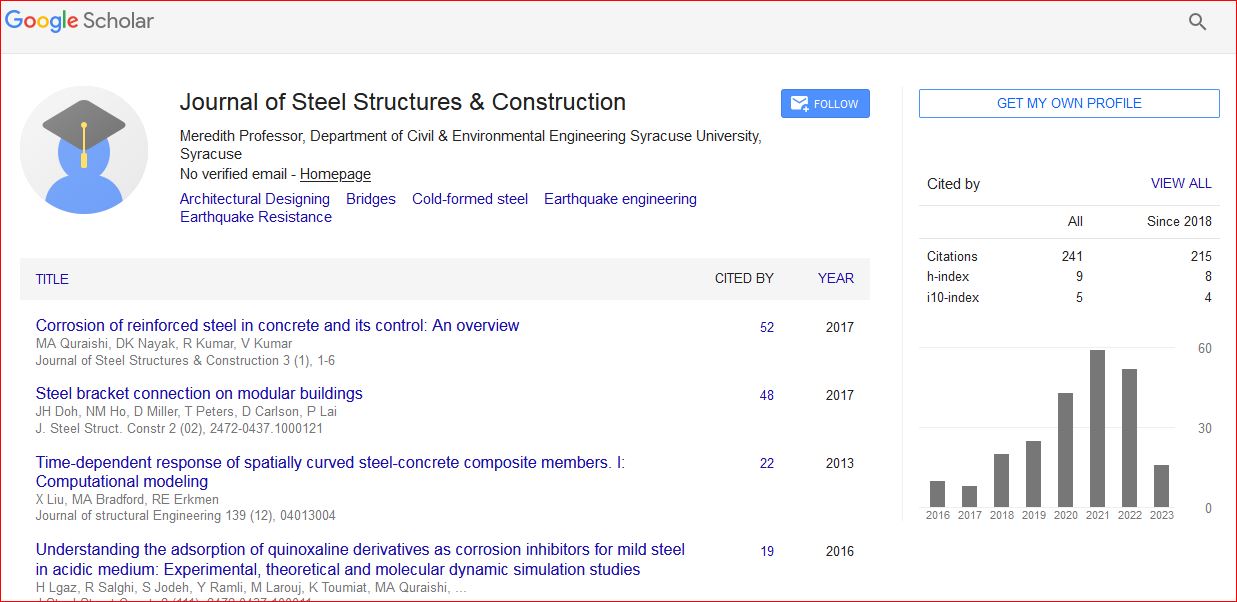
Journal of Steel Structures & Construction received 583 citations as per Google Scholar report