Commentary - (2025) Volume 14, Issue 5
Received: 01-Oct-2025, Manuscript No. idse-26-183623;
Editor assigned: 03-Oct-2025, Pre QC No. P-183623;
Reviewed: 17-Oct-2025, QC No. Q-183623;
Revised: 22-Oct-2025, Manuscript No. R-183623;
Published:
29-Oct-2025
, DOI: 10.37421/2168-9768.2025.14.510
Citation: Dlamini, Sibusiso. "Advancements in Irrigation and
Drainage Water Management." Irrigat Drainage Sys Eng 14 (2025):510.
Copyright: © 2025 Dlamini S. This is an open-access article distributed under the terms of the Creative Commons Attribution License, which permits unrestricted use,
distribution and reproduction in any medium, provided the original author and source are credited.
The field of hydraulic analysis and design for irrigation and drainage systems is undergoing significant advancements aimed at optimizing water use efficiency and promoting environmental sustainability. These advancements are critical for addressing the challenges of water scarcity and ensuring agricultural productivity in a changing climate. Recent research highlights the development of sophisticated modeling techniques that allow for accurate simulation of water flow, sediment transport, and solute movement within these complex systems, which is crucial for effective planning and management. The integration of Geographic Information Systems (GIS) and remote sensing technologies has further enhanced hydrological assessments by improving data acquisition and analysis accuracy. Innovative design strategies are being explored to mitigate prevalent issues such as waterlogging and soil salinization, thereby ensuring the long-term viability of agricultural lands and the health of associated ecosystems. These efforts are vital for engineers and water resource managers tasked with developing resilient water infrastructure. [1]
Furthermore, the impact of climate change on existing irrigation networks necessitates the proposal of adaptive design strategies. Hydrological models are increasingly employed to project future water availability and demand, thereby identifying vulnerabilities in current system designs. The research emphasizes the critical need for flexible and resilient irrigation infrastructure capable of withstanding altered precipitation patterns and rising evapotranspiration rates. Understanding the economic and social implications of climate-induced water scarcity is paramount, underscoring the importance of integrated water resource management. [2] In agricultural areas, the hydraulic efficiency and environmental implications of various drainage system designs are under close examination. The effectiveness of subsurface drainage systems in managing water tables and preventing soil salinization is crucial for maintaining soil health and crop yields. Computational fluid dynamics (CFD) is being utilized to simulate water flow and solute transport, providing valuable insights for optimizing drainage network layouts and component designs. The findings from such research are highly relevant for enhancing agricultural land productivity and reducing environmental pollution. [3] The application of artificial intelligence (AI) and machine learning (ML) is revolutionizing the optimization of irrigation system operations. Predictive models are being developed for water demand forecasting, irrigation scheduling, and fault detection in critical components like pumping stations and pipelines. The integration of AI/ML promises significant improvements in water use efficiency, reduction in energy consumption, and minimization of operational costs. These advancements are essential for modernizing irrigation infrastructure and aligning with sustainable water management goals. [4] Evaluating the performance of different canal lining materials is a key area of focus for reducing seepage losses and enhancing the hydraulic efficiency of irrigation canals. A comparative analysis of materials such as concrete, geomembranes, and other innovative options is being conducted based on their durability, cost-effectiveness, and environmental impact. This research provides essential data for selecting appropriate lining technologies to conserve water resources and improve water delivery reliability in irrigation networks. [5] Concurrent with agricultural water management, the design and management of urban drainage systems are crucial for mitigating flood risks, particularly in the face of increasing urbanization and extreme weather events. The use of green infrastructure solutions, such as permeable pavements and bioswales, in conjunction with traditional grey infrastructure, is being explored to improve stormwater management. This highlights the importance of integrated urban water management for creating resilient cities. [6] Managing water resources in arid and semi-arid regions presents unique challenges, with a specific focus on irrigation system design and water conservation strategies. The efficiency of various irrigation techniques, including drip and sprinkler irrigation, and their suitability for diverse local conditions are being investigated. Research also explores methods for reducing evaporation and enhancing water application uniformity, which are critical for sustainable agriculture in water-scarce environments. [7] The hydraulic modeling of sediment transport in irrigation canals is essential for addressing issues like siltation, which can significantly impact system capacity and operational efficiency. Numerical models are employed to simulate erosion and deposition processes under varying flow conditions. The research aims to provide design guidelines for canal geometry and flow velocities to minimize sediment accumulation, thereby reducing maintenance costs and ensuring the long-term functionality of irrigation infrastructure. [8] An economic and environmental assessment of different irrigation technologies is vital for promoting water productivity and energy efficiency. A comparative analysis of traditional surface irrigation methods against modern pressurized systems like sprinklers and drip irrigation is being conducted. This research offers a framework for decision-makers to select the most sustainable and cost-effective irrigation solutions, balancing agricultural output with resource conservation. [9] Finally, the influence of soil properties on the design and performance of subsurface drainage systems is a critical area of study. Understanding how soil texture, hydraulic conductivity, and layering affect drainage rates and the effectiveness of tile drains is crucial. This research provides practical guidance for engineers to tailor drainage designs to specific soil conditions, thereby optimizing water management for agricultural lands and preventing issues like waterlogging and salinity. [10]The advancements in hydraulic analysis and design for irrigation and drainage systems are fundamentally reshaping how water resources are managed for agricultural and environmental purposes. These systems are increasingly being designed with a focus on optimizing water use efficiency and ensuring long-term environmental sustainability. Sophisticated modeling techniques, including those that simulate water flow, sediment transport, and solute movement, are now standard tools for effective planning and management of these vital infrastructures. The integration of GIS and remote sensing has significantly improved the accuracy of hydrological assessments, providing a more robust foundation for design decisions. Furthermore, the development of innovative design strategies is crucial for addressing persistent challenges such as waterlogging and soil salinization, which threaten agricultural productivity and ecosystem health. The collective body of work in this area is instrumental for engineers and water resource managers in developing resilient water infrastructure. [1]
In response to the escalating impacts of climate change, research is actively focused on evaluating the performance of existing irrigation networks and proposing adaptive design strategies. Hydrological models play a pivotal role in projecting future water availability and demand scenarios, thereby pinpointing vulnerabilities within current irrigation system designs. There is a pronounced emphasis on the need to develop flexible and resilient irrigation infrastructure capable of adapting to altered precipitation patterns and increased evapotranspiration rates. Understanding the multifaceted economic and social consequences of climate-induced water scarcity is essential, highlighting the imperative for adopting integrated water resource management approaches. [2] Within agricultural landscapes, the hydraulic performance and environmental implications of various drainage system designs are subjects of intense scrutiny. The efficacy of subsurface drainage systems in controlling water table levels and mitigating soil salinization is paramount for preserving soil health and maximizing crop yields. The application of computational fluid dynamics (CFD) allows for the simulation of water flow and solute transport, offering invaluable insights for the optimization of drainage network configurations and component selection. The outcomes of these investigations are directly applicable to enhancing agricultural land productivity and minimizing negative environmental impacts. [3] The deployment of artificial intelligence (AI) and machine learning (ML) represents a transformative shift in optimizing the operational efficiency of irrigation systems. Advanced predictive models are being developed for crucial functions such as water demand forecasting, precision irrigation scheduling, and the early detection of faults in essential components like pumping stations and pipelines. The adoption of AI/ML technologies is poised to yield substantial improvements in water use efficiency, a significant reduction in energy consumption, and a decrease in overall operational expenditures, contributing to more modernized and sustainable irrigation practices. [4] A critical aspect of improving irrigation canal performance involves the evaluation of various lining materials aimed at minimizing seepage losses and enhancing hydraulic efficiency. Comparative analyses are being conducted on materials ranging from traditional concrete to advanced geomembranes and other novel options, assessing their durability, cost-effectiveness, and environmental footprint. The data generated from this research is indispensable for making informed decisions regarding the selection of appropriate lining technologies, thereby conserving precious water resources and ensuring reliable water delivery within irrigation networks. [5] Simultaneously, the design and management of urban drainage systems are receiving considerable attention, particularly concerning the mitigation of flood risks exacerbated by increasing urbanization and the heightened frequency of extreme weather events. The integration of green infrastructure solutions, such as permeable pavements and bioswales, alongside conventional grey infrastructure, is being explored as a means to enhance stormwater management capabilities. This approach underscores the importance of adopting a holistic, integrated urban water management strategy to foster resilient urban environments. [6] In arid and semi-arid regions, the effective management of water resources, with a specific focus on irrigation system design and water conservation, remains a paramount concern. Research is actively investigating the efficiency of diverse irrigation techniques, including drip and sprinkler systems, and their suitability for prevailing local conditions. Strategies for minimizing evaporation losses and improving the uniformity of water application are also being explored, as these are critical factors for achieving sustainable agricultural practices in water-scarce environments. [7] The study of hydraulic modeling for sediment transport in irrigation canals is crucial for addressing the pervasive issue of siltation, which directly impacts system capacity and overall efficiency. Numerical modeling techniques are being employed to accurately simulate the processes of erosion and deposition of sediments under a range of hydraulic conditions. The insights gained from this research are used to formulate design guidelines for canal cross-sections and flow velocities, aimed at minimizing sediment accumulation, thereby reducing maintenance burdens and ensuring the sustained operational integrity of irrigation infrastructure. [8] Economic and environmental assessments of different irrigation technologies are increasingly being undertaken to promote enhanced water productivity and energy efficiency. Comparative studies are evaluating the costs and benefits associated with traditional surface irrigation methods versus modern pressurized systems like sprinklers and drip irrigation. Such research provides essential frameworks for decision-makers to identify and implement the most sustainable and economically viable irrigation solutions, striking a balance between agricultural output and the imperative for resource conservation. [9] The influence exerted by soil properties on the design and operational performance of subsurface drainage systems is a subject of considerable importance. Detailed examinations are conducted to understand how variations in soil texture, hydraulic conductivity, and layering patterns affect the rate of water removal and the overall effectiveness of tile drainage systems. This research ultimately provides practical, evidence-based guidance for engineers to customize drainage designs to specific soil conditions, thereby optimizing water management strategies for agricultural lands and effectively preventing issues such as waterlogging and soil salinization. [10]This collection of research addresses critical aspects of water management in irrigation and drainage systems. It covers advancements in hydraulic modeling and design for sustainability, the impact of climate change on irrigation networks, and the evaluation of subsurface drainage systems for soil health. The use of artificial intelligence and machine learning for optimizing irrigation operations is explored, alongside comparative analyses of canal lining materials to reduce seepage. Urban drainage systems and green infrastructure are examined for flood risk mitigation. Water resource management in arid regions, hydraulic modeling of sediment transport in canals, and economic/environmental assessments of irrigation technologies are also discussed. Finally, the influence of soil properties on subsurface drainage performance is investigated, providing comprehensive insights for improving water management practices and agricultural productivity.
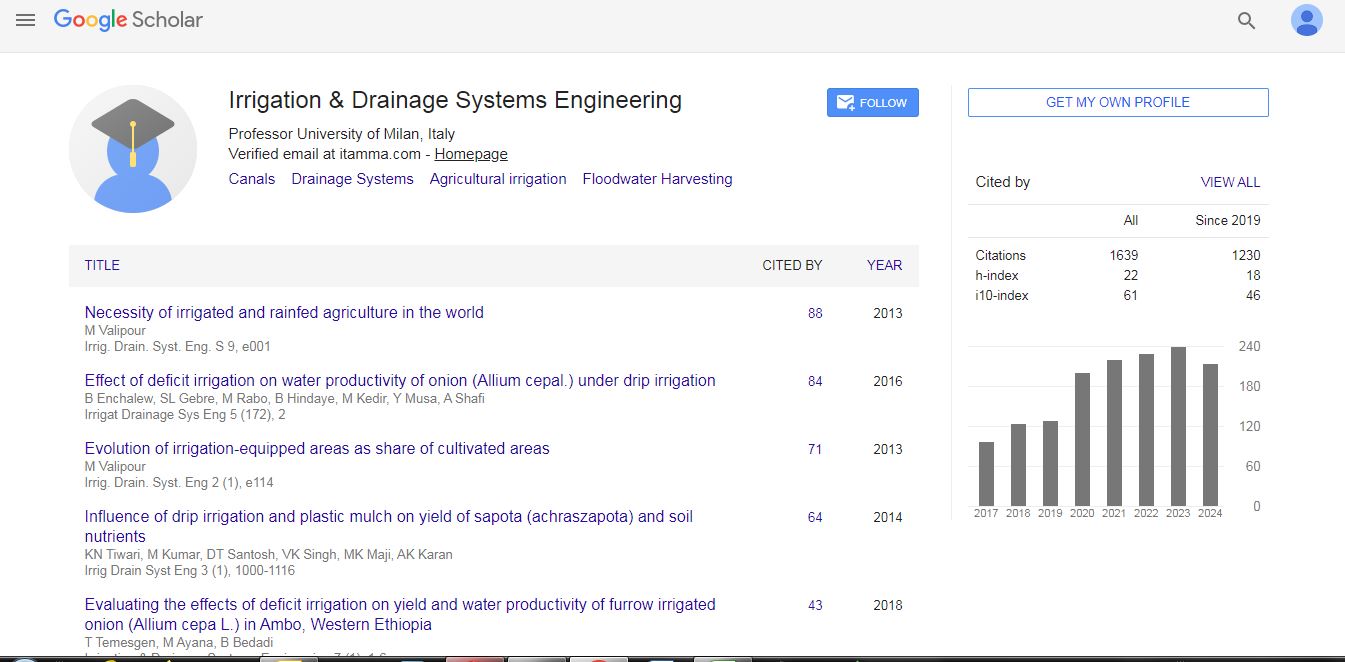
Irrigation & Drainage Systems Engineering received 835 citations as per Google Scholar report