Opinion - (2025) Volume 16, Issue 3
Received: 02-Jun-2025, Manuscript No. jmbd-26-179395;
Editor assigned: 04-Jun-2025, Pre QC No. P-179395;
Reviewed: 15-Jun-2025, QC No. Q-179395;
Revised: 23-Jun-2025, Manuscript No. R-179395;
Published:
30-Jun-2025
, DOI: 10.37421/2155-9929.2025.16.706
Citation: Thompson, Noah. ”Advancements in Infectious Disease Diagnosis and Management.” J Mol Biomark Diagn 16 (2025):706.
Copyright: © 2025 Thompson N. This is an open-access article distributed under the terms of the Creative Commons Attribution License, which permits unrestricted use, distribution and reproduction in any medium, provided the original author and source are credited.
The rapid identification and management of infectious diseases are paramount in modern healthcare, necessitating advancements in diagnostic capabilities. Molecular biomarkers and sophisticated diagnostic techniques are at the forefront of this revolution, offering unprecedented speed and accuracy in pathogen detection [1].
These innovations enable timely clinical decisions, ultimately leading to improved patient outcomes and more effective public health strategies. The continuous evolution of diagnostic technologies is critical, especially for decentralized healthcare settings where traditional laboratory infrastructure may be limited. The development of novel point-of-care diagnostic tools is crucial to address these challenges, allowing for rapid and sensitive testing in diverse environments [2].
This focus on accessibility and speed is a key driver in combating infectious disease outbreaks. Beyond direct pathogen detection, the exploration of host-derived biomarkers is gaining traction. Circulating cell-free DNA (cfDNA) has emerged as a promising biomarker, offering a non-invasive avenue for detecting microbial DNA and monitoring infections. This approach holds significant potential for early diagnosis and personalized treatment [3].
Complementing nucleic acid-based detection, molecular signals within the host, such as microRNAs (miRNAs), are also being investigated. Specific miRNA expression profiles can serve as indicators of infection, disease severity, and treatment response, paving the way for early detection and personalized medicine in infectious disease management [4].
In clinical practice, the ability to simultaneously detect multiple pathogens is often essential, particularly for respiratory infections that can present with complex coinfections. Multiplex PCR assays have proven to be efficient and accurate in identifying a range of pathogens concurrently, simplifying diagnosis and treatment planning [5].
A significant breakthrough in molecular diagnostics is the advent of CRISPR-based technologies. These systems offer a revolutionary platform for highly sensitive and specific pathogen detection, with the potential for rapid, field-deployable tests that can significantly enhance global health security [6].
For challenging and complex infectious diseases, especially those where conventional methods are insufficient, metagenomic sequencing provides a powerful solution. This technique can identify both known and novel pathogens simultaneously, offering a comprehensive view of the microbial landscape and aiding in the diagnosis of rare or emerging infections [7].
Biosensor technology represents another exciting frontier in infectious disease diagnostics. Various biosensor platforms are being developed for the rapid detection of viral biomarkers, with applications ranging from real-time monitoring to early outbreak detection, offering a crucial tool for surveillance and response [8].
The efficiency and portability of isothermal amplification techniques, such as Loop-mediated Isothermal Amplification (LAMP), are making them highly valuable for rapid molecular diagnostics. Their independence from complex thermal cyclers makes them ideal for resource-limited settings and point-of-care applications [9].
Finally, understanding the host's response to infection is a complementary diagnostic strategy. Host-response biomarkers, which detect changes in the host's immune system, can be particularly useful for identifying infections with fastidious or unknown pathogens and distinguishing active infections from colonization [10].
The field of infectious disease diagnostics is undergoing a profound transformation, driven by advancements in molecular biomarkers and sophisticated detection methods. Next-generation sequencing, polymerase chain reaction (PCR)-based techniques, and biosensor technologies are at the vanguard of this evolution, enabling the rapid and precise identification of pathogens [1].
This enhanced diagnostic capability is instrumental in facilitating prompt clinical decision-making, thereby improving patient prognoses and strengthening public health responses. In parallel, the imperative to equip decentralized healthcare settings with robust diagnostic tools has spurred the development of novel point-of-care (POC) diagnostic solutions. Molecular diagnostics, incorporating technologies like isothermal amplification and microfluidic devices, are key to creating rapid, sensitive, and specific tests capable of detecting a wide array of pathogens, overcoming the limitations of traditional laboratory-based approaches [2].
Emerging as a significant area of interest is the utilization of circulating cell-free DNA (cfDNA) as a diagnostic and monitoring biomarker for infectious diseases. Analysis of cfDNA, particularly through next-generation sequencing, allows for the non-invasive detection of microbial DNA, presenting a valuable method for pathogen identification and disease surveillance [3].
Further expanding the biomarker landscape, microRNAs (miRNAs) are being recognized for their potential role in diagnosing and prognosing infectious diseases. Distinct miRNA expression profiles can signal the presence of an infection, its severity, and predict responses to treatment, highlighting their importance in early detection and personalized therapeutic strategies [4].
The clinical utility of multiplex PCR assays is particularly evident in the simultaneous detection of multiple pathogens, especially in the context of respiratory infections. These molecular approaches offer efficiency and accuracy in identifying coinfections, which can complicate clinical management and require tailored treatment strategies [5].
The integration of CRISPR-based diagnostic systems represents a paradigm shift in infectious disease detection. These platforms provide a pathway to highly sensitive and specific identification of infectious agents, with the potential to deliver rapid, field-deployable testing that is crucial for global health security and pandemic preparedness [6].
For diagnosing infectious diseases that defy conventional diagnostic methods, metagenomic sequencing offers a powerful, comprehensive approach. By enabling the simultaneous identification of known and novel pathogens, metagenomics provides an in-depth understanding of the microbial community, although data analysis remains a critical consideration [7].
The application of biosensors for the rapid detection of viral biomarkers is another area of active development. Various biosensor platforms, including electrochemical and optical sensors, are being designed to detect viral nucleic acids or proteins, promising real-time monitoring and early detection capabilities for outbreaks [8].
Isothermal amplification techniques, exemplified by Loop-mediated Isothermal Amplification (LAMP), are increasingly important for rapid molecular diagnostics. Their ability to operate without thermal cycling equipment makes them exceptionally suitable for resource-limited settings and point-of-care diagnostics, enhancing accessibility and speed [9].
Lastly, the host-response biomarker approach offers a complementary diagnostic strategy by focusing on the host's immune system's reaction to infection. This method is particularly valuable for detecting pathogens that are difficult to culture or identify through traditional means, and for differentiating between active infection and colonization states [10].
This collection of research highlights the rapid advancements in the diagnosis and management of infectious diseases. Key areas of focus include molecular biomarkers, such as cell-free DNA and microRNAs, which offer new avenues for early detection and monitoring. Advanced techniques like next-generation sequencing, multiplex PCR, and CRISPR-based diagnostics are revolutionizing pathogen identification, providing speed, accuracy, and the ability to detect multiple agents simultaneously. The development of point-of-care diagnostics and biosensors is expanding accessibility, particularly in resource-limited settings. Metagenomic sequencing is proving invaluable for complex cases, while host-response biomarkers offer a complementary approach. Overall, these innovations are paving the way for more timely and effective clinical decisions, improved patient outcomes, and enhanced public health responses.
None
None
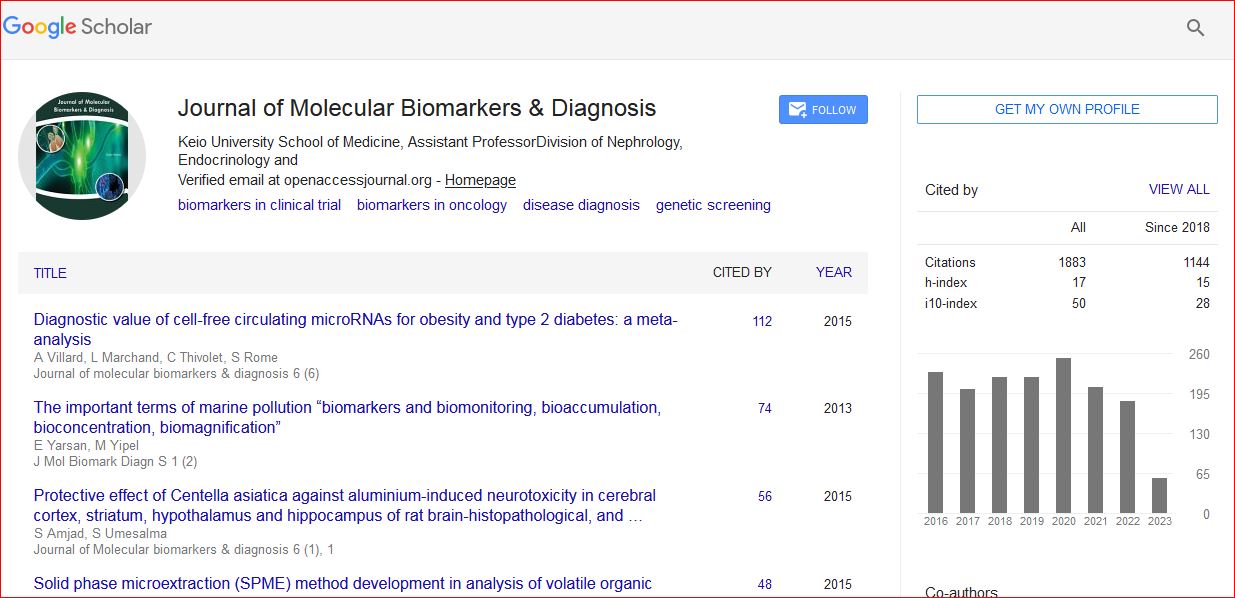
Journal of Molecular Biomarkers & Diagnosis received 2054 citations as per Google Scholar report