Opinion - (2025) Volume 15, Issue 2
Received: 03-Mar-2025, Manuscript No. jbpbt-25-178492;
Editor assigned: 05-Mar-2025, Pre QC No. P-178492;
Reviewed: 19-Mar-2025, QC No. Q-178492;
, Manuscript No. R-178492;
Published:
31-Mar-2025
, DOI: 10.37421/2155-9821.2025.15.668
Citation: Nakamura, Kenji. ”Advancements in Downstream Protein Purification for Biopharmaceuticals.” J Bioprocess Biotech 15 (2025): 668.
Copyright: © 2025 Nakamura K. This is an open-access article distributed under the terms of the Creative Commons Attribution License, which permits unrestricted use,
distribution and reproduction in any medium, provided the original author and source are credited.
The purification of proteins is a fundamental and critical step in the biopharmaceutical industry, underpinning the development and manufacturing of therapeutic and diagnostic agents. Achieving high purity is paramount to ensure safety, efficacy, and regulatory compliance. Downstream processing encompasses a series of separation and purification techniques designed to isolate target proteins from complex biological mixtures. Recent advancements in this field are continually pushing the boundaries of efficiency, scalability, and cost-effectiveness. One area of significant progress involves enhancing techniques for achieving high-purity proteins, which are essential for therapeutic and diagnostic applications. These advanced methods aim to minimize product loss and maximize efficiency by strategically integrating various separation steps, from initial clarification to final polishing. Overcoming challenges such as aggregation and host cell protein contamination is a key focus, particularly for methods that enable scalability and cost-effectiveness in large-scale biopharmaceutical production [1].
The purification of monoclonal antibodies (mAbs), a major class of biotherapeutics, presents unique challenges. Innovative solutions are being explored to address the need for efficient capture and polishing steps to effectively remove impurities like host cell proteins, DNA, and aggregates. The application of continuous chromatography and membrane-based technologies is streamlining these processes, leading to higher yields and reduced processing times, which is vital for the cost-effective production of biosimilars and next-generation antibody therapeutics [2].
Membrane chromatography has emerged as a powerful tool for large-scale protein purification. These systems offer high throughput and can be integrated into various stages of the downstream process, including clarification and buffer exchange. Strategies are being developed to maximize membrane capacity and longevity while addressing fouling issues and ensuring product recovery, which is crucial for the efficient scaling up of biopharmaceutical manufacturing [3].
Simulated Moving Bed (SMB) chromatography represents another significant advancement, enabling high-resolution protein purification. This technology facilitates continuous separation, leading to improved yield, purity, and reduced solvent consumption compared to traditional batch chromatography. SMB is particularly effective for purifying complex protein mixtures found in therapeutic protein production, offering a pathway to more sustainable and economical purification processes [4].
Ensuring product safety is a non-negotiable aspect of therapeutic protein production, with endotoxin removal being a critical concern. Various affinity-based and non-affinity-based methods are being reviewed for endotoxin detection and removal, including specialized chromatographic resins and filtration techniques. The insights gained from these strategies are essential for guaranteeing the safety and efficacy of biopharmaceuticals intended for parenteral administration [5].
Protein A affinity chromatography remains a cornerstone for the purification of antibody-based therapeutics. Ongoing research focuses on optimizing resin selection, binding conditions, and elution strategies to maximize capture efficiency and minimize protein degradation. Furthermore, strategies for recycling Protein A resin and developing alternative affinity ligands are crucial for reducing costs in large-scale manufacturing [6].
The development of novel multimodal chromatography resins offers new possibilities for challenging protein separations. These resins combine different interaction mechanisms, providing higher selectivity and resolution. Their effectiveness has been demonstrated in purifying proteins that are difficult to separate using traditional single-mode chromatography, thereby enhancing overall process efficiency and product quality [7].
Tangential Flow Filtration (TFF) is a fundamental technique widely employed for protein concentration and buffer exchange. Various TFF configurations and membrane types are utilized, with critical process parameters being optimized to enhance product recovery and minimize shear stress. TFF serves as an essential step in preparing protein solutions for subsequent purification or final formulation [8].
Beyond chromatographic and filtration methods, crystallization techniques are also being advanced as a polishing step for achieving very high purity for specific proteins. While not a primary separation method, controlled crystallization can be a powerful tool for research and small-scale applications, with ongoing research exploring additives and conditions to promote crystal formation and efficient redissolution with minimal protein denaturation [9].
The integration of Process Analytical Technology (PAT) into downstream processing is revolutionizing real-time monitoring and control. By employing inline sensors and advanced data analysis, PAT enables a deeper understanding and optimization of purification steps, leading to consistent product quality and reduced batch failures. This approach is vital for regulatory compliance and the economic viability of biopharmaceutical manufacturing [10].
The critical role of downstream processing in achieving high-purity proteins for therapeutic and diagnostic applications is underscored by recent advances in the field. These developments focus on sophisticated techniques that not only minimize product loss but also maximize efficiency. A key aspect involves the strategic integration of diverse separation methods, spanning from initial clarification to final polishing steps, to surmount common obstacles such as protein aggregation and host cell protein contamination. Emphasis is placed on methods that facilitate scalability and cost-effectiveness in large-scale biopharmaceutical production [1].
Innovations in purifying monoclonal antibodies (mAbs) are addressing the imperative for efficient capture and polishing stages to eliminate impurities like host cell proteins, DNA, and aggregates. The adoption of continuous chromatography and membrane-based technologies is streamlining these purification processes, resulting in enhanced yields and reduced processing durations. This progress is particularly significant for the cost-effective manufacturing of biosimilars and advanced antibody therapeutics [2].
Membrane chromatography is being optimized for large-scale protein purification, offering high throughput and adaptability across various downstream stages, from clarification to buffer exchange. Research efforts are concentrated on maximizing membrane capacity and extending their lifespan while effectively managing fouling and ensuring substantial product recovery. This optimization is indispensable for the efficient scale-up of biopharmaceutical manufacturing operations [3].
Simulated Moving Bed (SMB) chromatography is being explored for its capacity to achieve high-resolution protein purification. The continuous separation capabilities of SMB technology lead to superior yields, enhanced purity, and a reduction in solvent usage compared to conventional batch chromatography. The application of SMB is particularly beneficial for purifying intricate protein mixtures encountered in therapeutic protein production, paving the way for more sustainable and economically viable purification strategies [4].
A crucial aspect of therapeutic protein production is the rigorous removal of endotoxins. A review of various affinity-based and non-affinity-based methods for endotoxin detection and removal, including specialized chromatographic resins and filtration techniques, is essential. The insights derived from these strategies are fundamental to ensuring the safety and efficacy of biopharmaceuticals intended for parenteral administration [5].
Protein A affinity chromatography continues to be a foundational technique in the purification of antibody-based therapeutics. Efforts are underway to optimize resin selection, binding conditions, and elution protocols to maximize capture efficiency and minimize protein degradation. Concurrently, strategies for the recycling of Protein A resin and the development of alternative affinity ligands are being pursued as vital measures for cost reduction in large-scale manufacturing settings [6].
The creation of novel multimodal chromatography resins represents a significant advancement for tackling challenging protein separations. These resins leverage multiple interaction mechanisms, thereby enabling higher selectivity and improved resolution. Their demonstrated efficacy in purifying proteins that are recalcitrant to separation by traditional single-mode chromatography contributes to enhanced overall process efficiency and superior product quality [7].
Tangential Flow Filtration (TFF) is a widely recognized and fundamental technique for concentrating protein solutions and performing buffer exchange. The selection of appropriate TFF configurations and membrane types, coupled with the optimization of critical process parameters, is key to maximizing product recovery and minimizing shear-induced protein damage. TFF plays a vital role in preparing protein preparations for subsequent purification steps or final formulation [8].
Advancements in protein crystallization techniques are being investigated as a polishing step to achieve exceptionally high purity levels for specific proteins, particularly in research and small-scale applications. While not a primary separation method, controlled crystallization, alongside methods for efficient redissolution with minimal protein denaturation, is a valuable tool for high-purity protein preparation [9].
The implementation of Process Analytical Technology (PAT) in downstream processing is enhancing real-time monitoring and control capabilities. By integrating inline sensors and sophisticated data analysis tools, PAT facilitates a more profound understanding and optimization of purification steps, contributing to consistent product quality and a reduction in batch failures. This approach is indispensable for achieving regulatory compliance and ensuring the economic sustainability of biopharmaceutical manufacturing [10].
This collection of research highlights advancements in downstream processing for protein purification, crucial for biopharmaceutical applications. Key areas include optimizing techniques for high-purity proteins, with a focus on minimizing loss and maximizing efficiency through integrated separation methods. Innovations in monoclonal antibody purification emphasize continuous chromatography and membrane technologies for higher yields and reduced processing times. Membrane chromatography is discussed for its high throughput and scalability, while Simulated Moving Bed (SMB) chromatography offers high-resolution, continuous separation. Strategies for endotoxin removal are vital for product safety. Protein A affinity chromatography remains a cornerstone, with ongoing efforts in optimization and cost reduction through resin recycling. Multimodal chromatography resins are emerging for challenging separations, offering higher selectivity. Tangential Flow Filtration (TFF) is a fundamental technique for concentration and buffer exchange. Protein crystallization is explored as a polishing step for ultra-high purity. Finally, the integration of Process Analytical Technology (PAT) is transforming downstream processing through real-time monitoring and control for consistent quality and efficiency.
None
None
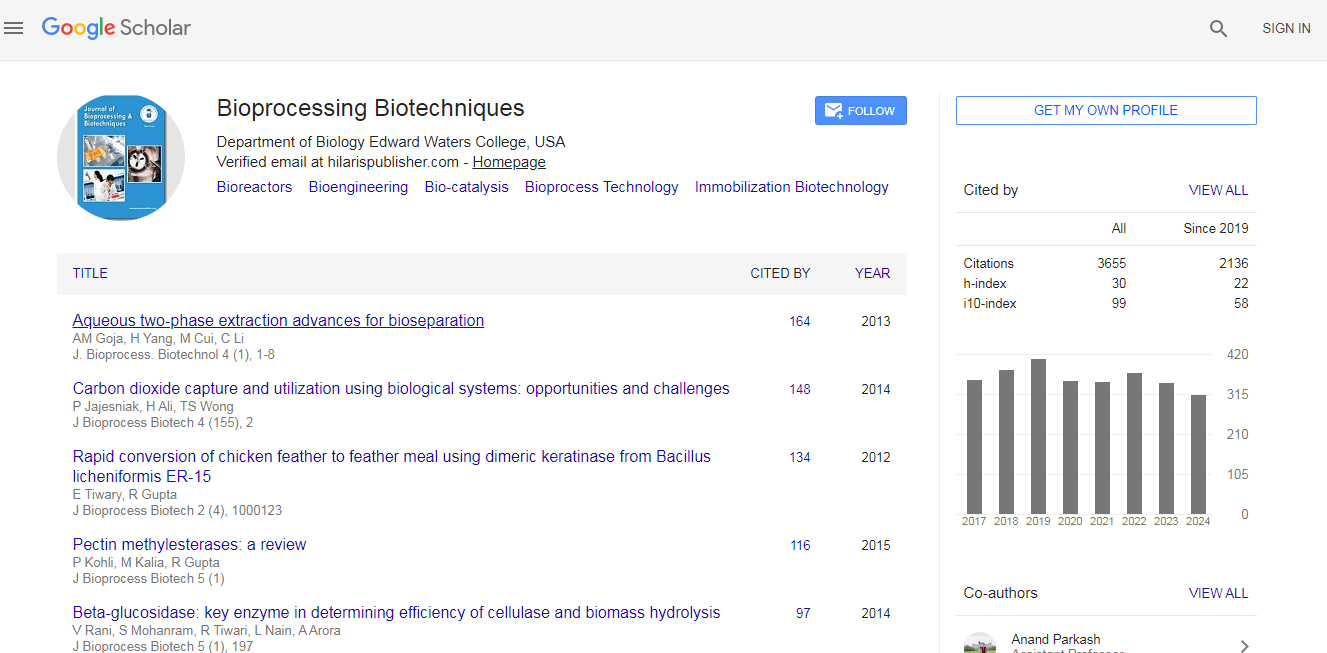
Journal of Bioprocessing & Biotechniques received 3351 citations as per Google Scholar report