Commentary - (2025) Volume 9, Issue 6
Received: 13-Sep-2024, Manuscript No. JGGE-24-147929;
Editor assigned: 16-Sep-2024, Pre QC No. JGGE-24-147929 (PQ);
Reviewed: 01-Oct-2024, QC No. JGGE-24-147929;
Revised: 14-Dec-2025, Manuscript No. JGGE-24-147929 (R);
Published:
21-Dec-2025
, DOI: 10.37421/2684-4567.2025.9.198
Citation: Dulski, Jaroslaw. "Advancements in CRISPR Technology: Applications and Ethical Considerations in Genetics." J Genet Genom 9 (2025): 198.
Copyright: © 2025 Dulski J. This is an open-access article distributed under the terms of the creative commons attribution license which permits unrestricted use, distribution and reproduction in any medium, provided the original author and source are credited.
CRISPR technology has emerged as a revolutionary tool in the field of genetics, offering unprecedented precision in gene editing. Originally discovered as a natural defense mechanism in bacteria, CRISPR-Cas9 has been adapted to target and modify specific DNA sequences in a wide range of organisms, including humans. This breakthrough has opened up new avenues for scientific research, medicine, and agriculture, potentially transforming our approach to genetic disorders, crop improvement, and beyond. However, the rapid advancements in CRISPR technology also raise significant ethical considerations. As we explore the potential applications and implications of CRISPR, it is crucial to balance innovation with responsible stewardship to ensure that these powerful tools are used ethically and equitably.
The advent of CRISPR technology has marked a revolutionary milestone in genetic research and biotechnology, heralding a new era of precise and versatile gene editing. Since its initial discovery as a bacterial defense mechanism, CRISPR-Cas9 has been refined and adapted to become one of the most powerful tools available for genetic manipulation. This innovative technology allows scientists to target specific DNA sequences with remarkable accuracy, enabling groundbreaking advances in medical research, agriculture, and synthetic biology. However, as with any powerful tool, CRISPR's potential is accompanied by complex ethical questions and challenges. As we delve into the advancements and applications of CRISPR technology, it is crucial to address not only the scientific possibilities but also the ethical considerations that accompany its use, ensuring that progress is achieved responsibly and with consideration for its broader societal impacts.
Advancements in CRISPR technology have significantly expanded its capabilities and applications. The development of more precise CRISPR systems, such as CRISPR-Cas12 and CRISPR-Cas13, has improved targeting accuracy and reduced off-target effects, enhancing the reliability of gene editing. Researchers are now employing CRISPR for a variety of purposes, including the correction of genetic mutations responsible for inherited diseases, the engineering of crops with improved traits such as drought resistance, and the creation of models for studying complex diseases. Additionally, CRISPR has potential applications in the field of synthetic biology, where it can be used to design novel organisms with specific functions. Despite these promising applications, the technology also presents ethical challenges. These include concerns about the potential for unintended consequences in gene editing, the risks of germline modifications that could be passed on to future generations, and issues of equity in access to these advancements.
CRISPR technology has undergone significant advancements since its inception, evolving into a highly sophisticated and versatile tool for genetic engineering. Initially known for its simplicity and efficiency, the technology has seen the development of refined versions, including CRISPR-Cas12 and CRISPR-Cas13, which offer enhanced precision and reduced off-target effects. These improvements have expanded CRISPR’s applications across various fields. In medicine, CRISPR holds promise for treating genetic disorders by enabling precise correction of disease-causing mutations. For instance, clinical trials are exploring its potential to cure conditions like sickle cell anemia and cystic fibrosis by directly editing patients' DNA. Beyond individual therapies, CRISPR is also being investigated for its role in combating infectious diseases, including potential applications in targeting viruses like HIV and SARS-CoV-2. In agriculture, CRISPR technology is revolutionizing crop and livestock breeding by creating genetically modified organisms with desirable traits such as increased yield, disease resistance, and climate adaptability. This has the potential to address food security challenges and contribute to sustainable agricultural practices. Moreover, CRISPR’s application extends to synthetic biology, where it is used to design and construct novel organisms with specific functions or capabilities. This includes creating bioengineered microbes for environmental cleanup or producing valuable compounds. However, these advancements are accompanied by significant ethical considerations. The potential for unintended genetic consequences, the risks associated with germline editing, and issues related to genetic privacy and equity are critical concerns. Ethical debates also focus on the implications of CRISPR’s use in human enhancement and its long-term impact on genetic diversity and ecosystem balance. As CRISPR technology continues to evolve, it is essential to address these ethical challenges to ensure that its applications are developed and implemented responsibly.
The advancements in CRISPR technology represent a significant leap forward in our ability to manipulate genetic material with precision. The diverse applications of CRISPR from treating genetic disorders to enhancing agricultural productivity highlight its transformative potential. However, as we harness the power of this technology, it is imperative to address the accompanying ethical considerations. Thoughtful regulation, transparent dialogue, and ongoing research are essential to navigate the complexities of gene editing responsibly. By ensuring that CRISPR technology is developed and applied in an ethical manner, we can maximize its benefits while minimizing risks, ultimately contributing to the betterment of society and the advancement of scientific knowledge. The rapid advancement of CRISPR technology has revolutionized the field of genetics, offering unprecedented precision in gene editing and an array of transformative transformative applications. From its potential to correct genetic disorders and enhance agricultural crops to its use in developing novel therapies and understanding complex genetic interactions, CRISPR holds the promise of significantly advancing both scientific research and clinical practice. However, the remarkable capabilities of CRISPR also bring forth complex ethical considerations that must be addressed. Issues such as the potential for unintended genetic consequences, the implications of germline editing, and the equitable access to these technologies are critical points of discussion. As we continue to explore the boundaries of CRISPR’s applications, it is essential to foster an ongoing dialogue among scientists, ethicists, policymakers, and the public to ensure that these powerful tools are used responsibly and equitably. In summary, while CRISPR technology represents a significant leap forward in genetic research and therapeutic development, its full potential can only be realized by carefully balancing innovation with ethical oversight. The future of CRISPR will depend not only on its technical advancements but also on our collective ability to navigate the ethical landscape and address the societal implications of its use.
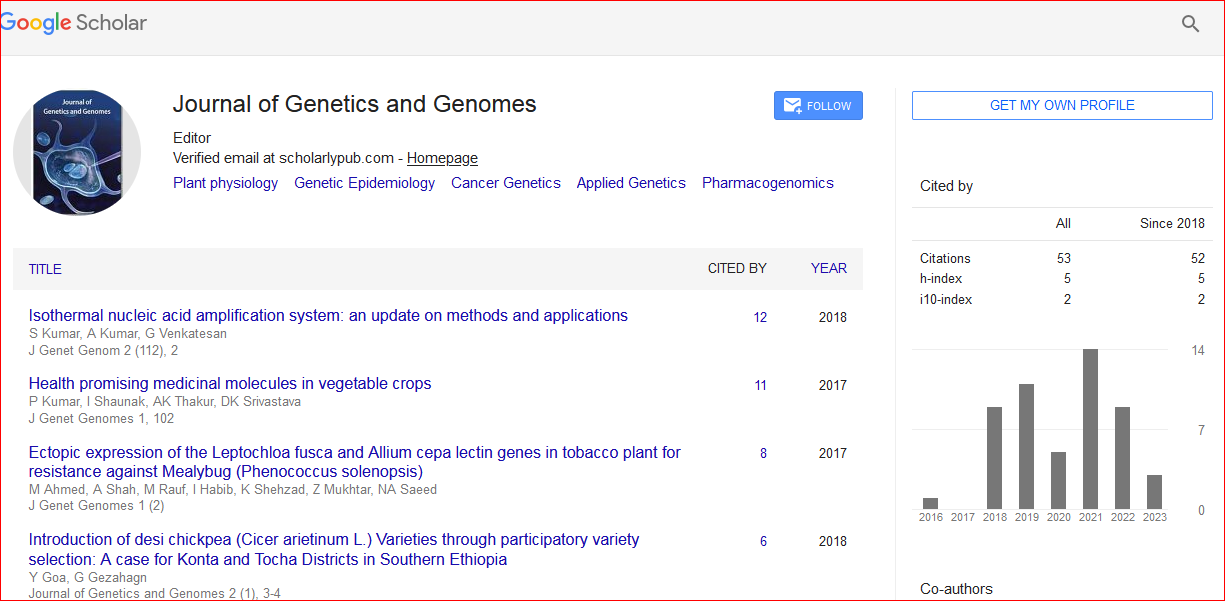
Journal of Genetics and Genomes received 65 citations as per Google Scholar report