Opinion - (2025) Volume 16, Issue 3
Received: 01-May-2025, Manuscript No. jpm-26-179406;
Editor assigned: 05-May-2025, Pre QC No. P-179406;
Reviewed: 19-May-2025, QC No. Q-179406;
Revised: 22-May-2025, Manuscript No. R-179406;
Published:
29-May-2025
, DOI: 10.37421/2090-0902.2025.16.534
Citation: Solheim, Ingrid. ”Advancements in Computational Physics: Algorithms, ML, Acceleration.” J Phys Math 16 (2025):534.
Copyright: © 2025 Solheim I. This is an open-access article distributed under the terms of the Creative Commons Attribution License, which permits unrestricted use, distribution and reproduction in any medium, provided the original author and source are credited.
The field of computational physics has seen remarkable advancements, driven by the need to tackle increasingly complex problems in fundamental science and engineering. Sophisticated numerical algorithms and theoretical frameworks are continuously being developed to simulate and analyze phenomena that elude analytical solutions. These computational techniques are becoming indispensable tools for researchers across diverse disciplines, pushing the boundaries of what can be explored and understood. This paper aims to survey recent developments in computational physics, highlighting methodologies that enable deeper insights into physical systems. One significant area of progress lies in the application of advanced computational techniques for solving challenging physical mathematics problems. These methods often involve the synergy between advanced numerical algorithms and theoretical physics, enabling the simulation of phenomena that are otherwise intractable. The development of novel algorithms for high-dimensional integration, differential equation solving, and statistical mechanics has had a profound impact on fields ranging from quantum mechanics to fluid dynamics, offering new avenues for research and discovery [1].
The integration of machine learning, particularly deep neural networks, has emerged as a powerful approach to accelerate and enhance the solution of partial differential equations (PDEs) in physics. These data-driven methods can learn intricate relationships within physical systems, providing accurate solutions with significantly reduced computational cost compared to traditional numerical solvers. Their application to areas like quantum many-body systems and fluid turbulence demonstrates considerable potential for both efficiency gains and facilitating new discoveries [2].
Furthermore, the pursuit of high-fidelity simulations has led to the development of novel frameworks for modeling chaotic systems. Techniques such as adaptive mesh refinement coupled with advanced spectral methods are proving effective in improving the accuracy and efficiency of modeling turbulent flows and complex molecular dynamics. Algorithms that dynamically adjust computational resources based on solution complexity are crucial for achieving substantial performance improvements in these challenging simulations [3].
In parallel, the use of specialized hardware, such as graphical processing units (GPUs), has revolutionized the acceleration of computational simulations. For instance, GPU acceleration of Monte Carlo simulations in statistical physics allows for significant speedups in calculating thermodynamic properties and phase transitions for complex many-body models. Efficient GPU programming strategies tailored for physics simulations are essential for tackling large-scale computational challenges [4].
The development of robust and efficient numerical methods continues to be a priority for simulating complex physical phenomena. High-order discontinuous Galerkin methods, for example, are being applied to solve hyperbolic conservation laws in plasma physics and astrophysics, providing accurate handling of discontinuities and shocks. These methodologies often incorporate flexible mesh adaptation and high-order accuracy, leading to more precise simulations of fluid dynamics [5].
The intersection of symbolic computation and numerical methods offers a compelling approach to solving problems in theoretical physics that involve complex algebraic manipulations and symbolic differentiation. Hybrid approaches that leverage the strengths of both paradigms can lead to more efficient and accurate solutions for problems characterized by intricate analytical expressions and differential equations [6].
Addressing the computational demands of high-dimensional problems in fields like quantum chemistry is another critical area of research. Novel spectral collocation methods, especially those employing tensor network representations, are showing promise in efficiently handling the exponential scaling of computational cost with dimension. These methods offer a significant advancement over traditional approaches for computing molecular states [7].
Multiscale computational approaches are vital for modeling phenomena that span a wide range of physical scales, from molecular dynamics to continuum mechanics. The development of algorithms that can seamlessly bridge these scales enables the simulation of materials behavior under extreme conditions and the study of complex biological systems. Such methods reduce computational burden by utilizing appropriate models at each scale, leading to more comprehensive analyses [8].
Finally, the efficient solution of large-scale sparse linear systems remains a persistent bottleneck in many computational physics simulations. Novel parallel algorithms designed for modern distributed memory architectures, often employing domain decomposition techniques, are crucial for achieving scalability and efficiency. These algorithms are vital for advancing research in areas like computational electromagnetics and structural mechanics [9].
The current landscape of computational physics is characterized by a diverse array of advanced methodologies aimed at elucidating complex natural phenomena. Among these, sophisticated numerical algorithms play a pivotal role in tackling intricate physical mathematics problems. By fostering a synergy between advanced numerical techniques and theoretical physics, researchers can effectively simulate and analyze systems that are beyond the reach of analytical approaches alone. The continuous development and application of novel algorithms for high-dimensional integration, solving differential equations, and in statistical mechanics are profoundly impacting fields such as quantum mechanics and fluid dynamics, providing unprecedented insights into their fundamental workings [1].
Machine learning, particularly in the form of deep neural networks, has emerged as a transformative force in accelerating and improving the solutions to partial differential equations (PDEs) within physics. These data-driven approaches possess the remarkable ability to discern and learn complex relationships inherent in physical systems, thereby yielding accurate solutions at a considerably reduced computational expense compared to conventional numerical solvers. The successful demonstration of these methods in the study of quantum many-body systems and fluid turbulence underscores their significant potential for driving both computational efficiency and groundbreaking discoveries [2].
The advancement of high-fidelity simulations is greatly facilitated by novel frameworks designed for the analysis of chaotic systems. The integration of adaptive mesh refinement techniques with sophisticated spectral methods is proving instrumental in enhancing both the accuracy and computational efficiency of modeling turbulent flows and intricate molecular dynamics. A key aspect of these advancements lies in the development of algorithms capable of dynamically allocating computational resources based on the inherent complexity of the solution, leading to substantial improvements in overall performance [3].
Leveraging the power of specialized hardware, such as graphical processing units (GPUs), has become a cornerstone for accelerating computational simulations in various physics domains. For instance, the application of GPU acceleration to Monte Carlo simulations in statistical physics has yielded significant speedups in the computation of thermodynamic properties and the identification of phase transitions in complex many-body models. The insights provided into efficient GPU programming strategies tailored for physics simulations highlight their utility in addressing large-scale computational challenges [4].
Robust and efficient numerical methods are continuously being refined to accurately simulate complex physical behaviors. The development and application of high-order discontinuous Galerkin methods, for example, are crucial for solving hyperbolic conservation laws that arise in fields like plasma physics and astrophysics. These methods are designed to precisely handle discontinuities and shocks, often incorporating flexible mesh adaptation and achieving high-order accuracy, which collectively enable more precise simulations of complex fluid phenomena [5].
At the confluence of symbolic computation and numerical techniques lies a promising avenue for addressing complex theoretical physics problems. This is particularly relevant in areas that necessitate elaborate algebraic manipulations and symbolic differentiation. A hybrid approach, which capitalizes on the distinct strengths of both symbolic and numerical paradigms, has been shown to yield more efficient and accurate solutions for problems involving intricate analytical expressions and differential equations [6].
The challenge of solving high-dimensional eigenvalue problems in quantum chemistry, which often exhibit exponential scaling of computational cost with dimension, is being met with innovative spectral collocation methods. The incorporation of tensor network representations within these methods offers an efficient way to manage this complexity. The demonstrated capability of these techniques to accurately compute ground and excited states for sophisticated molecular systems represents a substantial leap forward from traditional computational approaches [7].
Multiscale computational strategies are indispensable for the accurate modeling of phenomena that manifest across vastly different physical scales, ranging from molecular dynamics to continuum mechanics. The creation of algorithms that can fluidly bridge these disparate scales is essential for simulating material behaviors under extreme conditions and for investigating intricate biological systems. By employing contextually appropriate models at each scale, these methods effectively reduce the overall computational burden, enabling more comprehensive and insightful analyses [8].
The resolution of large-scale sparse linear systems poses a common and significant computational hurdle in numerous physics simulations. The development of novel parallel algorithms specifically designed for contemporary distributed memory architectures, often incorporating domain decomposition strategies, is critical for achieving the necessary scalability and efficiency. Such advancements are vital for progress in computationally intensive fields like electromagnetics and structural mechanics [9].
This collection of research highlights advancements in computational physics, focusing on sophisticated numerical algorithms, machine learning, and hardware acceleration. Papers discuss novel techniques for solving complex physical mathematics problems, including high-dimensional integration and differential equations. The application of deep neural networks to accelerate the solution of PDEs is explored, alongside adaptive mesh refinement for chaotic systems and GPU acceleration for Monte Carlo simulations. High-order discontinuous Galerkin methods are presented for fluid phenomena, and hybrid symbolic-numerical techniques are discussed for theoretical physics. Additionally, spectral collocation with tensor networks addresses high-dimensional quantum chemistry problems, while multiscale frameworks bridge molecular and continuum physics. Efficient parallel algorithms for sparse linear systems are also detailed, emphasizing scalability and performance for various simulation types.
None
None
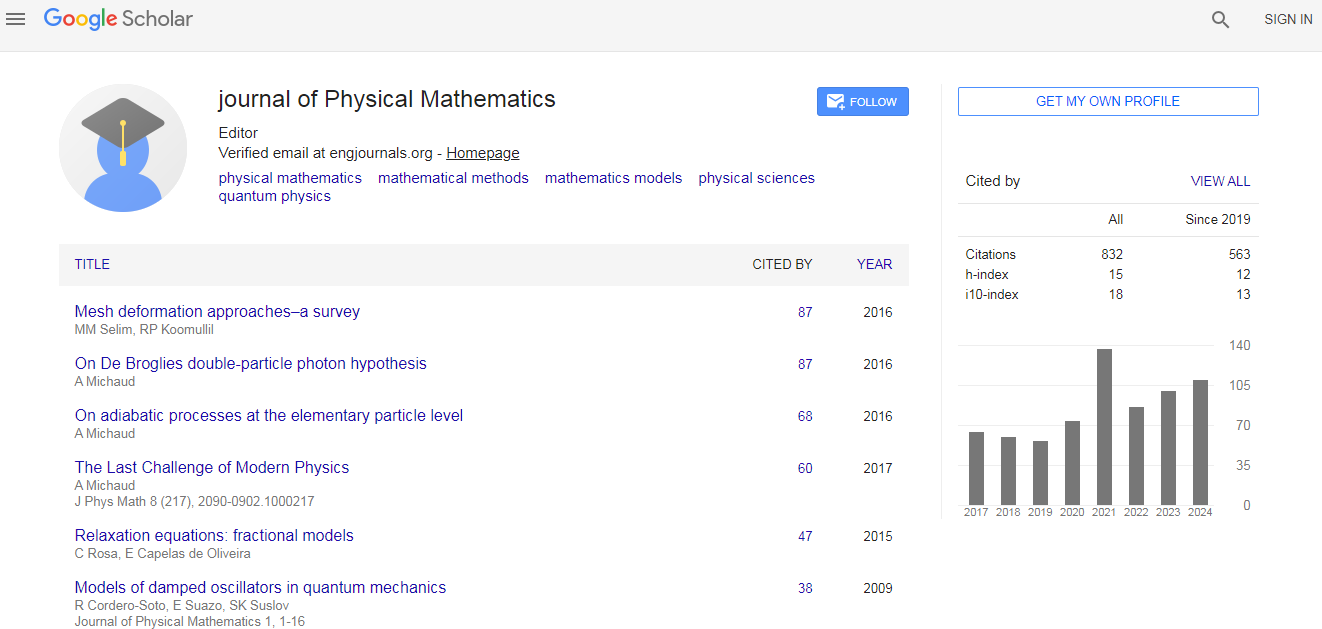
Physical Mathematics received 686 citations as per Google Scholar report