Brief Report - (2025) Volume 14, Issue 4
Received: 01-Jul-2025, Manuscript No. jtsm-26-179557;
Editor assigned: 03-Jul-2025, Pre QC No. P-179557;
Reviewed: 17-Jul-2025, QC No. Q-179557;
Revised: 22-Dec-2025, Manuscript No. R-179557;
Published:
28-Jul-2025
, DOI: 10.37421/2167-0919.2025.14.507
Citation: Salah, Noura Ben. ”Advanced Wireless Network Management: AI and Beyond.” J Telecommun Syst Manage 14 (2025):507.
Copyright: © 2025 Salah B. Noura This is an open-access article distributed under the terms of the Creative Commons Attribution License, which permits unrestricted use,
distribution and reproduction in any medium, provided the original author and source are credited.
The management of heterogeneous wireless networks presents a complex set of challenges, necessitating sophisticated strategies for resource allocation and Quality of Service (QoS) provisioning to ensure optimal performance and user experience [1].
The integration of diverse wireless technologies, such as cellular and Wi-Fi, within a unified network infrastructure demands intelligent solutions for spectrum sharing. Cognitive radio capabilities, augmented by machine learning, offer a promising avenue for predicting spectrum availability and optimizing resource allocation across different bands [2].
Mobility management is a critical concern in these dynamic environments, particularly for users transitioning between various access technologies. Predictive handover mechanisms, informed by user behavior and real-time network conditions, are crucial for minimizing service interruptions and maintaining seamless connectivity [3].
As wireless networks continue to evolve, energy efficiency has emerged as a significant consideration. Adaptive resource management schemes that intelligently reconfigure network components and optimize transmission power are essential for reducing energy consumption without compromising performance [4].
Enhancing system throughput and ensuring user fairness in heterogeneous wireless networks can be achieved through joint optimization of power and bandwidth allocation. Game-theoretic approaches enable distributed, autonomous decision-making among network operators, leading to balanced resource distribution [5].
The complexity of dynamic spectrum access in heterogeneous wireless networks can be effectively addressed by deep reinforcement learning (DRL). This approach allows the network to learn optimal usage policies through interaction with the environment, adapting to dynamic scenarios and improving spectrum utilization [6].
Interference management becomes increasingly critical in dense heterogeneous wireless networks, especially with the proliferation of small cell deployments. Coordinated interference mitigation techniques, leveraging information sharing among base stations, can significantly enhance cell edge performance and overall network capacity [7].
Network slicing represents a fundamental enabler for 5G and beyond, allowing for the dynamic allocation of resources and management of services across distinct virtual networks. This caters to diverse application requirements, such as ultra-reliable low-latency communication and massive machine-type communication [8].
Effective load balancing is paramount for heterogeneous wireless networks to ensure uniform resource utilization and prevent congestion. Distributed algorithms that consider user density, channel conditions, and network load can optimize handover decisions, leading to improved network performance and user satisfaction [9].
The integration of artificial intelligence (AI) and machine learning (ML) is revolutionizing the management of heterogeneous wireless networks. AI-driven orchestration frameworks offer adaptive resource management, performance optimization, and failure prediction capabilities, paving the way for more intelligent and efficient network operations [10].
Heterogeneous wireless networks present a significant challenge in terms of resource allocation and Quality of Service (QoS) provisioning. To address this, novel approaches dynamically adjust parameters based on real-time network conditions, aiming to improve user experience and spectral efficiency by integrating diverse network technologies through intelligent decision-making mechanisms [1].
Intelligent spectrum sharing techniques are vital for heterogeneous wireless environments. By integrating cognitive radio capabilities and employing machine learning-based frameworks, spectrum availability can be predicted and resource allocation optimized across cellular and unlicensed bands, leading to enhanced throughput and reduced interference [2].
Mobility management in heterogeneous wireless networks is primarily concerned with seamless transitions for mobile users between different access technologies. Predictive handover mechanisms, which consider user behavior and network conditions, are essential for minimizing service interruption and maintaining consistent QoS, highlighting the importance of proactive handovers [3].
Energy-efficient resource management is a growing imperative in heterogeneous wireless networks. Adaptive schemes that intelligently manage network components and transmission power can lead to considerable energy savings without compromising overall performance, addressing the demand for sustainability [4].
Joint optimization of power and bandwidth allocation is a key strategy for enhancing system throughput and user fairness in heterogeneous wireless networks. Distributed resource allocation algorithms, often based on game theory, facilitate autonomous decision-making among network operators, improving spectral efficiency and resource distribution [5].
Dynamic spectrum access in heterogeneous wireless networks can be significantly improved through deep reinforcement learning (DRL). A DRL-based framework allows the network to learn optimal spectrum usage policies by interacting with its environment, resulting in better spectrum utilization and reduced interference, especially in complex and dynamic scenarios [6].
Interference management in dense heterogeneous wireless networks, particularly those with small cell deployments, requires sophisticated strategies. Coordinated techniques that leverage information sharing among base stations can optimize transmission parameters, leading to substantial improvements in cell edge performance and network capacity [7].
Network slicing is a fundamental technology for heterogeneous wireless networks, especially in the context of 5G and beyond. It enables dynamic allocation of resources and management of services across multiple virtual networks, catering to diverse application requirements such as ultra-reliable low-latency communication and massive machine-type communication through flexible and efficient slicing mechanisms [8].
Load balancing in heterogeneous wireless networks is crucial for achieving uniform resource utilization and preventing congestion. Distributed algorithms that dynamically consider factors like user density, channel conditions, and network load enable intelligent handover decisions, thus enhancing network performance and user satisfaction [9].
The increasing complexity of heterogeneous wireless networks is being managed through the integration of artificial intelligence (AI) and machine learning (ML). AI-driven orchestration frameworks provide adaptive resource management, performance optimization, and predictive capabilities, driving more efficient and intelligent wireless network operations [10].
This collection of research addresses key challenges in managing heterogeneous wireless networks. Papers explore advanced techniques for resource allocation, Quality of Service (QoS) provisioning, and spectrum sharing, often leveraging artificial intelligence, machine learning, and cognitive radio. Mobility management through predictive handovers and interference mitigation in dense deployments are also significant themes. Furthermore, energy efficiency, network slicing for diverse service requirements, and load balancing for uniform resource utilization are investigated. The overarching goal is to enhance network performance, spectral efficiency, user experience, and sustainability in complex wireless environments.
None
None
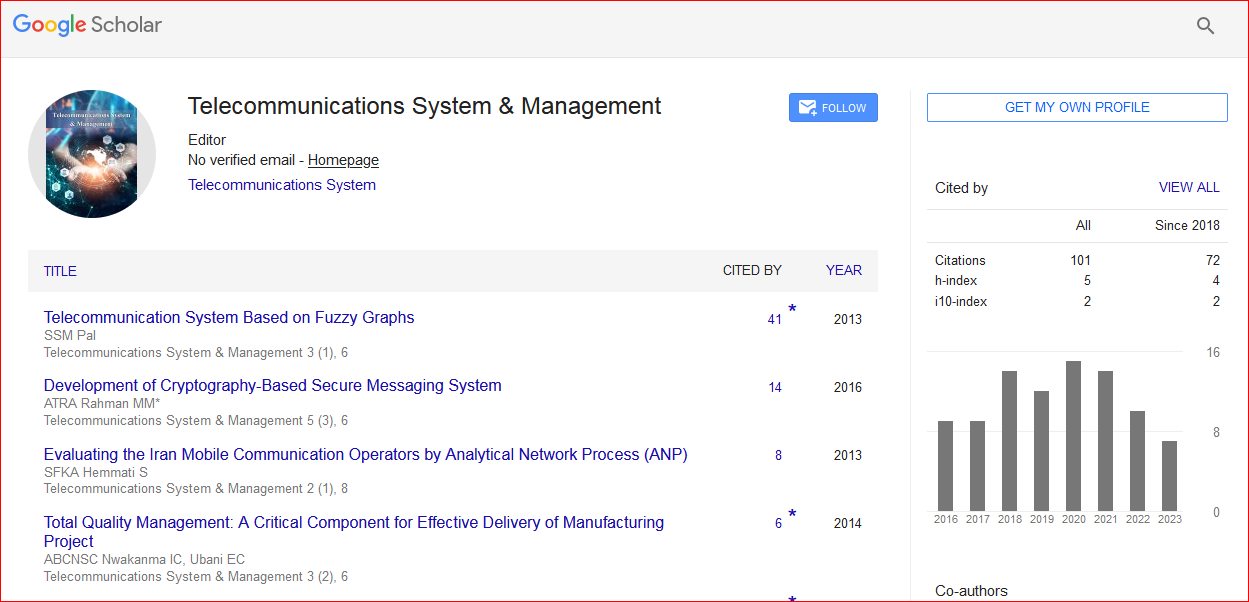
Telecommunications System & Management received 109 citations as per Google Scholar report