Commentary - (2025) Volume 16, Issue 2
Received: 28-Mar-2025, Manuscript No. gjto-25-175371;
Editor assigned: 31-Mar-2025, Pre QC No. P-175371;
Reviewed: 14-Apr-2025, QC No. QC-175371;
Revised: 21-Apr-2025, Manuscript No. R-175371;
Published:
28-Apr-2025
, DOI: 10.37421/2229-8711.2025.16.436
Citation: Voss, Leonard. ”Advanced Tech: Reshaping Industries and Life.” Global J Technol Optim 16 (2025):436.
Copyright: © 2025 Voss L. This is an open-access article distributed under the terms of the Creative Commons Attribution License, which permits unrestricted use, distribution
and reproduction in any medium, provided the original author and source are credited.
The current technological landscape is characterized by rapid innovation across numerous domains, each promising to redefine existing paradigms and open new frontiers. This collection explores a diverse array of these advancements, from the intricate world of artificial intelligence in healthcare to the vast expanses of space exploration. Understanding these developments is key to appreciating the trajectory of global progress and the challenges that accompany such profound shifts. Artificial Intelligence (AI) is profoundly impacting medicine, transforming how diseases are diagnosed, how treatments are personalized, and how drugs are discovered. Despite its immense potential, AI also presents challenges related to data complexity and ethical considerations, which require careful navigation as the field progresses towards more precise and efficient healthcare solutions [1].
Parallel to this, industries worldwide are increasingly adopting sustainable technological innovations. This movement emphasizes a shift towards circular economies and eco-efficient production methods, which are vital for environmental protection and ensuring long-term economic viability. This transition is not only driven by regulatory pressures but also by a growing consumer demand for more responsible and environmentally conscious practices [2]. Manufacturing, a cornerstone of global economy, is undergoing a profound digital transformation. This involves integrating advanced technologies like the Internet of Things (IoT), Artificial Intelligence (AI), and big data analytics into operational models. The result is a significant boost in productivity and the creation of more agile, responsive production systems, leading to what are commonly referred to as smarter factories [3]. In the realm of advanced computation, quantum computing is steadily advancing, holding the promise to solve incredibly complex problems that are currently intractable for classical computers. Its implications span critical fields such as cryptography, materials science, and drug development. While still in its nascent stages, the progress in quantum computing signals a fundamental shift in computational power that will reshape technological capabilities [4]. Biotechnology has witnessed a revolution with CRISPR-Cas gene editing technologies. These innovations have not only transformed biological research but also opened up vast therapeutic applications by allowing for the precise modification of DNA. This powerful tool offers immense potential for treating genetic diseases and gaining a deeper understanding of fundamental biological processes [5].
Nanotechnology is also making considerable strides within medicine, offering novel approaches that promise to revolutionize patient care. These include advanced methods for targeted drug delivery, sophisticated diagnostic imaging techniques, and innovative tissue engineering solutions. Such nanoscale interventions are enabling more precise therapies and earlier disease detection, significantly improving patient outcomes [6]. In the digital security landscape, blockchain technology is emerging as a robust solution for enhancing cybersecurity. Its decentralized and immutable nature provides inherent advantages, leading to improved data integrity, more secure transactions, and transparent record-keeping. This addresses many vulnerabilities found in traditional centralized systems [7]. Environmental concerns are being addressed through significant advancements in renewable energy technologies. These innovations are accelerating the global transition away from a reliance on fossil fuels. Progress in solar, wind, and energy storage systems is making clean energy more accessible and efficient, playing a crucial role in combating climate change [8]. Education is also being reshaped by technological innovation, specifically through Augmented Reality (AR) and Virtual Reality (VR). These technologies are transforming learning practices by creating immersive and interactive environments. They offer new, engaging ways to educate students, help visualize complex concepts, and provide invaluable practical training experiences [9].
Finally, the aspirations for future space exploration and commercial ventures are heavily reliant on advances in space propulsion systems. Innovations in areas like electric propulsion, advanced chemical rockets, and other potential advanced concepts are crucial. These developments are enabling more efficient and ambitious missions, allowing humanity to venture deeper into space [10]. Collectively, these technological advancements represent a mosaic of human ingenuity, pushing the boundaries of what is possible. From enhancing human health and protecting our planet to revolutionizing industries and exploring the cosmos, these innovations highlight a period of unprecedented scientific and technological evolution.
The contemporary world is in the midst of a profound technological transformation, marked by groundbreaking innovations that are reshaping various sectors and aspects of daily life. This era is characterized by a drive towards efficiency, sustainability, and advanced problem-solving, leveraging digital and biological frontiers alike. Many of these developments are interconnected, creating a complex web of progress that promises to address some of humanity's most pressing challenges. A central theme in this technological wave is the application of Artificial Intelligence (AI) across diverse domains. In medicine, AI is rapidly enhancing diagnostics, personalizing treatments, and significantly optimizing drug discovery processes [1]. This integration addresses complex data challenges and navigates ethical considerations, paving the way for more precise and efficient healthcare systems. Concurrently, manufacturing is undergoing a comprehensive digital transformation, integrating technologies like the Internet of Things (IoT), AI, and big data analytics. This shift is not merely incremental; it redefines operational models, substantially boosts productivity, and enables the creation of more agile and responsive production systems, leading to the rise of smarter factories [3]. Beyond Earth, the development of advanced space propulsion systems, including electric propulsion and cutting-edge chemical rockets, is crucial for both future space exploration and commercial ventures, enabling more ambitious and efficient missions into deep space [10]. These applications highlight AI's role as a foundational technology, driving innovation from micro-level health interventions to macro-level industrial and cosmic endeavors.
Sustainability is another critical driver of current technological advancements. Industries are increasingly adopting sustainable innovations, moving decisively towards circular economies and eco-efficient production practices [2]. This transition is vital not only for environmental protection but also for ensuring long-term economic viability, spurred by both regulatory frameworks and growing consumer demand for responsible business practices. Complementing this, significant advancements in renewable energy technologies are accelerating the global transition away from fossil fuels. Innovations in solar, wind, and energy storage systems are making clean energy more accessible and efficient, thereby playing a pivotal role in combating climate change and fostering a sustainable future [8]. These efforts underscore a collective commitment to mitigating environmental impact through technological ingenuity.
Further extending the reach of technological progress are innovations in advanced computing and biotechnology. Quantum computing, though still in early developmental stages, holds immense promise for solving problems currently considered intractable for classical computers, with potential impacts across cryptography, materials science, and drug development [4]. This represents a significant leap in computational power. In biological sciences, CRISPR-Cas gene editing technologies have revolutionized research and therapeutic applications by enabling precise modification of DNA. This powerful tool offers tremendous potential for treating genetic diseases and enhancing our understanding of fundamental biological processes [5]. Similarly, nanotechnology is making substantial strides in medicine, offering novel approaches for targeted drug delivery, advanced diagnostic imaging, and tissue engineering. These nanoscale interventions lead to more precise therapies and earlier disease detection, improving patient outcomes [6]. These fields exemplify the pursuit of deeper scientific understanding and precise interventions.
Finally, the evolution of secure and immersive digital environments marks another significant area of progress. Blockchain technology is emerging as a robust solution for enhancing cybersecurity due to its decentralized and immutable nature. It provides improved data integrity, secure transactions, and transparent record-keeping, effectively addressing vulnerabilities inherent in traditional systems [7]. Meanwhile, Augmented Reality (AR) and Virtual Reality (VR) are transforming educational practices by creating immersive and interactive learning environments. These technologies offer novel ways to engage students, visualize complex concepts, and provide invaluable practical training experiences, signifying a new era for pedagogical approaches [9]. Together, these advancements are not just isolated improvements but interconnected elements pushing the boundaries of what is possible, promising a future that is more intelligent, sustainable, and interconnected.
Artificial Intelligence (AI) is fundamentally changing healthcare, offering breakthroughs in diagnostics, personalized treatment plans, and accelerating drug discovery, even while addressing challenges like data complexity and ethical considerations. Industries are also embracing sustainable technological innovations, aiming for circular economies and eco-efficient production, a critical move for both environmental protection and long-term economic stability driven by regulations and consumer demand. Manufacturing itself is undergoing a digital revolution, integrating technologies such as the Internet of Things (IoT), AI, and big data analytics. This redefines operational models, significantly boosting productivity and enabling more agile and responsive production systems, ultimately leading to smarter factories. In advanced computing, quantum computing is making strides, holding the potential to tackle complex problems that are currently beyond the reach of classical computers. This has profound implications for fields like cryptography, materials science, and drug development, signaling a major shift in computational power. Biotechnologically, CRISPR-Cas gene editing technologies have revolutionized biological research and therapeutic applications by allowing precise modification of DNA.
This powerful tool presents immense potential for treating genetic diseases and deepening our understanding of fundamental biological processes. Nanotechnology is also considerably advancing medicine, providing new approaches for targeted drug delivery, sophisticated diagnostic imaging, and innovative tissue engineering, leading to improved patient outcomes through more precise interventions and earlier disease detection. For security, blockchain technology stands out as a robust solution for enhancing cybersecurity due to its decentralized and immutable nature. It offers improved data integrity, secure transactions, and transparent record-keeping, thereby addressing vulnerabilities inherent in traditional systems. Environmentally, significant advancements in renewable energy technologies are accelerating the global transition away from fossil fuels. Innovations in solar, wind, and energy storage systems are making clean energy more accessible and efficient, effectively combating climate change. In education, Augmented Reality (AR) and Virtual Reality (VR) are transforming practices by creating immersive and interactive learning environments. These technologies provide new ways to engage students, visualize complex concepts, and deliver practical training experiences. Lastly, innovations in space propulsion systems, including electric propulsion and advanced chemical rockets, are proving crucial for future space exploration and commercial ventures, enabling more efficient and ambitious missions deeper into space.
None
None
Yu-Fang L, Jia-Qi L, Lin-Zhuo M. "Artificial intelligence in medicine: Applications, challenges, and future perspectives".Front Pharmacol 13 (2022):868722.
Indexed at, Google Scholar, Crossref
Muhammad AK, Kashif H, Muhammad F. "Sustainable technological innovations in industry: A systematic review and future research agenda".J Clean Prod 418 (2023):138243.
Indexed at, Google Scholar, Crossref
Kai-Wen T, Shih-Chih C, Po-Yuan H. "Digital transformation in manufacturing: Current state and future trends".J Manuf Syst 61 (2021):686-702.
Indexed at, Google Scholar, Crossref
Subhash CK, Ravi P, Ashwani KS. "Quantum computing: A review of current progress and future directions".SN Comput Sci 3 (2022):379.
Indexed at, Google Scholar, Crossref
Shuhao X, Jianping C, Zhiyuan L. "CRISPR-Cas systems: From fundamental mechanisms to programmable genome editing".Front Bioeng Biotechnol 9 (2021):644155.
Indexed at, Google Scholar, Crossref
Pradeep CB, Pradeep K, Anil K. "Recent Advances in Nanotechnology and Its Applications in Medicine".Nanomaterials 11 (2021):190.
Indexed at, Google Scholar, Crossref
Muhammad W, Muhammad A, Muhammad A. "Blockchain technology for cybersecurity: A comprehensive review".J Netw Comput Appl 172 (2020):102832.
Indexed at, Google Scholar, Crossref
Mohamed H, Elsayed ME, Abdulaziz SA. "Recent advances in renewable energy technologies and their applications".Sustain Energy Technol Assess 52 (2022):102073.
Indexed at, Google Scholar, Crossref
Maria EC, Paula CL, Rocio G. "The current state of augmented reality and virtual reality research in education: A systematic review".Educ Inf Technol 28 (2023):1017-1049.
Indexed at, Google Scholar, Crossref
Pradeep K, Rajesh K, Sanjay K. "Advances in Space Propulsion Systems: A Review".Aerosp Sci Technol 110 (2021):106478.
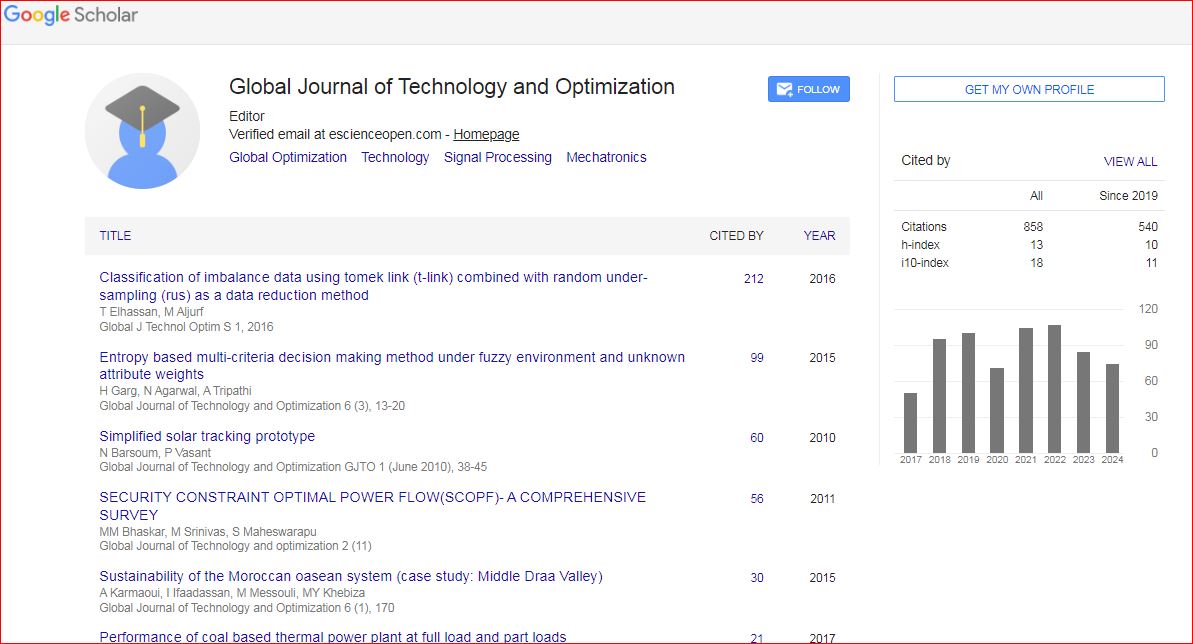
Global Journal of Technology and Optimization received 847 citations as per Google Scholar report