Brief Note - (2025) Volume 12, Issue 3
Received: 01-Jun-2025, Manuscript No. jreac-26-185782;
Editor assigned: 03-Jun-2025, Pre QC No. P-185782;
Reviewed: 17-Jun-2025, QC No. Q-185782;
Revised: 23-Jun-2025, Manuscript No. R-185782;
Published:
30-Jun-2025
, DOI: 10.37421/2380-2391.2025.12.435
Citation: Petrova, Elena. ”Advanced Preconcentration Techniques for Ultra-Trace Analysis.” J Environ Anal Chem 12 (2025):435.
Copyright: © 2025 Petrova E. This is an open-access article distributed under the terms of the Creative Commons Attribution License, which permits unrestricted use, distribution and reproduction in any medium, provided the original author and source are credited.
Environmental analysis at ultra-trace levels presents significant challenges due to the extremely low concentrations of analytes and the complexity of environmental matrices. To overcome these limitations, preconcentration techniques are indispensable for enhancing the sensitivity and selectivity of analytical methods, thereby enabling accurate pollution assessment and risk evaluation. These techniques effectively isolate and concentrate target analytes from large sample volumes, bringing them to detectable levels for various analytical instruments. One of the primary focuses in this field has been the exploration of advanced extraction methodologies. Recent investigations have highlighted the critical role of preconcentration techniques such as solid-phase extraction (SPE), cloud point extraction (CPE), and dispersive liquid-liquid microextraction (DLLME) in significantly improving detection limits for contaminants in complex environmental samples. The goal is to boost sensitivity and selectivity, which are paramount for precise environmental monitoring and understanding pollution's impact on human health and ecosystems [1].
Furthermore, the development of novel sorbent materials has been a key area of research. Magnetic nanoparticles, for instance, have emerged as promising candidates for the preconcentration of heavy metal ions from aqueous environmental samples. Their unique properties, often enhanced by functionalization with specific chelating agents, offer advantages in terms of rapid separation, high adsorption capacity, and efficient recovery, contributing to more sustainable and sensitive analytical approaches [2].
Innovative extraction formats are also continually being developed to improve efficiency and reduce solvent consumption. The study of hollow fiber-supported liquid-phase microextraction (HF-LPME) coupled with gas chromatography-mass spectrometry (GC-MS) for organochlorine pesticides in water exemplifies this trend. This technique effectively isolates and concentrates analytes from substantial sample volumes, leading to enhanced sensitivity and reduced environmental impact, which is particularly valuable for routine environmental monitoring programs [3].
Materials with unique adsorptive properties are also being leveraged for preconcentration. Graphene oxide, for example, has been utilized as a novel sorbent in solid-phase extraction (GO-SPE) for the preconcentration of polycyclic aromatic hydrocarbons (PAHs) from environmental water samples. Its high surface area and strong adsorption affinity make it an effective material for extracting PAHs, facilitating their sensitive determination by chromatographic methods [4].
Microextraction techniques continue to evolve, offering rapid and efficient ways to concentrate analytes. Dispersive liquid-liquid microextraction (DLLME) coupled with high-performance liquid chromatography (HPLC) has been developed for the determination of phthalate esters in bottled water. DLLME is known for its rapid extraction times and high enrichment factors, which are crucial for the sensitive detection of endocrine-disrupting compounds in various matrices [5].
The application of specialized solvents is another avenue for enhancing extraction efficiency. Ionic liquids have been explored as extraction solvents for the preconcentration of phenolic compounds from wastewater samples. These unique solvents, characterized by their low volatility and tunable polarity, present a promising approach for efficient and selective extraction of environmental pollutants, offering advantages over traditional organic solvents [6].
Solid-phase microextraction (SPME) remains a cornerstone in environmental analysis, with continuous advancements in its application. Recent reviews highlight the progress in SPME techniques for analyzing volatile and semi-volatile organic compounds in diverse environmental matrices. Developments in new fiber coatings and optimized extraction strategies are aimed at improving extraction efficiency and selectivity for detecting trace-level contaminants [7].
Cloud point extraction (CPE) is also being adapted for specific environmental challenges, such as the preconcentration of platinum group metals from industrial wastewater. CPE is recognized as an efficient and environmentally friendly method for concentrating trace metals, thereby improving their detection limits when analyzed using techniques like inductively coupled plasma-mass spectrometry (ICP-MS) [8].
Advanced nanomaterials are also playing a crucial role in preconcentration. Modified silica nanoparticles have been developed for the preconcentration of per- and polyfluoroalkyl substances (PFAS) in drinking water. These functionalized nanoparticles exhibit excellent adsorption capacity and selectivity for PFAS, enabling sensitive determination and aiding in the assessment of water contamination [9].
The field of ultra-trace environmental analysis relies heavily on sophisticated preconcentration strategies to overcome the inherent difficulties associated with detecting analytes at extremely low concentrations in complex sample matrices. These techniques are vital for accurate pollution assessment and the evaluation of associated health risks. Preconcentration methods serve to isolate and concentrate target substances from large sample volumes, making them amenable to detection by various analytical instrumentation. Recent scientific endeavors have underscored the significance of advanced preconcentration methods, including solid-phase extraction (SPE), cloud point extraction (CPE), and dispersive liquid-liquid microextraction (DLLME). These techniques have demonstrated a remarkable ability to enhance detection limits for a wide range of contaminants found in environmental samples. The primary objective is to improve both the sensitivity and selectivity of analytical measurements, which are critical for reliable environmental monitoring and the assessment of pollution's impact on public health and ecological systems [1].
The development and application of novel sorbent materials represent a significant advancement in preconcentration science. Magnetic nanoparticles, for example, are being extensively investigated for their utility in preconcentrating heavy metal ions from aqueous environmental samples. When appropriately functionalized with specific chelating agents, these nanoparticles offer substantial benefits, such as rapid separation from the sample matrix, high capacity for analyte adsorption, and efficient recovery of the preconcentrated analytes. This contributes to the development of analytical methods that are both more sensitive and environmentally sustainable [2].
Continuous innovation in extraction formats is also a key driver for improving analytical efficiency and reducing environmental footprint. The development of hollow fiber-supported liquid-phase microextraction (HF-LPME) coupled with gas chromatography-mass spectrometry (GC-MS) for the analysis of organochlorine pesticides in water illustrates this progress. This technique excels at isolating and concentrating analytes from substantial volumes of water samples, leading to improved sensitivity and a significant reduction in solvent usage. Such advancements are particularly beneficial for large-scale environmental monitoring programs [3].
Materials possessing unique adsorptive characteristics are being increasingly exploited for preconcentration applications. Graphene oxide, recognized for its extensive surface area and potent adsorption capabilities, has been employed as a novel sorbent in solid-phase extraction (GO-SPE) for the preconcentration of polycyclic aromatic hydrocarbons (PAHs) from environmental water samples. The inherent properties of graphene oxide make it an effective medium for extracting PAHs, thereby facilitating their sensitive determination using established chromatographic techniques [4].
Microextraction techniques are evolving rapidly, offering expedient and effective means for analyte preconcentration. Dispersive liquid-liquid microextraction (DLLME), often integrated with high-performance liquid chromatography (HPLC), has been successfully applied to the determination of phthalate esters in bottled water. The DLLME technique is characterized by its rapid extraction kinetics and high enrichment factors, which are essential for achieving sensitive detection of endocrine-disrupting compounds in various types of water [5].
The utilization of specialized solvent systems is another important strategy for optimizing extraction performance. Ionic liquids have emerged as effective extraction solvents for the preconcentration of phenolic compounds from wastewater samples. Their distinctive properties, including minimal volatility and adjustable polarity, position them as promising alternatives for the efficient and selective extraction of environmental pollutants, offering potential advantages over conventional organic solvents [6].
Solid-phase microextraction (SPME) continues to be a vital technique in environmental analytical chemistry, with ongoing advancements enhancing its capabilities. Recent reviews highlight the progress made in SPME methodologies for the analysis of volatile and semi-volatile organic compounds across a spectrum of environmental matrices. Innovations in the development of novel fiber coatings and the refinement of extraction protocols are geared towards augmenting extraction efficiency and selectivity, particularly for the detection of analytes present at trace levels [7].
Cloud point extraction (CPE) is also being adapted and refined for specialized environmental applications, such as the preconcentration of platinum group metals from industrial wastewater. CPE is recognized for its efficiency and environmentally benign nature in concentrating trace metals. By employing CPE, detection limits can be significantly improved when coupled with advanced analytical techniques like inductively coupled plasma-mass spectrometry (ICP-MS) [8].
Cutting-edge nanomaterials are playing an increasingly significant role in the development of advanced preconcentration strategies. Modified silica nanoparticles have been engineered for the effective preconcentration of per- and polyfluoroalkyl substances (PFAS) in drinking water samples. These functionalized nanoparticles exhibit superior adsorption capacities and selectivity for PFAS, which is crucial for enabling their sensitive determination and for effectively assessing the extent of contamination in water resources [9].
This collection of research explores advanced preconcentration techniques essential for ultra-trace environmental analysis. Methods such as solid-phase extraction (SPE), cloud point extraction (CPE), and dispersive liquid-liquid microextraction (DLLME) are highlighted for their ability to enhance detection limits and improve the sensitivity and selectivity of contaminant analysis in complex environmental matrices. Innovations include the use of magnetic nanoparticles, graphene oxide, hollow fiber-supported liquid-phase microextraction, ionic liquids, modified silica nanoparticles, and stir bar sorptive extraction. These techniques collectively aim to provide more accurate pollution assessment, reduce solvent consumption, and enable the sensitive detection of a wide range of environmental pollutants, from heavy metals and organic compounds to emerging contaminants like PFAS.
None
None
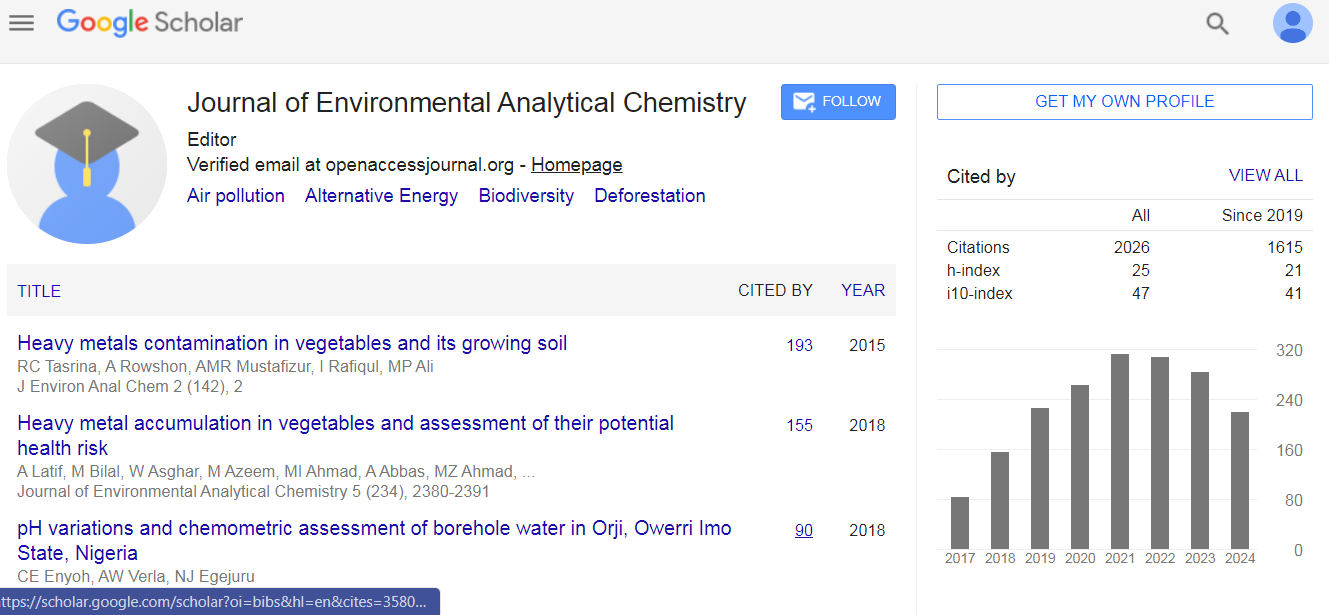
Journal of Environmental Analytical Chemistry received 1781 citations as per Google Scholar report