Commentary - (2025) Volume 14, Issue 5
Received: 01-Oct-2025, Manuscript No. jnc-25-173981;
Editor assigned: 03-Oct-2025, Pre QC No. P-173981;
Reviewed: 17-Oct-2025, QC No. Q-173981;
Revised: 22-Oct-2025, Manuscript No. R-173981;
Published:
29-Oct-2025
, DOI: 10.37421/2167-1168.2025.14.729
Citation: Nguyen, Chloe. ”Advanced Practice Nursing: Elevating Care and Outcomes.” J Nurs Care 14 (2025):729.
Copyright: © 2025 Nguyen C. This is an open-access article distributed under the terms of the Creative Commons Attribution License, which permits unrestricted use, distribution and reproduction in any medium, provided the original author and source are credited.
This article delves into the meaning of 'Advanced Clinical Practice' in nursing, meticulously breaking down its foundational elements and defining characteristics. It clarifies the scope and capabilities intrinsic to these specialized roles, emphasizing that a unified understanding is crucial for nurses to contribute effectively and for healthcare systems to appropriately value their expertise. Establishing a common language for advanced nursing roles is paramount for professional advancement[1].
This systematic review meticulously examines the real-world impact of Advanced Clinical Practice roles within nursing and midwifery on patient care outcomes. It consistently demonstrates that these advanced roles lead to demonstrably positive results, including enhanced patient satisfaction and improved access to essential healthcare services. This underscores their indispensable contribution to the functionality and efficacy of modern healthcare systems, making the tangible benefits brought by advanced practitioners profoundly evident[2].
This comprehensive scoping review investigates the proactive contributions of Advanced Practice Nurses in confronting the persistent nursing and healthcare workforce shortages. What this really means is that these specialized roles represent a vital and strategic component of the solution, offering concrete avenues to significantly expand overall care capacity and effectively address critical gaps in service delivery. They are not merely supplementary personnel; they are foundational to building future healthcare resilience and sustainability[3].
This integrative review thoroughly synthesizes a diverse array of studies to gain a holistic understanding of the extensive influence wielded by Advanced Clinical Practice roles in nursing. It powerfully highlights how these roles make substantial contributions across multiple domains, including significantly enhancing patient safety, streamlining care coordination, and boosting the overall operational efficiency of health services. It becomes clear that Advanced Clinical Nurses frequently act as crucial bridges in care pathways, thereby markedly improving patient experiences and leading to superior health outcomes[4].
This detailed scoping review methodically explores the presence, varied functions, and inherent value of Advanced Practice Nursing within the vital field of public health. It compellingly reveals that these nurses are absolutely critical for the successful execution of community health initiatives, proactive disease prevention strategies, and impactful health promotion programs. Their specialized expertise in advanced assessment techniques and targeted interventions demonstrably creates a significant positive impact on population-level health outcomes, solidifying their essential role[5].
This integrative review deeply explores the firsthand experiences of Advanced Practice Nurses who dedicate their expertise to caring for cancer patients. It profoundly highlights both the unique professional challenges and the deep personal rewards inherent in their demanding work. The review vividly demonstrates how these nurses consistently deliver complex, compassionate, and highly specialized care, even while skillfully navigating often overwhelming and emotionally taxing clinical environments. Their central and invaluable role is unequivocally paramount in substantially improving the overall quality of life for individuals grappling with cancer[6].
This insightful article provides a comprehensive global overview of Advanced Practice Nursing, meticulously examining how these roles, their educational requirements, and diverse regulatory frameworks vary significantly across different countries and regions. It strongly emphasizes the critical need for greater harmonization and the establishment of consistent international standards to effectively support and advance these roles on a worldwide scale. This makes it abundantly clear that adopting a broad global perspective is absolutely essential for the continuous progression of the profession and for maximizing its far-reaching impact on healthcare[7].
This impactful scoping review thoroughly investigates the various barriers and crucial facilitators that either significantly impede or actively promote the successful integration of Advanced Practice Nursing roles within primary care settings. It plainly reveals that persistent issues such as a lack of clear and consistent role definition, alongside insufficient understanding from other healthcare professionals like physicians, can indeed present considerable challenges. However, the review also powerfully demonstrates that robust interprofessional collaboration, coupled with strongly supportive organizational policies, undeniably paves the way for substantial success and effective integration[8].
This systematic review critically assesses the measurable influence of Advanced Practice Nurses on patient outcomes specifically within demanding acute care settings. It unequivocally found that these highly skilled nurses consistently and significantly improve patient satisfaction levels, demonstrably reduce rates of hospital readmissions, and actively enhance the overall quality of care provided. Their specialized and advanced clinical skills are clearly making a profound and quantifiable difference in these critical and fast-paced healthcare environments[9].
This comprehensive scoping review methodically examines the critically important role played by Advanced Practice Nursing in the sensitive and specialized domain of palliative care. It particularly highlights their exceptional expertise in managing complex symptoms, providing crucial support to families, and facilitating essential end-of-life discussions with profound sensitivity. The review effectively demonstrates how these dedicated nurses are central to delivering holistic, compassionate, and person-centered care for patients confronting serious and life-limiting illnesses. They truly elevate the existing standard of palliative care, ensuring dignity and comfort[10].
Advanced Clinical Practice in nursing is subject to continuous conceptual analysis, which aims to delineate its foundational elements and distinguishing characteristics. The goal here is to forge a unified understanding that is crucial for advanced practice nurses to contribute effectively and for healthcare systems to fully recognize and integrate their substantial value [1]. Research consistently affirms that these advanced roles demonstrably lead to significant positive outcomes, including heightened patient satisfaction and improved access to essential care services, thus highlighting their indispensable contribution to the overall functionality and efficacy of modern healthcare systems [2]. Beyond direct patient care, integrative reviews further confirm that Advanced Clinical Nurses play a pivotal role in enhancing patient safety, optimizing care coordination, and boosting the overarching operational efficiency of health services. They frequently act as crucial bridges in complex care pathways, thereby markedly improving patient journeys and leading to superior health outcomes across various settings [4]. Furthermore, in critical and fast-paced environments, the specialized skills of these nurses consistently make a profound and measurable difference, not only by improving patient satisfaction but also by significantly reducing hospital readmissions and elevating the overall quality of care provided [9].
A critically important aspect of Advanced Practice Nursing involves their proactive and strategic engagement in addressing persistent nursing and broader healthcare workforce shortages. What this really means is that these specialized roles are not merely supplementary personnel; they represent a vital and foundational component of the solution, offering concrete avenues to significantly expand overall care capacity and effectively address critical gaps in service delivery. They are, in essence, indispensable for building future healthcare resilience and ensuring sustainable, high-quality service provision [3]. The well-documented positive impact these nurses have on patient outcomes, which notably includes improved satisfaction and enhanced access to care, directly underpins their value in mitigating staffing crises and bolstering system capabilities [2, 9]. The demonstrated influence of these advanced roles on overall health service efficiency further underscores their potential to stabilize and strengthen healthcare systems under immense pressure [4].
The versatility and profound impact of Advanced Practice Nursing are clearly evident across a diverse array of specialized clinical and community settings. In the realm of public health, for instance, these nurses are absolutely crucial for the successful design and execution of community health initiatives, proactive disease prevention strategies, and impactful health promotion programs. Their advanced expertise in comprehensive assessment and targeted interventions demonstrably creates a significant positive impact on population-level health outcomes, solidifying their essential role in fostering community well-being [5]. For individuals grappling with cancer, Advanced Practice Nurses provide complex, compassionate, and highly specialized care, skillfully navigating often overwhelming and emotionally taxing clinical environments. Their central and invaluable role is unequivocally paramount in substantially improving the overall quality of life for these patients through their expert support and clinical management [6]. Similarly, within the sensitive and specialized domain of palliative care, their expertise in managing complex symptoms, providing crucial support to families, and facilitating essential end-of-life discussions with profound sensitivity is central to delivering holistic, compassionate, and person-centered care for patients confronting serious and life-limiting illnesses. They truly elevate the existing standard of palliative care, ensuring dignity and comfort throughout the patient journey [10]. Moreover, in demanding acute care settings, Advanced Practice Nurses consistently and significantly improve patient satisfaction levels, demonstrably reduce rates of hospital readmissions, and actively enhance the overall quality of care provided. Their specialized and advanced clinical skills are clearly making a profound and quantifiable difference in these critical and fast-paced healthcare environments [9].
Examining Advanced Practice Nursing from a comprehensive global perspective reveals significant variations in their defined roles, educational requirements, and diverse regulatory frameworks across different countries and regions. This highlights a critical and pressing need for greater harmonization and the establishment of consistent international standards to effectively support and foster the advancement of these roles on a worldwide scale [7]. Despite their proven value and widespread adoption in many areas, the successful integration of Advanced Practice Nursing roles into settings such as primary care often faces specific challenges. Issues identified include a persistent lack of clear and consistent role definition, alongside insufficient understanding and acceptance from other healthcare professionals, particularly physicians, which can indeed present considerable hurdles. However, compelling evidence also powerfully demonstrates that robust interprofessional collaboration, coupled with strongly supportive organizational policies and clear frameworks, undeniably paves the way for substantial success and effective integration, ensuring these roles reach their full potential and are utilized optimally within the healthcare landscape [8]. Ultimately, a unified understanding of their core elements and defined boundaries is not just an academic exercise; it is absolutely key for health systems globally to fully recognize and effectively utilize their comprehensive value and capabilities [1].
Advanced Clinical Practice in nursing is a dynamic and essential field, continually being defined to ensure a unified understanding of its core elements and capabilities. These advanced roles consistently demonstrate significant positive impacts on patient care, leading to improved satisfaction, enhanced access to services, better safety, and more efficient care coordination. They actively address critical healthcare workforce shortages by expanding care capacity and filling service delivery gaps, making them crucial for future healthcare resilience. The value of Advanced Practice Nursing is evident across diverse settings. In public health, they drive community initiatives and improve population health outcomes. For cancer and palliative care patients, they provide complex, compassionate, and holistic support, significantly enhancing quality of life and elevating care standards. In acute care, their specialized skills improve patient satisfaction and reduce hospital readmissions. Globally, while roles and regulations vary, there's a clear call for harmonization to maximize their impact. Despite challenges like unclear role definitions and professional understanding, strong collaboration and supportive policies are vital for successful integration, especially in primary care. Ultimately, Advanced Practice Nurses are indispensable for modern healthcare, driving patient-centered outcomes and system efficiency.
None
None
1. Fiona R, Ruth O, Jonathan D. "Advanced clinical practice in nursing: A concept analysis".Int J Nurs Stud 153 (2024):104642.
Indexed at, Google Scholar, Crossref
2. Kiarash G, Ruth O, Jonathan D. "Advanced clinical practice in nursing and midwifery: a systematic review on its impact on patient care".Int J Nurs Stud 147 (2023):104595.
Indexed at, Google Scholar, Crossref
3. Matthew FS, Peter LA, Allison JA. "Advanced practice nursing's role in addressing the nursing and healthcare workforce crisis: A scoping review".Nurs Outlook 72 (2024):102047.
Indexed at, Google Scholar, Crossref
4. Emine R, Gül BÅ?, Fatma A. "The influence of advanced clinical practice roles in nursing: An integrative review".Nurs Forum 58 (2023):e12999.
Indexed at, Google Scholar, Crossref
5. Lynn N, Jacqueline H, Paula C. "Advanced practice nursing in public health: A scoping review".Public Health Nurs 40 (2023):1056-1065.
Indexed at, Google Scholar, Crossref
6. Emma M, Harriet S, Jessica D. "An Integrative Review of the Experiences of Advanced Practice Nurses Providing Care to Patients with Cancer".Oncol Nurs Forum 49 (2022):172-192.
Indexed at, Google Scholar, Crossref
7. Joyce P, Milan J, Jane Z. "Advanced practice nursing: A global perspective on roles, education, and regulatory frameworks".J Nurs Scholarsh 52 (2020):481-492.
Indexed at, Google Scholar, Crossref
8. Noortje vS, Gijs H, Ronald vdS. "A scoping review on barriers and facilitators to the implementation of advanced practice nursing roles in primary care".Prim Health Care Res Dev 22 (2021):e20.
Indexed at, Google Scholar, Crossref
9. Pamela C, Judith K, Marilyn R. "The impact of advanced practice nurses on patient outcomes in acute care settings: A systematic review".J Adv Nurs 76 (2020):705-720.
Indexed at, Google Scholar, Crossref
10. Constance D, Pamela T, Carol DZ. "Advanced Practice Nursing in Palliative Care: A Scoping Review".J Hosp Palliat Nurs 23 (2021):118-128.
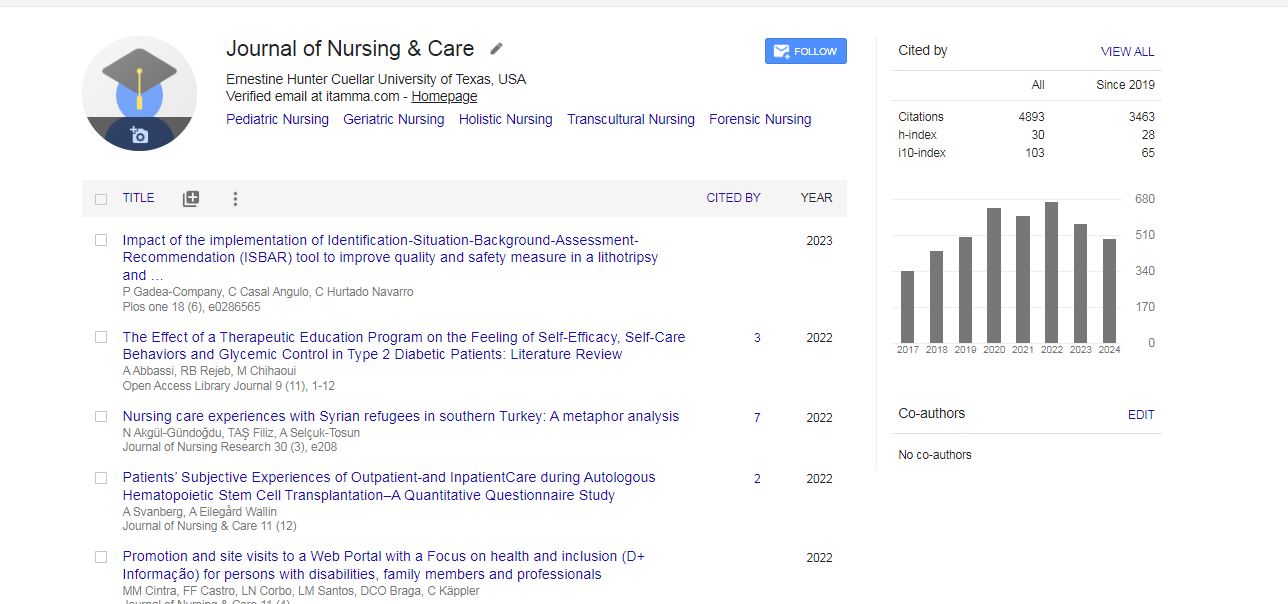
Journal of Nursing & Care received 4230 citations as per Google Scholar report