Perspective - (2025) Volume 10, Issue 6
Received: 02-Nov-2025, Manuscript No. apn-26-179356;
Editor assigned: 04-Nov-2025, Pre QC No. P-179356;
Reviewed: 16-Nov-2025, QC No. Q-179356;
Revised: 23-Nov-2025, Manuscript No. R-179356;
Published:
30-Nov-2025
, DOI: 10.37421/2573-0347.2025.10.463
Citation: Wei, Chen. âAdvanced Practice Nurses: Medication Management Expertise and Outcomes.â J Adv Practice Nurs 10 (2025):463.
Copyright: © 2025 Wei C. This is an open-access article distributed under the terms of the Creative Commons Attribution License, which permits unrestricted use, distribution
and reproduction in any medium, provided the original author and source are credited.
Advanced practice nurses (APNs) play a vital and expanding role in modern healthcare, particularly in the critical area of medication management. Their enhanced scope of practice, which includes prescriptive authority, allows them to significantly impact patient care and outcomes [1].
The ethical considerations surrounding APNs' prescriptive authority are paramount, requiring a deep understanding of accountability frameworks and robust decision-making processes to ensure patient safety and therapeutic effectiveness [2].
Furthermore, the impact of APNs' prescriptive authority extends to broader healthcare access and quality, enabling them to serve underserved populations and improve the overall efficiency of healthcare delivery [3].
However, APNs encounter various challenges and facilitators in their pursuit of safe medication prescribing, including access to information, consultation limitations, and regulatory variations that necessitate strategic solutions for improvement [4].
Understanding the legal and regulatory frameworks that govern APN prescriptive authority is crucial, as variations across jurisdictions can influence practice scope and necessitate compliance for safe medication practices [5].
Comparative studies have begun to assess the safety and effectiveness of APN prescribing, often demonstrating outcomes comparable to or even superior to physician-led prescribing, particularly in primary care settings [6].
To uphold the highest standards, the implementation of quality improvement initiatives is essential for enhancing medication practices among APNs, focusing on systems-based approaches to reduce errors and adverse events [7].
The educational preparation of APNs in medication prescribing is a foundational element, requiring robust curricula that integrate pharmacology, pharmacotherapeutics, and clinical decision-making to ensure competency [8].
Emerging technologies, such as telehealth, are also transforming APN capabilities in medication management, facilitating remote patient monitoring and improving adherence, especially for those in remote or underserved areas [9].
Looking forward, the future trajectory of advanced practice nursing points towards an expansion of prescriptive authority, with APNs poised to lead in population health initiatives and complex chronic disease management, while maintaining stringent standards of safe practice [10].
The crucial role of advanced practice nurses (APNs) in medication management is underscored by their prescriptive authority and the responsibilities associated with ensuring safe medication practices. They contribute to improved patient outcomes through evidence-based prescribing, patient education, and collaborative care models, emphasizing the importance of ongoing education and regulatory adherence [1].
Examining the evolving landscape of advanced practice nursing, this study focuses on the ethical considerations surrounding prescriptive authority. It delves into the accountability frameworks and decision-making processes APNs employ when prescribing medications, highlighting the need for robust ethical guidelines and continuous professional development to optimize patient safety and therapeutic effectiveness [2].
This review synthesizes current evidence on the impact of APNs' prescriptive authority on healthcare access and quality. It highlights how APNs expand patient access to primary and specialty care, particularly in underserved areas, and discusses strategies for enhancing safe prescribing through interprofessional collaboration and health information technology, concluding that expanded APN roles lead to improved patient outcomes and more efficient healthcare delivery [3].
This qualitative study investigates the perceptions of APNs regarding the challenges and facilitators of safe medication prescribing. Findings reveal that while APNs feel empowered by their prescriptive authority, they face barriers such as limited access to updated drug information, physician consultation limitations, and varying state regulations, suggesting enhanced continuing education, mentorship programs, and streamlined communication as solutions [4].
This research examines the legal and regulatory frameworks governing APN prescriptive authority across different jurisdictions. It analyzes variations in scope of practice, collaborative agreements, and required supervision, emphasizing the importance of understanding these legal nuances to ensure compliance and maintain safe medication practices, advocating for greater uniformity in regulations to support APNs in their prescribing roles [5].
This comparative study assesses the safety and effectiveness of medication prescribing by APNs compared to physician-led prescribing in primary care settings. The findings indicate that APNs prescribe medications safely and effectively, with comparable or even superior patient outcomes in many cases, highlighting their critical role in managing chronic conditions and promoting preventative care through appropriate medication selection and patient education [6].
Focusing on patient safety, this article examines the implementation of quality improvement initiatives to enhance medication practices among APNs. It discusses the use of prescription drug monitoring programs, medication reconciliation processes, and patient counseling strategies, emphasizing a systems-based approach to reducing medication errors and adverse drug events through continuous monitoring and feedback mechanisms [7].
This narrative review explores the educational preparation required for APNs to develop competency in safe and effective medication prescribing. It addresses the integration of pharmacology, pharmacotherapeutics, and clinical decision-making into APN curricula, advocating for standardized educational outcomes and experiential learning opportunities to equip APNs with the necessary knowledge and skills for independent and collaborative prescribing [8].
This study investigates the implementation of telehealth and its impact on APNs' ability to manage patient medications safely. It examines how virtual consultations and remote patient monitoring facilitate medication adherence, identification of adverse effects, and adjustments to treatment plans, suggesting that telehealth is a valuable tool for extending APN reach and enhancing medication management, particularly in remote or underserved populations [9].
This perspective piece discusses the future trajectory of advanced practice nursing, with a specific focus on the expansion of prescriptive authority and its implications for population health. It examines emerging trends, policy recommendations, and the potential for APNs to lead in areas such as chronic disease management, mental health, and substance use disorders, emphasizing the ongoing need for APNs to advocate for their roles and maintain the highest standards of safe and effective medication practices [10].
This collection of research highlights the expanding role and significant contributions of Advanced Practice Nurses (APNs) in medication management. APNs demonstrate expertise in evidence-based prescribing, patient education, and collaborative care, leading to improved patient outcomes. The ethical and legal frameworks governing their prescriptive authority are crucial for ensuring safe practices, with ongoing discussions about regulatory variations and the need for uniformity. Studies compare APN prescribing favorably against physician-led approaches, emphasizing their effectiveness in primary care and chronic disease management. Challenges such as access to information and varying state regulations are acknowledged, with proposed solutions including enhanced education and communication. Quality improvement initiatives, such as prescription drug monitoring and medication reconciliation, are vital for enhancing safety. The integration of telehealth and robust educational preparation are identified as key facilitators for APNs to effectively manage medications and contribute to broader population health goals.
None
None
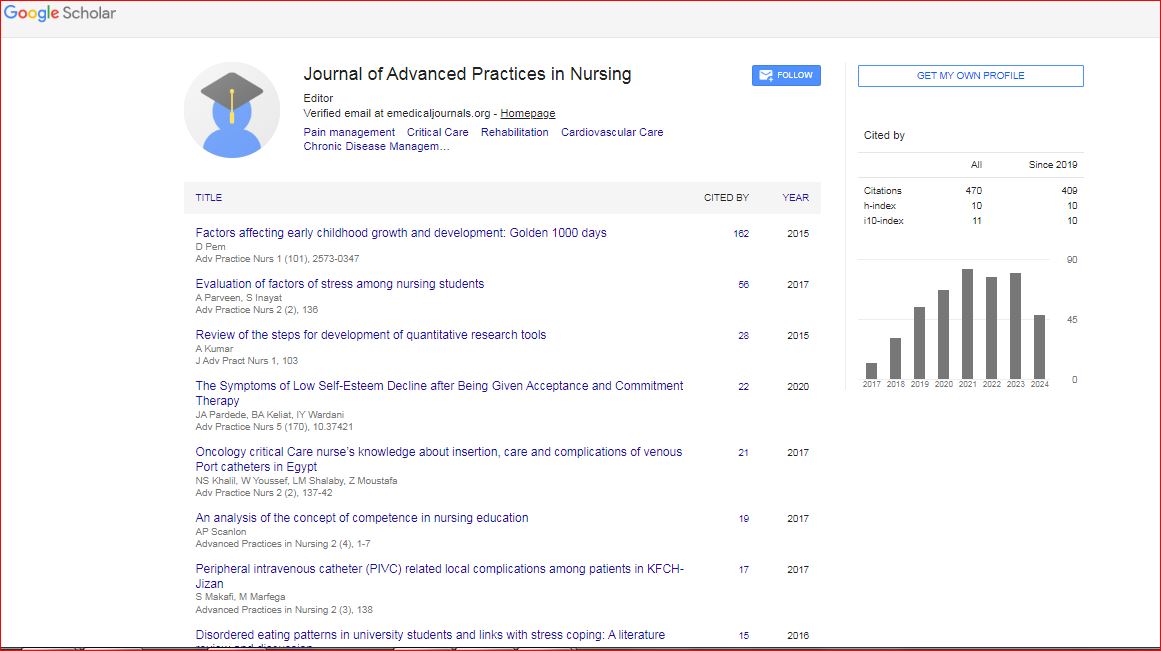
Journal of Advanced Practices in Nursing received 410 citations as per Google Scholar report