Short Communication - (2025) Volume 10, Issue 3
Received: 01-May-2025, Manuscript No. apn-26-179091;
Editor assigned: 04-May-2025, Pre QC No. P-179091;
Reviewed: 14-May-2025, QC No. Q-179091;
Revised: 21-May-2025, Manuscript No. R-179091;
Published:
28-May-2025
, DOI: 10.37421/2573-0347.2025.10.436
Citation: OâConnor, Liam. âAdvanced Practice Nurses: Leading Wound, Ostomy, Continence Care.â J Adv Practice Nurs 10 (2025):436.
Copyright: © 2025 OâConnor L. This is an open-access article distributed under the terms of the Creative Commons Attribution License, which permits unrestricted use,
distribution and reproduction in any medium, provided the original author and source are credited.
The advanced practice of wound, ostomy, and continence (WOC) nursing plays a pivotal role in comprehensive patient management, encompassing a broad spectrum of specialized care. This discipline has seen significant evolution, with WOC nurses increasingly contributing to interdisciplinary teams, patient education initiatives, and the implementation of evidence-based practices to enhance outcomes for individuals facing complex WOC needs. The current landscape of WOC nursing is characterized by evolving scopes of practice and a forward-looking perspective on future challenges and opportunities [1].
Innovations in wound care technology are continuously transforming patient management, offering novel solutions for healing and recovery. This includes the review of advanced dressings, the application of negative pressure wound therapy (NPWT), and the utilization of bioengineered skin substitutes. Advanced practice nurses are instrumental in the selection and effective use of these technologies, aiming to optimize wound healing, minimize complications, and substantially improve patients' quality of life, while also considering economic factors [2].
Nurse-led stoma care programs have demonstrated a significant positive impact on patient outcomes and overall satisfaction, underscoring the value of specialized nursing interventions. Advanced practice nurses provide expert stoma management, encompassing crucial elements such as patient education, appropriate appliance selection, and proactive prevention of potential complications. The findings consistently suggest that comprehensive and individualized stoma care profoundly enhances quality of life and reduces reliance on healthcare services [3].
The management of urinary and fecal incontinence requires sophisticated assessment techniques and tailored treatment modalities, areas where advanced practice nurses excel. They are adept at developing personalized continence management plans, integrating pharmacological, behavioral, and technological interventions. Furthermore, these nurses address the profound psychosocial impact of incontinence, employing strategies to empower patients and improve their overall well-being [4].
The integration of telehealth technologies into WOC nursing practice represents a significant advancement in healthcare delivery. This approach facilitates remote patient monitoring, virtual consultations, and digital wound assessments, thereby enhancing access to care, particularly for geographically dispersed or underserved populations. The article also critically examines the inherent challenges and outlines best practices for effective telehealth implementation in this specialized field [5].
The psychological impact of chronic wounds, stomas, and incontinence on patients' mental health is a critical consideration that requires a nuanced approach. Advanced practice nurses play an essential role in addressing these psychosocial challenges through empathetic communication, dedicated counseling, and consistent support. This emphasizes a holistic approach to patient care, where mental health considerations are seamlessly integrated into the broader WOC management strategy [6].
Complex wounds, such as pressure injuries, diabetic foot ulcers, and surgical site infections, demand specialized management strategies. Advanced assessment tools, evidence-based treatment protocols, and the leadership of advanced practice nurses in multidisciplinary wound care teams are crucial. The prevention of wound complications and the vital role of patient education are also key components discussed in this context [7].
The evolving role of advanced practice nurses in ostomy care is particularly vital in addressing challenging stoma-related issues. This includes managing peristomal skin complications, optimizing pouching system function, and addressing conditions like parastomal hernias. The need for specialized knowledge and advanced skills in ostomy management is paramount to ensuring the best possible patient outcomes and enhancing their quality of life [8].
Neurogenic bladder dysfunction, often seen in patients with spinal cord injuries or other neurological conditions, necessitates a comprehensive approach to management. Advanced practice nurses are central to implementing evidence-based interventions, including intermittent catheterization, pharmacotherapy, and considerations for surgical options, all aimed at improving bladder health and preventing complications [9].
Effective management of patients with complex wound, ostomy, and continence needs is critically dependent on interdisciplinary collaboration. Advanced practice nurses are positioned to lead and actively participate in collaborative care models, fostering seamless transitions and improved patient outcomes. This involves prioritizing clear communication, shared decision-making, and leveraging the unique expertise of each member of the healthcare team [10].
The advanced practice of wound, ostomy, and continence (WOC) nursing is fundamentally important for providing comprehensive patient care, addressing a wide range of complex health needs. This specialized field has witnessed a significant expansion in its scope, with WOC nurses now playing integral roles in interdisciplinary care settings, empowering patients through education, and championing the adoption of evidence-based practices to elevate patient outcomes. The ongoing discourse within the field highlights both current obstacles and future trajectories for WOC nursing [1].
Contemporary wound management is being revolutionized by technological advancements, offering cutting-edge solutions for chronic and complex wounds. This includes the exploration of novel wound dressings, the sophisticated application of negative pressure wound therapy (NPWT), and the use of regenerative therapies like bioengineered skin substitutes. Advanced practice nurses are indispensable in guiding the selection and implementation of these innovative technologies, aiming to accelerate wound healing, mitigate adverse events, and significantly enhance the patient's overall quality of life, while also being mindful of the economic implications of care [2].
Nurse-led stoma care initiatives have been demonstrably effective in improving patient results and satisfaction levels, underscoring the profound influence of specialized nursing interventions. Within these programs, advanced practice nurses deliver expert stoma management, which encompasses vital patient education, guidance on the selection of appropriate pouching systems, and strategic prevention of common complications. Evidence suggests that a holistic, individualized approach to stoma care markedly improves patients' quality of life and reduces the frequency of healthcare utilization [3].
Addressing the complexities of urinary and fecal incontinence requires sophisticated assessment techniques and the application of diverse treatment modalities, areas where advanced practice nurses demonstrate exceptional proficiency. They are skilled in formulating individualized continence management strategies, which may include pharmacological interventions, behavioral modifications, and the integration of technological aids. Moreover, these nurses are attuned to the substantial psychosocial burden associated with incontinence, actively employing strategies to foster patient empowerment and improve their sense of well-being [4].
The integration of telehealth into the WOC nursing domain represents a paradigm shift in how specialized care can be delivered. This innovative model enables remote patient monitoring, facilitates virtual consultations, and allows for digital assessment of wounds, thereby expanding access to essential care, particularly for individuals residing in rural or underserved regions. The article also thoroughly examines the inherent challenges associated with telehealth adoption and proposes best practices for its successful implementation within this specialized nursing practice [5].
Recognizing and addressing the profound psychological impact that chronic wounds, stomas, and incontinence can have on a patient's mental health is a critical aspect of holistic care. Advanced practice nurses are uniquely positioned to navigate these psychosocial challenges, employing empathetic communication, providing essential counseling, and offering consistent support. This underscores the necessity of a comprehensive approach to patient care, one that fully integrates mental health considerations into the framework of WOC management [6].
The management of intricate wounds, encompassing conditions such as pressure injuries, diabetic foot ulcers, and surgical site infections, necessitates a high level of clinical expertise and advanced strategies. This includes the deployment of sophisticated assessment tools, adherence to evidence-based treatment protocols, and the pivotal role of advanced practice nurses in leading multidisciplinary wound care teams. Furthermore, the proactive prevention of wound-related complications and the continuous reinforcement of patient education are emphasized as core components of effective wound management [7].
The professional landscape for advanced practice nurses in ostomy care is continuously evolving, particularly concerning the management of intricate stoma-related complications. This includes addressing issues such as peristomal skin integrity, optimizing pouching system performance, and managing conditions like parastomal hernias. The indispensable nature of specialized knowledge and advanced clinical skills in ostomy management is highlighted as crucial for achieving optimal patient outcomes and enhancing their overall quality of life [8].
Neurogenic bladder dysfunction, a condition frequently encountered in individuals with spinal cord injuries or other neurological impairments, demands a thorough and integrated management approach. Advanced practice nurses are at the forefront of implementing evidence-based interventions, which may range from intermittent catheterization and pharmacotherapy to surgical considerations, all designed to enhance bladder function and prevent potentially serious complications [9].
Effective management of patients facing complex wound, ostomy, and continence issues is inextricably linked to robust interdisciplinary collaboration. Advanced practice nurses are vital in initiating and sustaining collaborative care models, ensuring that patient care is coordinated, seamless, and leads to superior outcomes. This collaborative process hinges on open communication, mutual decision-making, and the optimal utilization of each healthcare team member's unique expertise and contributions [10].
This compilation of research highlights the critical and evolving role of advanced practice nurses (APNs) in wound, ostomy, and continence (WOC) care. APNs are instrumental in implementing evidence-based practices, utilizing innovative technologies like NPWT and bioengineered skin substitutes, and leading specialized programs for stoma and incontinence management. The articles emphasize the importance of patient education, psychosocial support, and interdisciplinary collaboration to improve patient outcomes and quality of life. Telehealth is presented as a key tool for expanding access to WOC nursing services, while the management of complex wounds and neurogenic bladder dysfunction requires specialized APN expertise. Overall, these studies underscore the indispensable contribution of APNs in addressing the multifaceted needs of individuals with WOC conditions.
None
None
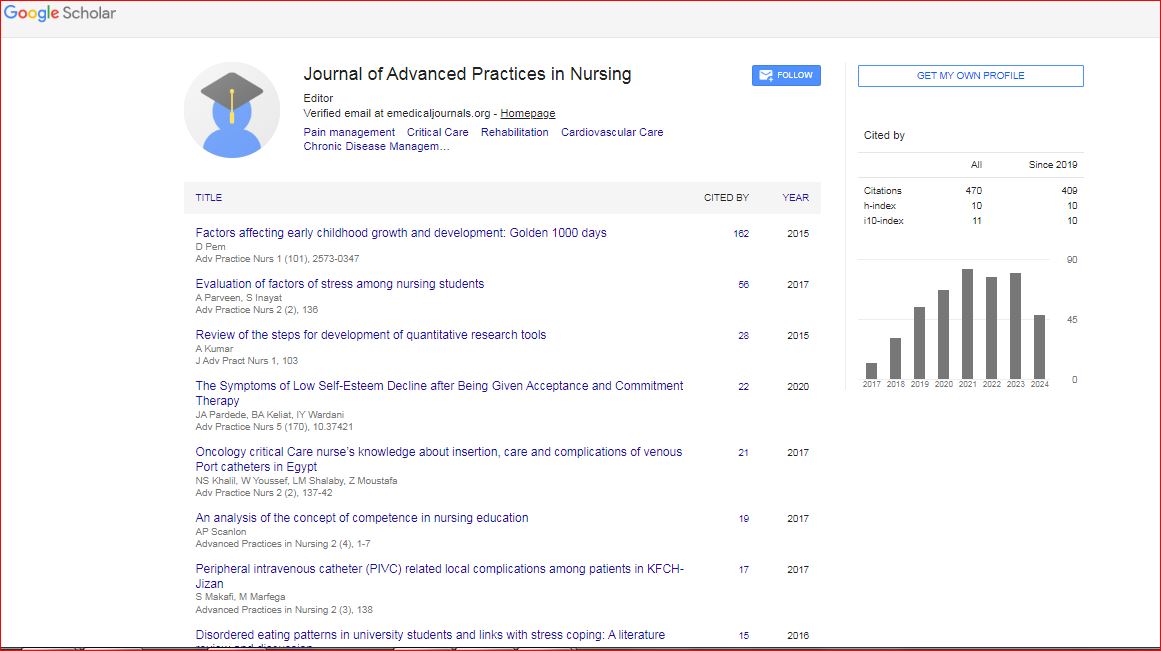
Journal of Advanced Practices in Nursing received 410 citations as per Google Scholar report