Brief Report - (2025) Volume 11, Issue 2
Received: 01-Apr-2025, Manuscript No. jssc-26-188252;
Editor assigned: 03-Apr-2025, Pre QC No. P-188252;
Reviewed: 17-Apr-2025, QC No. Q-188252;
Revised: 22-Apr-2025, Manuscript No. R-188252;
Published:
29-Apr-2025
, DOI: 10.37421/2472-0437.2025.11.287
Citation: Carter, Emily. "Advanced Optimization Techniques for
Steel Structures." J Steel Struct Constr 11 (2025):287.
Copyright: © 2025 Carter E. This is an open-access article distributed under the terms of the Creative Commons Attribution License, which permits unrestricted use, distribution
and reproduction in any medium, provided the original author and source are credited.
The field of structural engineering is continuously evolving, driven by the need for more efficient, sustainable, and resilient construction solutions. Contemporary construction projects demand innovative approaches to material utilization and structural design. One area of significant focus is the optimization of steel structures, which form the backbone of many modern buildings and infrastructure. Advanced techniques are being developed to push the boundaries of what is possible with steel, ensuring that structures not only meet current demands but are also prepared for future challenges.
This exploration delves into the cutting-edge advancements shaping the design of steel structures today. Computational methods and performance-based design paradigms are at the forefront, enabling engineers to achieve unprecedented levels of efficiency and safety. The integration of these advanced methodologies allows for a more nuanced understanding of structural behavior under various conditions, leading to optimized material usage and enhanced overall performance. Key insights highlight the practical application of these techniques in real-world scenarios. Material selection and optimization are critical components in achieving the desired structural properties. The use of advanced steel alloys, coupled with intelligent material selection strategies, plays a pivotal role in enhancing structural integrity and seismic resilience. This ensures that steel structures can withstand significant loads and extreme events, providing a higher degree of safety for occupants and the surrounding environment. The balance between cost-effectiveness and performance is a central theme in these developments. In parallel, the integration of artificial intelligence and machine learning is revolutionizing the way steel building components are designed and fabricated. Predictive modeling and generative design approaches are enabling the minimization of material waste and the creation of novel, highly efficient structural forms. The focus on practical implementation and scalability in large-scale construction projects underscores the immediate impact of these technologies on the industry. Furthermore, multi-objective optimization frameworks are being developed to address the complex interplay of economic, environmental, and structural performance criteria. By integrating life cycle assessment with structural analysis, designers can make informed decisions that lead to more sustainable and cost-effective steel structures without compromising safety. The validation of these methodologies through case studies demonstrates their practical applicability. Optimizing the connections within steel structures is another crucial area of research. These critical elements significantly influence the overall performance and efficiency of a building. Innovative connection designs that enhance ductility and load-carrying capacity, while also simplifying fabrication and erection, are being developed and validated through advanced analysis and testing. Seismic optimization of tall steel buildings using performance-based design principles is paramount, especially in seismically active regions. Strategies focusing on the optimal placement and sizing of structural elements and bracing systems are crucial for achieving target performance objectives under earthquake loads. This leads to the creation of safer and more robust steel structures. Beyond the primary structural elements, the optimization of steel building envelopes is gaining attention. The interplay between cladding systems, insulation, and the underlying steel frame can significantly impact thermal performance and structural integrity, leading to more energy-efficient and comfortable buildings. The resilience of steel structures under extreme conditions, such as fire, is also a key consideration. Research into fire-resistant coatings and optimized structural configurations ensures adequate safety during fire events, enhancing the overall fire performance of steel buildings. Finally, the concept of digital twins for the continuous optimization of steel structures throughout their lifecycle offers a revolutionary approach. Real-time data monitoring and design adjustments powered by digital twins can enhance performance and longevity, transforming maintenance and upgrade strategies for modern steel buildings.The contemporary construction landscape is witnessing a profound transformation in the optimization of steel structures, driven by the pursuit of enhanced material efficiency, structural integrity, and resilience. Advanced computational methods and performance-based design principles are central to this evolution, enabling engineers to achieve superior outcomes. The integration of techniques such as topology optimization and the strategic selection of advanced steel alloys are highlighted as key strategies for balancing cost-effectiveness with sustainability and safety in modern steel structural design.
Artificial intelligence and machine learning algorithms are emerging as powerful tools for real-time optimization of steel building components. These technologies facilitate the minimization of material waste and the enhancement of fabrication processes through predictive modeling. Moreover, generative design approaches are revealing potential for novel and highly efficient structural forms that might otherwise be overlooked, with a strong emphasis on practical implementation and scalability in large construction projects. Multi-objective optimization for steel frames considers a holistic approach, balancing economic, environmental, and structural performance criteria. The introduction of frameworks that integrate life cycle assessment with structural analysis guides design decisions towards more sustainable and cost-effective solutions without compromising safety. The validation of these methodologies through diverse case studies confirms their broad applicability in modern building typologies. The optimization of connections in steel structures is crucial for their overall performance and efficiency. Research is focusing on innovative connection designs that not only improve ductility and load-carrying capacity but also simplify fabrication and erection processes. The use of advanced finite element analysis and experimental testing ensures the reliability and resilience of these optimized connection details. In the realm of seismic design, performance-based design principles are guiding the optimization of tall steel buildings. Strategies aimed at achieving specific performance objectives under seismic loads involve the precise placement and sizing of structural elements and bracing systems. This research contributes valuable insights into creating safer and more robust steel structures for seismically prone regions. The optimization of steel building envelopes is a critical aspect of modern sustainable design. By considering the interaction between cladding systems, insulation, and the underlying steel frame, it is possible to enhance thermal performance and structural integrity, leading to reduced energy consumption and improved occupant comfort. The aim is to foster more integrated and efficient building designs. Ensuring the fire performance of steel structures is paramount for safety. Research in this area focuses on the development and application of fire-resistant coatings and optimized structural configurations. Advanced thermal and structural analysis techniques are employed to refine material usage and design strategies, thereby improving the fire resilience of steel buildings. Furthermore, the application of advanced simulation tools is proving instrumental in the design optimization of steel bridges. Studies examine aerodynamic stability, fatigue life, and material efficiency, demonstrating how computational fluid dynamics and structural simulations can lead to lighter, stronger, and more durable bridge structures essential for modern infrastructure. The integration of sustainable design principles with structural optimization is a growing trend. This involves exploring the use of recycled steel and methods for reducing embodied carbon. Methodologies for optimizing material quantities and selecting materials with lower environmental impact are being developed to promote greener construction practices within the steel sector. Lastly, the concept of digital twins offers a transformative approach to the continuous optimization of steel structures throughout their lifecycle. By leveraging real-time sensor data for structural health monitoring and informing design adjustments, digital twins have the potential to significantly enhance performance and longevity, revolutionizing maintenance and upgrade strategies for steel buildings.This collection of research explores advanced optimization techniques for steel structures in modern construction. Key themes include the integration of computational methods, performance-based design, and artificial intelligence to enhance material efficiency, structural integrity, and seismic resilience. Studies cover multi-objective optimization balancing economic and environmental factors, optimizing connections for improved performance, and enhancing fire and thermal performance of steel building envelopes. The use of advanced steel alloys, generative design, and digital twin technology for lifecycle optimization are also discussed, aiming for safer, more sustainable, and cost-effective steel structures.
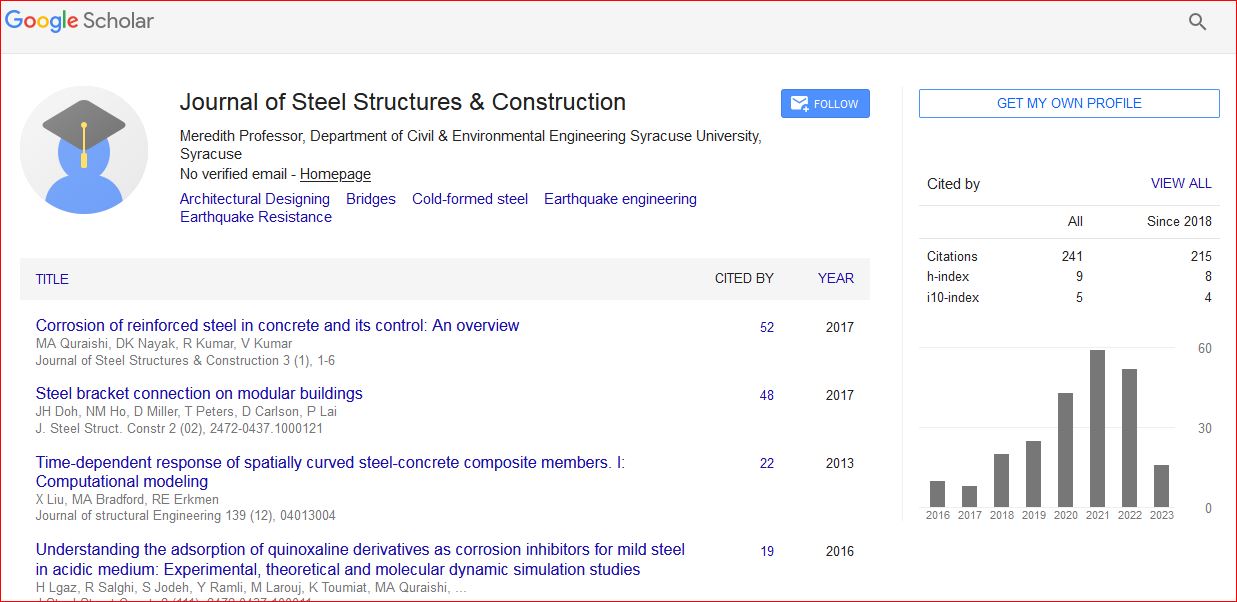
Journal of Steel Structures & Construction received 583 citations as per Google Scholar report