Opinion - (2025) Volume 10, Issue 5
Received: 01-Sep-2025, Manuscript No. apn-26-179330;
Editor assigned: 03-Sep-2025, Pre QC No. P-179330;
Reviewed: 14-Sep-2025, QC No. Q-179330;
Revised: 22-Sep-2025, Manuscript No. R-179330;
Published:
29-Sep-2025
, DOI: 10.37421/2573-0347.2025.10.450
Citation: Grant, Oliver. âAdvanced Nursing Assessment: Integrating Factors and Technology.â J Adv Practice Nurs 10 (2025):450.
Copyright: © 2025 Grant O. This is an open-access article distributed under the terms of the Creative Commons Attribution License, which permits unrestricted use, distribution
and reproduction in any medium, provided the original author and source are credited.
The field of advanced nursing practice is fundamentally shaped by the depth and breadth of patient assessment, a cornerstone for effective care delivery. Advanced practice nurses (APNs) employ a multifaceted approach, integrating physical, psychosocial, and cultural dimensions to guide their clinical decisions and enhance patient outcomes. This holistic perspective is crucial for navigating the complexities of modern healthcare and ensuring individualized care [1].
The integration of technology has significantly transformed the landscape of patient assessment, with tools such as telehealth and electronic health records (EHRs) offering new avenues for data collection, communication, and remote monitoring. These advancements aim to improve efficiency and patient access, though challenges related to adoption and training persist [2].
Beyond the technical aspects, the human element of assessment remains paramount. Qualitative explorations into the experiences of APNs reveal the critical importance of building therapeutic relationships, practicing active listening, and embodying cultural humility to elicit sensitive and accurate information. These interpersonal skills are vital for understanding the intricate factors influencing patient well-being [3].
A rapidly evolving area within patient assessment is the incorporation of genomics. Understanding genetic information allows APNs to better stratify risk, develop personalized treatment plans, and implement preventative strategies. This necessitates ongoing education and careful consideration of ethical implications as the field expands [4].
At the heart of effective patient assessment lies critical thinking. APNs must synthesize diverse data, identify subtle changes, and formulate differential diagnoses through robust clinical reasoning. Continuous professional development is key to honing these essential skills, ensuring assessment is an active and dynamic process [5].
Patients with chronic conditions present unique assessment challenges, requiring a longitudinal approach to identify comorbidities and manage complex symptom profiles. APNs play a vital role in coordinating care and empowering patients in self-management, emphasizing a long-term perspective in patient care [6].
Cultural competence is an indispensable component of accurate and effective patient assessment. APNs who understand diverse patient beliefs, values, and health practices can improve patient satisfaction and treatment adherence, underscoring the significance of culturally informed care [7].
Mental health assessment within advanced nursing practice demands specialized skills and awareness of unique challenges. Employing standardized tools and therapeutic communication, APNs adopt a biopsychosocial approach to evaluate psychiatric conditions and guide interventions, crucial for comprehensive patient care [8].
The integration of evidence-based practice (EBP) into patient assessment empowers APNs to refine their strategies, select appropriate tools, and interpret findings effectively. Staying current with research and applying it clinically ensures the delivery of optimal patient care, leveraging the best available knowledge [9].
Ethical considerations are integral to comprehensive patient assessment. Issues of patient autonomy, informed consent, confidentiality, and potential bias must be addressed with a patient-centered approach that upholds individual rights and fosters trust. Ethical practice is a non-negotiable aspect of advanced nursing care [10].
The foundational aspect of advanced nursing practice is the comprehensive patient assessment, which enables APNs to deliver high-quality care. This process involves a holistic evaluation, considering physical, psychosocial, and cultural factors to inform clinical decisions and optimize patient outcomes. The ability to interpret complex data and apply evidence-based practices is central to this role, with an ongoing evolution incorporating new technologies and interprofessional collaboration [1].
Technological advancements have significantly influenced patient assessment practices in advanced nursing. The adoption of telehealth and electronic health records (EHRs) facilitates enhanced data collection, streamlined communication, and effective remote patient monitoring. While these tools offer benefits in efficiency and accessibility, addressing challenges related to their implementation and ensuring adequate training are critical for their successful integration into advanced practice settings [2].
Qualitative research highlights that the humanistic aspects of care are integral to comprehensive psychosocial assessments. Advanced practice nurses develop therapeutic relationships, employ active listening, and practice cultural humility to gather accurate and sensitive patient information. These skills are essential for understanding the complex interplay of factors affecting patient well-being and for navigating challenging assessment scenarios [3].
The increasing relevance of genomics in patient care necessitates its integration into routine assessments by APNs. Understanding an individual's genetic makeup can inform risk stratification, personalize treatment plans, and guide preventative healthcare strategies. This growing field requires APNs to possess specialized knowledge and address associated ethical considerations [4].
Critical thinking is an indispensable skill for advanced practice nurses conducting comprehensive patient assessments. The ability to synthesize diverse data sources, recognize subtle patient changes, and formulate accurate differential diagnoses relies on sophisticated clinical reasoning. Continuous professional development is key to refining these cognitive processes, ensuring that assessment is an active and insightful endeavor [5].
Assessing patients with chronic conditions presents a unique set of complexities that advanced nursing practice must address. This involves a longitudinal perspective, focusing on the identification of comorbidities and the management of multifaceted symptom profiles. Strategies to promote patient self-management and effective care coordination are crucial for long-term well-being [6].
Cultural competence plays a pivotal role in ensuring the accuracy and effectiveness of patient assessments. Advanced practice nurses must possess a deep understanding of patients' diverse beliefs, values, and health practices to conduct assessments that are both sensitive and relevant. Culturally informed care directly impacts patient satisfaction and adherence to treatment plans [7].
Comprehensive mental health assessments are a critical function of advanced practice nurses. This domain requires specialized knowledge to evaluate psychiatric conditions effectively, utilizing standardized screening tools and adept therapeutic communication techniques. A biopsychosocial approach is fundamental to addressing mental health needs holistically [8].
The integration of evidence-based practice (EBP) is essential for advanced practice nurses to conduct rigorous patient assessments. By applying EBP, APNs can enhance their assessment strategies, select appropriate diagnostic tools, and interpret findings with greater precision. This commitment to using current research ensures the delivery of the highest standard of patient care [9].
Ethical considerations are interwoven throughout the process of comprehensive patient assessment. Advanced practice nurses must navigate issues such as patient autonomy, informed consent, confidentiality, and the potential for implicit bias. A patient-centered approach that prioritizes respect for individual rights and cultivates trust is paramount in ethical advanced nursing practice [10].
Advanced nursing practice relies heavily on comprehensive patient assessment, integrating physical, psychosocial, and cultural factors for optimal outcomes. Technology, such as telehealth and EHRs, is enhancing data collection and communication, though challenges in adoption remain. The human element, including therapeutic relationships and cultural humility, is crucial for sensitive and accurate assessments. Genomics is emerging as a vital area, informing personalized care and risk stratification, while critical thinking skills are essential for synthesizing data and differential diagnoses. Managing chronic conditions requires a longitudinal approach and patient engagement. Cultural competence improves assessment accuracy and patient adherence. Mental health assessments demand specialized skills and a biopsychosocial framework. Evidence-based practice guides assessment strategies for effective care, and ethical considerations, including patient autonomy and confidentiality, are paramount in all aspects of assessment.
None
None
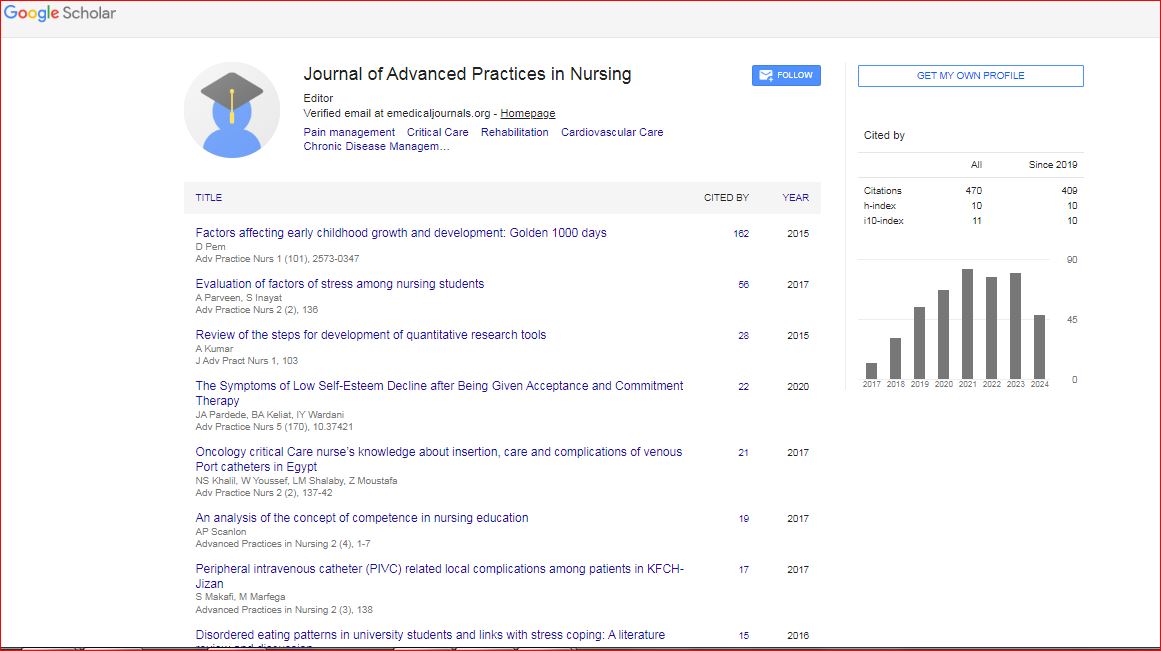
Journal of Advanced Practices in Nursing received 410 citations as per Google Scholar report