Opinion - (2025) Volume 9, Issue 6
Received: 01-Nov-2025, Manuscript No. fsb-26-189974;
Editor assigned: 03-Nov-2025, Pre QC No. P-189974;
Reviewed: 17-Nov-2025, QC No. Q-189974;
Revised: 23-Nov-2025, Manuscript No. R-189974;
Published:
29-Nov-2025
, DOI: 10.37421/2577-0543.2025.9.260
Citation: Muller, Thomas. ”Advanced Nanodrug Delivery for Poorly Soluble Drugs.” J. Formul. Sci. Bioavailability 09 (2025):260.
Copyright: © 2025 Muller T. This is an open-access article distributed under the terms of the Creative Commons Attribution License, which permits unrestricted use, distribution and reproduction in any medium, provided the original author and source are credited.
The enhancement of oral bioavailability for poorly soluble drugs remains a significant challenge in pharmaceutical formulation and development. Various sophisticated strategies have been developed to overcome these limitations, leveraging advanced drug delivery systems. Micellar and vesicular systems, including liposomes and solid lipid nanoparticles, represent promising avenues for improving the solubility and absorption of such compounds, thereby increasing their therapeutic efficacy [1].
Liposomes, in particular, have emerged as versatile nanocarriers capable of encapsulating both hydrophilic and hydrophobic drugs. Their unique structure allows them to protect the encapsulated drug from degradation in the biological environment and to facilitate its passage across biological membranes, leading to improved bioavailability and therapeutic outcomes for hydrophobic drugs [2].
Solid lipid nanoparticles (SLNs) are another class of lipid-based nanocarriers that have shown considerable promise for oral drug delivery. These systems are designed to protect drugs from degradation within the gastrointestinal tract and to enhance their absorption, thereby increasing systemic availability. The careful selection of formulation parameters is crucial for optimizing SLN performance [3].
Micellar solubilization, a well-established technique, utilizes surfactants to form micelles that can encapsulate hydrophobic drug molecules. This process significantly increases the apparent solubility of poorly soluble drugs in aqueous media, making them amenable to oral administration and improving their bioavailability. The choice of surfactant and micelle characteristics are key factors [4].
Niosomes, which are non-ionic surfactant vesicles, offer an alternative to liposomes for enhancing the oral bioavailability of poorly soluble drugs. These systems are characterized by improved drug loading, stability, and controlled release properties, which contribute to a substantial increase in bioavailability compared to conventional formulations [5].
Nanoemulsions have also demonstrated their potential as effective carriers for lipophilic drugs, improving their oral bioavailability. By forming fine oil-in-water emulsions, nanoemulsions provide a large surface area for drug dissolution and can promote lymphatic uptake, bypassing the first-pass metabolism and enhancing systemic absorption [6].
Polymeric micelles, formed by the self-assembly of block copolymers, are gaining attention for their ability to enhance the bioavailability of poorly soluble drugs. These nanostructures can effectively encapsulate drugs, offering controlled release and improved stability, which are critical for successful drug delivery [7].
Transfersomes, a type of ultradeformable liposomal vesicle, are being investigated for their capability to traverse biological barriers more effectively. Their inherent deformability allows them to pass through tight junctions and enhance drug absorption, leading to improved therapeutic efficacy and oral bioavailability [8].
Nanostructured lipid carriers (NLCs) represent a second-generation lipid nanoparticle system designed to address some of the limitations of SLNs. NLCs offer enhanced drug loading capacity and improved stability, which are crucial for achieving better oral bioavailability of poorly soluble drugs through improved formulation characteristics [9].
Self-emulsifying drug delivery systems (SEDDS) are liquid formulations that spontaneously form fine oil-in-water emulsions upon contact with gastrointestinal fluids. This rapid emulsification process facilitates drug dissolution and absorption, making SEDDS a powerful tool for enhancing the oral bioavailability of lipophilic drugs by promoting their efficient delivery [10].
Micellar and vesicular systems are at the forefront of strategies to improve the bioavailability of poorly soluble drugs. These advanced delivery platforms are designed to protect drugs from degradation, enhance their solubility, and facilitate absorption across biological membranes, paving the way for more effective oral and parenteral administration [1].
The intrinsic properties of liposomes make them exceptionally well-suited for delivering hydrophobic drugs. Their lipid bilayer structure can encapsulate drugs within the aqueous core or lipid matrix, protecting them from enzymatic degradation and premature clearance. This encapsulation strategy significantly improves the bioavailability of drugs that are otherwise poorly absorbed [2].
Solid lipid nanoparticles (SLNs) offer a robust matrix for encapsulating drugs, providing protection from the harsh environment of the gastrointestinal tract. The lipid matrix of SLNs can be designed to control the release of the encapsulated drug, ensuring sustained therapeutic levels and improved oral absorption, thereby enhancing systemic availability [3].
Micellar solubilization leverages the amphiphilic nature of surfactants to create micelles, which are colloidal aggregates with a hydrophobic core. This core can effectively solubilize lipophilic drug molecules, dramatically increasing their solubility in aqueous media and facilitating their absorption through the intestinal epithelium [4].
Niosomes, formed from non-ionic surfactants, present a stable and versatile vesicular system for drug delivery. Their ability to encapsulate a wide range of drugs and their favorable interactions with biological membranes contribute to enhanced drug loading and improved oral bioavailability, offering a viable alternative to liposomes [5].
Nanoemulsions are thermodynamically stable or kinetically stable dispersions of oil and water stabilized by surfactants. Their extremely small droplet size (<200 nm) allows for increased surface area, leading to faster drug dissolution and absorption. Furthermore, nanoemulsions can influence drug distribution and metabolism, improving oral bioavailability [6].
Polymeric micelles, self-assembled from amphiphilic block copolymers, possess unique characteristics that make them attractive for drug delivery. They offer excellent drug loading capacities, tunable drug release profiles, and stability in physiological fluids, all of which are critical for enhancing the bioavailability of challenging drug molecules [7].
Transfersomes are a unique class of vesicular carriers distinguished by their extreme deformability. This allows them to undergo significant structural changes and squeeze through narrow biological pores and tight junctions in biological membranes, leading to greatly enhanced permeation and oral absorption of entrapped drugs [8].
Nanostructured lipid carriers (NLCs) are designed to improve upon the properties of SLNs by incorporating a blend of solid and liquid lipids. This structural modification allows for higher drug entrapment efficiency and reduced drug expulsion during storage, ultimately leading to superior oral bioavailability compared to first-generation lipid nanoparticles [9].
Self-emulsifying drug delivery systems (SEDDS) are isotropic mixtures that spontaneously form fine oil-in-water emulsions or microemulsions upon gentle agitation in aqueous media. This rapid and spontaneous emulsification process ensures that the drug is presented in a readily absorbable form, significantly boosting its oral bioavailability, especially for lipophilic compounds [10].
This collection of research highlights various advanced drug delivery systems for enhancing the oral bioavailability of poorly soluble and lipophilic drugs. Micellar and vesicular systems, including liposomes, solid lipid nanoparticles, niosomes, polymeric micelles, and transfersomes, are explored for their ability to improve drug solubility, protect against degradation, and facilitate absorption across biological membranes. Nanoemulsions and self-emulsifying drug delivery systems (SEDDS) also demonstrate significant potential by promoting rapid drug dissolution and absorption. The common theme across these studies is the optimization of formulation parameters to achieve enhanced systemic availability and therapeutic efficacy of challenging drug molecules.
None
None
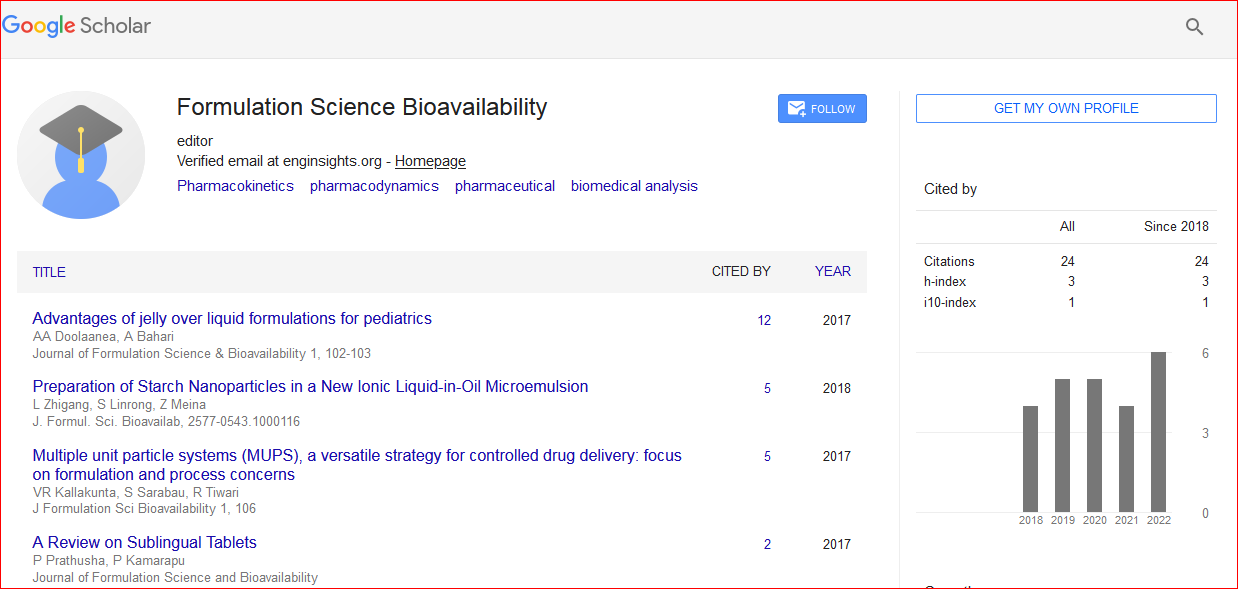
Journal of Formulation Science & Bioavailability received 23 citations as per Google Scholar report