Brief Report - (2025) Volume 14, Issue 2
Received: 01-Apr-2025, Manuscript No. idse-26-182757;
Editor assigned: 03-Apr-2025, Pre QC No. P-182757;
Reviewed: 17-Apr-2025, QC No. Q-182757;
Revised: 22-Apr-2025, Manuscript No. R-182757;
Published:
29-Apr-2025
, DOI: 10.37421/2168-9768.2025.14.477
Citation: Santos, Fernando. "Advanced Irrigation and Drainage
for Sustainable Agriculture." Irrigat Drainage Sys Eng 14 (2025):467.
Copyright: © 2025 Santos F. This is an open-access article distributed under the terms of the Creative Commons Attribution License, which permits unrestricted use,
distribution and reproduction in any medium, provided the original author and source are credited.
The intricate field of irrigation and drainage systems engineering plays a pivotal role in modern agriculture, directly influencing both crop yields and the long-term viability of our natural resources. Optimizing agricultural productivity while simultaneously ensuring environmental sustainability are the twin pillars upon which effective water management in agriculture rests. Advanced water management techniques are essential for maximizing the benefits derived from limited water supplies, ensuring that every drop contributes to crop growth and minimizing waste. Efficient conveyance and distribution strategies are also critical, as they dictate how water is delivered to the fields, minimizing losses during transit and ensuring uniform application. Furthermore, the design considerations for effective drainage are paramount to prevent detrimental conditions such as waterlogging and soil salinization, which can severely impair soil health and crop productivity.
The integration of modern technologies for monitoring and control is increasingly vital, allowing for real-time adjustments and data-driven decision-making to further enhance efficiency. These well-designed systems offer significant economic benefits by increasing yields and reducing input costs, while also providing substantial ecological benefits by conserving water resources and protecting soil and water quality. The engineering design and management of agricultural drainage systems represent a crucial aspect of this broader picture, focusing on the technical solutions needed to manage excess water. Understanding the complex hydrological processes at play, coupled with a deep knowledge of soil properties and specific crop water requirements, forms the foundation for developing effective drainage strategies. Innovative approaches to both subsurface and surface drainage are continually being explored, with a strong emphasis on cost-effectiveness and minimizing environmental impact, leading to practical guidelines for engineers. Water use efficiency in agricultural irrigation is a central theme, and a review of modern irrigation technologies reveals a spectrum of methods, each with its own advantages and disadvantages. Evaluating the performance of systems like drip, sprinkler, and center pivot in terms of water use efficiency, energy consumption, and crop yield allows for informed choices. The integration of sensor-based irrigation scheduling and automation offers a pathway to further optimize water application, leading to significant water savings and reduced environmental stress, a key objective in water-scarce regions. The hydrological impacts of large-scale irrigation projects on downstream ecosystems are a significant concern that requires careful consideration and management. Analyzing changes in water flow, sediment transport, and water quality resulting from infrastructure like dams and irrigation canals is essential for understanding the broader environmental footprint. Integrated watershed management and the implementation of environmental flow requirements are crucial for mitigating negative consequences and ensuring the ecological health of river systems. Comparative analysis of different irrigation scheduling methods, particularly those based on soil moisture monitoring, highlights significant improvements in water use efficiency. Evaluating time-based, crop-based, and soil moisture-based approaches reveals the superiority of the latter for precision agriculture, reducing yield losses and optimizing water application. The design and performance of subsurface drainage systems are particularly important for salinity control and yield improvement in arid and semi-arid regions. Examining the impact of drain spacing, depth, and material is key to developing effective salt removal and water table control strategies. This provides practical insights for designing efficient and cost-effective systems to reclaim saline soils, a widespread challenge in many agricultural areas. The integration of advanced technologies like remote sensing and Geographic Information Systems (GIS) offers powerful tools for monitoring and managing irrigation systems. Utilizing satellite imagery and aerial surveys to assess crop water stress, irrigation uniformity, and water resource distribution enhances efficiency and supports informed decision-making. The application of these technologies is transforming how irrigation systems are managed, allowing for more precise and responsive operations. Water harvesting techniques for supplemental irrigation in rainfed agricultural systems present an opportunity to enhance productivity in water-scarce environments. Analyzing the potential of methods like contour bunds, micro-catchments, and small dams to conserve soil moisture and boost crop yields provides valuable guidance for selecting appropriate strategies based on local conditions. The environmental impacts of agricultural drainage water quality are a critical area of research, focusing on nutrient and pesticide loads. Understanding the fate and transport of these pollutants in receiving water bodies and their effects on aquatic ecosystems informs the development of best management practices. Mitigation strategies such as constructed wetlands and buffer strips are vital for improving water quality. Finally, the economic evaluation of different irrigation technologies for smallholder farmers in developing countries is essential for sustainable agricultural development. Assessing the cost-benefit ratios of adopting various technologies, such as treadle pumps and solar-powered systems, alongside socio-economic considerations and financial support, is crucial for enhancing adoption and improving livelihoods.The fundamental principles and practical applications of irrigation and drainage systems engineering are comprehensively explored, emphasizing their critical role in optimizing agricultural productivity and ensuring environmental sustainability. Key insights encompass advanced water management techniques designed to maximize water use efficiency, alongside efficient conveyance and distribution strategies that minimize losses during transport. The design considerations for effective drainage are highlighted as crucial for preventing waterlogging and soil salinization, thereby preserving soil health. Furthermore, the integration of modern technologies for monitoring and control is discussed, underscoring the economic and ecological benefits associated with well-designed systems.
The engineering design and management of agricultural drainage systems are examined in detail, with a focus on understanding hydrological processes, soil properties, and crop water requirements to develop effective solutions. The research showcases innovative approaches to both subsurface and surface drainage, considering factors such as cost-effectiveness and environmental impact, ultimately providing practical guidelines for engineers. A significant portion of the discussion revolves around water use efficiency in agricultural irrigation, reviewing a range of modern technologies. This includes an evaluation of drip, sprinkler, and center pivot systems based on their water use efficiency, energy consumption, and impact on crop yield. The integration of sensor-based irrigation scheduling and automation is presented as a method to further optimize water application, leading to substantial water savings and reduced environmental stress. The hydrological impacts of large-scale irrigation projects on downstream ecosystems are investigated, analyzing changes in water flow, sediment transport, and water quality. This necessitates integrated watershed management and the implementation of environmental flow requirements to mitigate negative consequences and maintain the ecological health of river systems. A comparative analysis of different irrigation scheduling methods, particularly those utilizing soil moisture monitoring, demonstrates a significant improvement in water use efficiency and a reduction in yield losses, highlighting their value for precision agriculture. The design and performance of subsurface drainage systems are explored in the context of reducing soil salinity and improving crop yields in arid and semi-arid regions. Factors such as drain spacing, depth, and material are examined to assess their impact on salt removal and water table control, offering practical insights for efficient and cost-effective system design to reclaim saline soils. The integration of remote sensing and Geographic Information Systems (GIS) for monitoring and managing irrigation systems is discussed, outlining how satellite imagery and aerial surveys can assess crop water stress, irrigation uniformity, and water resource distribution. These technologies are shown to enhance irrigation efficiency and support informed decision-making for water resource managers. Water harvesting techniques for supplemental irrigation in rainfed agricultural systems are analyzed for their potential to conserve soil moisture and enhance crop productivity in water-scarce environments. Guidance is provided on selecting appropriate strategies, such as contour bunds and micro-catchments, based on local climatic and topographical conditions. The environmental impacts of agricultural drainage water quality are examined, focusing on pollutant loads, including nutrients and pesticides. The fate and transport of these pollutants in receiving water bodies and their effects on aquatic ecosystems are discussed, emphasizing the importance of best management practices like constructed wetlands and buffer strips for pollution mitigation. Finally, the economic evaluation of different irrigation technologies for smallholder farmers in developing countries is undertaken, assessing cost-benefit ratios of adopting systems like treadle pumps and solar-powered pumps. The study emphasizes the importance of local socio-economic conditions and the provision of appropriate financial support and training to enhance technology adoption and improve agricultural livelihoods.This collection of research highlights the critical importance of advanced irrigation and drainage systems for sustainable agriculture. Key themes include optimizing water management through efficient conveyance, distribution, and advanced techniques to boost agricultural productivity while safeguarding environmental health. Drainage systems are crucial for preventing waterlogging and salinization, with innovative designs and management strategies focusing on hydrological processes and soil properties. Modern irrigation technologies, such as drip and sprinkler systems, are evaluated for their water use efficiency, with soil moisture monitoring and sensor-based automation showing significant promise for precision agriculture. The environmental impacts of irrigation projects on downstream ecosystems and the quality of agricultural drainage water are examined, emphasizing the need for integrated watershed management and best practices for pollution mitigation. Water harvesting techniques offer supplemental irrigation solutions for rainfed agriculture, while economic evaluations of technologies for smallholder farmers underscore the importance of context-specific adoption strategies.
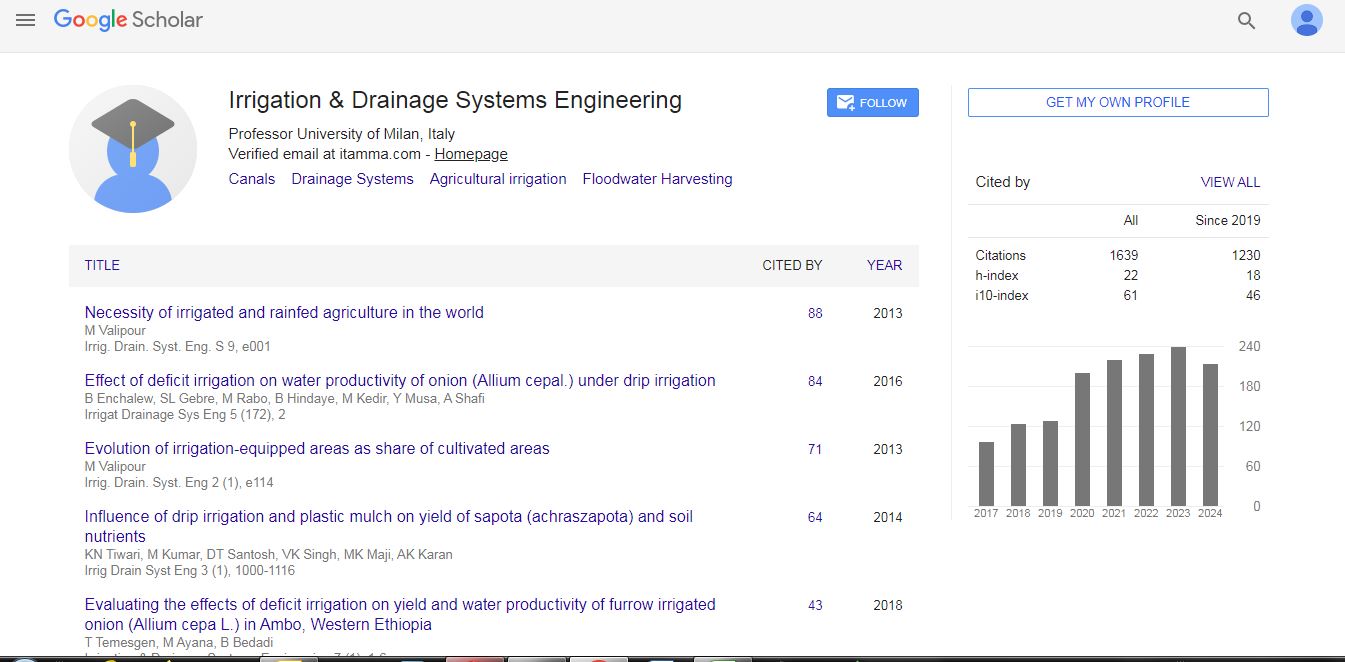
Irrigation & Drainage Systems Engineering received 835 citations as per Google Scholar report