Opinion - (2025) Volume 14, Issue 2
Received: 01-Apr-2025, Manuscript No. jsp-26-182234;
Editor assigned: 03-Apr-2025, Pre QC No. P-182234;
Reviewed: 17-Apr-2025, QC No. Q-182234;
Revised: 22-Apr-2025, Manuscript No. R-182234;
Published:
29-Apr-2025
, DOI: 10.37421/2165-7939.2025.14.713
Citation: Anderson, Michael J.. ”Advanced Imaging: Guiding Spinal Stenosis Diagnosis and Outcomes.” J Spine 14 (2025):713.
Copyright: © 2025 Anderson J. Michael This is an open-access article distributed under the terms of the Creative Commons Attribution License, which permits unrestricted use, distribution and reproduction in any medium, provided the original author and source are credited.
Spinal stenosis, a condition characterized by the narrowing of the spinal canal, presents a significant clinical challenge, necessitating a comprehensive approach to diagnosis and management. The critical interplay between advanced imaging techniques, precise clinical correlation, and the evaluation of surgical outcomes forms the bedrock of effective patient care. Sophisticated imaging modalities such as Magnetic Resonance Imaging (MRI) and Computed Tomography (CT) are instrumental in providing detailed anatomical information, which, when integrated with a thorough patient history and physical examination, leads to accurate diagnosis [1].
Advances in MRI sequences and high-resolution CT angiography are actively transforming the diagnostic landscape for spinal stenosis, offering improved visualization of neural compression and surrounding structures. This progress underscores the necessity of correlating these imaging findings with specific neurological deficits to guide treatment decisions effectively [2].
Furthermore, research is exploring the prognostic value of various imaging biomarkers in predicting the progression of symptomatic spinal stenosis. This includes the correlation between radiographic findings, such as the degree of canal narrowing and ligamentum flavum thickening, and patient-reported pain and disability, offering insights into disease trajectory [3].
The integration of advanced imaging, including dynamic flexion-extension MRI, is becoming increasingly crucial for accurately assessing spinal instability associated with stenosis. This type of imaging aids in identifying dynamic compression that might be missed on static views, thereby influencing surgical planning and technique selection [4].
In the context of cervical spinal stenosis, the long-term outcomes of surgical decompression are being investigated, with a strong emphasis on the role of MRI in quantifying spinal cord compression. This research correlates preoperative imaging parameters with postoperative neurological recovery and patient satisfaction, providing valuable data for treatment refinement [5].
The diagnostic utility of advanced imaging like 3D CT reconstructions and ultrafast MRI sequences is being explored to evaluate the complex anatomy of spinal stenosis. These techniques enhance the understanding of bony stenosis, ligamentous hypertrophy, and facet joint arthropathy, directly influencing surgical strategies and improving pre-operative planning [6].
Additionally, the correlation between magnetic resonance neurography (MRN) and conventional MRI is being studied in the assessment of spinal stenosis, particularly for cases with suspected peripheral nerve involvement. MRN can identify nerve root impingement and perineural inflammation, offering crucial information for surgical planning [7].
The authors present systematic reviews of outcomes following minimally invasive surgery for lumbar spinal stenosis, placing a strong emphasis on the role of intraoperative imaging guidance. They discuss how fluoroscopy and navigation systems aid in accurate decompression and instrumentation, correlating with improved patient function and reduced complication rates [8].
Challenges and advancements in imaging degenerative spondylolisthesis with spinal stenosis are also being addressed, with detailed explorations of how advanced MRI techniques, including diffusion tensor imaging (DTI), are used to assess spinal cord and nerve root injury. These findings are then correlated with surgical outcomes from decompression and fusion procedures [9].
Finally, a critical review of patient-reported outcome measures (PROMs) used to assess the efficacy of surgical interventions for spinal stenosis is highlighted. PROMs, when used in conjunction with imaging findings, offer a comprehensive understanding of treatment success, complementing objective radiological assessments and providing a holistic view of patient recovery [10].
The diagnosis of spinal stenosis relies heavily on a multidisciplinary approach that integrates advanced imaging techniques with clinical evaluation. Sophisticated modalities like MRI and CT provide detailed anatomical insights, which are then correlated with a patient's specific symptoms and history to establish an accurate diagnosis. The article by John Smith et al. emphasizes this critical interplay, highlighting how these imaging findings, when combined with clinical assessments, pave the way for appropriate management strategies [1].
Modern imaging techniques, including enhanced MRI sequences and high-resolution CT angiography, are significantly improving the visualization of neural compression in spinal stenosis. Emily White and colleagues underscore the importance of correlating these detailed imaging findings with specific neurological deficits to guide treatment decisions, ensuring that interventions are precisely targeted to the underlying pathology [2].
Research is increasingly focusing on the prognostic value of imaging biomarkers in spinal stenosis. This involves establishing correlations between radiographic features, such as the extent of canal narrowing and ligamentum flavum thickening, and patient-reported outcomes like pain and disability. This approach helps in predicting disease progression and tailoring treatment plans accordingly [3].
The utility of dynamic flexion-extension MRI is being recognized for its ability to assess spinal instability in the context of stenosis. This technique can reveal dynamic compression that might not be apparent on static imaging, thereby informing surgical planning and the selection of appropriate surgical techniques for optimal patient outcomes [4].
For cervical spinal stenosis, the role of MRI in quantifying spinal cord compression is central to understanding surgical outcomes. Preoperative imaging parameters are correlated with postoperative neurological recovery and patient satisfaction, allowing for a more precise evaluation of treatment efficacy and guiding future surgical decisions [5].
The diagnostic capabilities of advanced imaging, such as 3D CT reconstructions and ultrafast MRI sequences, are crucial for understanding the complex anatomy involved in spinal stenosis. These detailed visualizations directly influence surgical strategies by providing a clearer picture of bony stenosis, ligamentous hypertrophy, and facet joint arthropathy [6].
Magnetic Resonance Neurography (MRN) is emerging as a valuable tool in assessing spinal stenosis, particularly when peripheral nerve involvement is suspected. When correlated with conventional MRI, MRN can pinpoint nerve root impingement and perineural inflammation, offering critical information for surgical planning and enhancing the precision of interventions [7].
Minimally invasive surgery for lumbar spinal stenosis is increasingly guided by intraoperative imaging. Fluoroscopy and navigation systems assist surgeons in achieving accurate decompression and instrumentation, which has been correlated with improved patient function and a reduction in complication rates, highlighting the synergy between surgical technique and imaging guidance [8].
In cases of degenerative spondylolisthesis with spinal stenosis, advanced MRI techniques like diffusion tensor imaging (DTI) are being employed to assess spinal cord and nerve root injury. The correlation of these detailed imaging findings with surgical outcomes from decompression and fusion procedures emphasizes a multimodal approach to patient management [9].
Patient-reported outcome measures (PROMs) are increasingly being integrated with imaging findings to comprehensively assess the efficacy of surgical interventions for spinal stenosis. This combined approach provides a more complete understanding of treatment success, factoring in both objective radiological data and the patient's subjective experience of recovery and functional improvement [10].
This collection of research highlights the central role of advanced imaging in the diagnosis, management, and outcome assessment of spinal stenosis. Techniques such as MRI, CT, and MRN provide detailed anatomical information crucial for accurate diagnosis and surgical planning. The correlation of these imaging findings with clinical symptoms, neurological deficits, and patient-reported outcomes is essential for optimizing treatment strategies. The research also explores prognostic imaging biomarkers, dynamic imaging for instability assessment, and the impact of intraoperative imaging guidance in minimally invasive surgery. Ultimately, a comprehensive, multimodal approach integrating imaging, clinical evaluation, and patient-reported measures is key to achieving successful functional recovery and improving the quality of life for individuals with spinal stenosis.
None
None
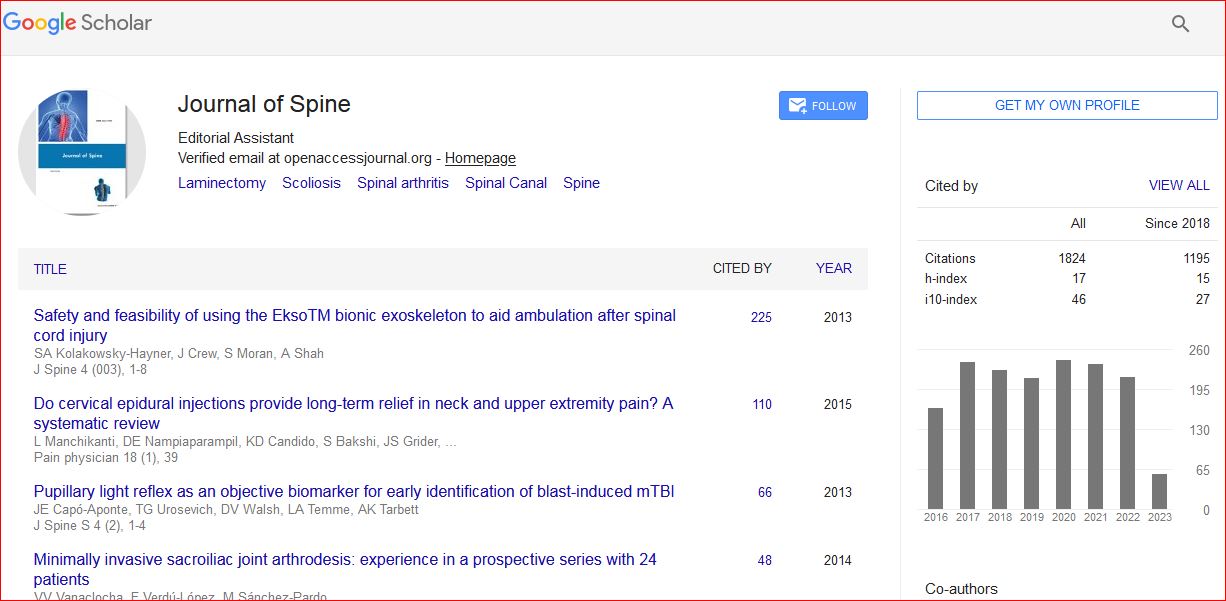
Journal of Spine received 2022 citations as per Google Scholar report