Perspective - (2025) Volume 15, Issue 5
Received: 01-Sep-2025, Manuscript No. jcde-25-177514;
Editor assigned: 03-Sep-2025, Pre QC No. P-177514;
Reviewed: 17-Sep-2025, QC No. Q-177514;
Revised: 22-Sep-2025, Manuscript No. R-177514;
Published:
29-Sep-2025
, DOI: 10.37421/2165-784X.2025.15.627
Citation: Novak, Eva. ”Advanced Hydraulic Design and Sustainable
Water Management.” J Civil Environ Eng 15 (2025):627.
Copyright: © 2025 Novak E. This is an open-access article distributed under the terms of the Creative Commons Attribution License, which permits unrestricted use, distribution
and reproduction in any medium, provided the original author and source are credited.
Research explores the optimization of labyrinth spillway design using a hybrid metaheuristic approach, specifically combining the whale optimization algorithm (WOA) and simulated annealing (SA). This method aims to enhance discharge efficiency and energy dissipation, vital for dam safety and cost-effectiveness, with findings showing the WOA-SA algorithm outperforming traditional methods in designing more efficient spillways [1].
Another study addresses critical design factors for hydraulic structures in river restoration, focusing on mitigating negative impacts on fish migration and habitat. This work highlights the necessity of incorporating fish passage solutions, flow velocity controls, and habitat connectivity during initial design phases, advocating for multidisciplinary approaches to create structures that fulfill both hydraulic and ecological needs for long-term river health [2].
Investigation into flood control dam design incorporates increasing climate change uncertainties, particularly extreme rainfall events. Through a case study, a methodology is demonstrated for integrating probabilistic climate projections into dam parameters like spillway capacity and reservoir storage, underscoring the need for adaptive design strategies to ensure future effectiveness and safety of flood protection infrastructure [3].
The sustainable design of urban drainage systems is examined by integrating green infrastructure (GI) components such as rain gardens, permeable pavements, and green roofs. This research focuses on how these natural systems effectively manage stormwater runoff, reduce flood risks, and improve urban water quality. A framework is proposed for optimizing GI placement and sizing to achieve ecological benefits alongside traditional drainage functions, fostering more resilient cities [4].
An optimization approach for hydropower plant intake structures targets the reduction of sediment ingress, a factor known to significantly reduce turbine efficiency and lifespan. The authors investigate various geometric configurations and flow conditions through numerical modeling and experimental data, offering practical guidelines for designing intake structures that enhance operational reliability and minimize maintenance costs by effectively managing sediment transport [5].
Coastal protection structures are also subject to design advancements, with a study evaluating the effectiveness of nature-based solutions (NBS) compared to traditional hard engineering. This research focuses on features like oyster reefs, mangroves, and dune systems, which provide protection against erosion and storm surges while offering ecological benefits. A multi-criteria assessment framework for integrating NBS into coastal defense strategies is emphasized, promoting resilient and environmentally sound designs [6].
Innovative design principles are proposed for irrigation canal networks, specifically for regions facing severe water scarcity. The focus here is on minimizing conveyance losses, optimizing water distribution, and integrating smart technologies for demand-driven delivery. This study delves into advanced hydraulic modeling and sensor-based control systems to achieve higher water use efficiency, which is critical for sustainable agriculture in arid and semi-arid environments [7].
Crucial seismic design considerations for large earth-fill dams are investigated, a paramount aspect of infrastructure safety in earthquake-prone regions. The study uses advanced numerical simulations and dynamic analyses to assess dam response to seismic loads, specifically concerning liquefaction, slope stability, and permanent deformation. Findings provide updated guidelines and methodologies for engineers to design more resilient and safer earth-fill dams against catastrophic seismic events [8].
Further research focuses on advanced computational fluid dynamics (CFD) modeling techniques to improve the design of energy dissipators, particularly stilling basins downstream of spillways. Effective energy dissipation is crucial to prevent scour and protect riverbeds and structures. The study validates CFD models against physical experiments, demonstrating their accuracy in predicting flow patterns and energy loss, thus offering a powerful tool for optimizing these critical hydraulic structures [9].
Finally, the design and performance of subsurface drainage systems in agricultural lands are examined, vital for managing soil salinity and waterlogging. Authors analyze various design parameters, including drain spacing, depth, and material selection under different soil and climate conditions. This study highlights the importance of precise design methodologies to optimize crop yields and prevent land degradation, emphasizing the economic and environmental benefits of well-designed drainage infrastructure [10].
Modern hydraulic engineering consistently seeks to optimize design for efficiency and safety. For instance, the design of labyrinth spillways has been significantly advanced by combining metaheuristic algorithms like the Whale Optimization Algorithm and Simulated Annealing, leading to improved discharge efficiency and energy dissipation crucial for dam safety and cost-effectiveness [1]. Similarly, hydropower plant intake structures are being optimized to minimize sediment ingress, a key factor in turbine efficiency and lifespan, through investigations into various geometric configurations and flow conditions using numerical modeling [5]. Downstream, the design of energy dissipators, particularly stilling basins, benefits from advanced Computational Fluid Dynamics (CFD) modeling, which accurately predicts flow patterns and energy loss, thereby preventing scour and protecting river structures [9].
A growing emphasis is placed on integrating ecological considerations into hydraulic infrastructure. River restoration efforts now prioritize fish-friendly designs, focusing on elements like fish passage solutions, flow velocity controls, and habitat connectivity to mitigate negative impacts on aquatic life and ensure long-term river health [2]. In coastal defense, nature-based solutions (NBS) are being evaluated as effective alternatives to traditional hard engineering. Features such as oyster reefs, mangroves, and dune systems offer protection against erosion and storm surges while providing significant ecological benefits, promoting resilient and environmentally friendly coastal designs [6].
Addressing the challenges of a changing climate, researchers are developing adaptive strategies for critical infrastructure. Flood control dam design, for example, now incorporates climate change uncertainties, especially extreme rainfall events. Methodologies integrate probabilistic climate projections into design parameters like spillway capacity and reservoir storage, recognizing the necessity for designs that account for future hydrological shifts [3]. Concurrently, seismic design considerations for large earth-fill dams are undergoing rigorous investigation, employing advanced numerical simulations and dynamic analyses to assess responses to seismic loads. This work focuses on aspects like liquefaction, slope stability, and permanent deformation to create more resilient dams in earthquake-prone regions [8].
Urban and agricultural water management also sees significant design innovations. Sustainable urban drainage systems are increasingly integrating green infrastructure (GI) components, including rain gardens, permeable pavements, and green roofs. These natural systems are effective in managing stormwater runoff, reducing flood risks, and improving water quality within urban environments, offering a framework for optimizing GI placement and sizing for ecological and drainage benefits [4]. In water-scarce regions, innovative irrigation canal networks are designed to minimize conveyance losses and optimize water distribution, utilizing smart technologies and sensor-based control systems for demand-driven delivery, which is vital for sustainable agriculture [7]. Furthermore, subsurface drainage systems in agricultural lands are being refined to manage soil salinity and waterlogging, with analyses of drain spacing, depth, and material selection under varying conditions to optimize crop yields and prevent land degradation [10].
These studies collectively highlight the multidisciplinary and evolving nature of hydraulic infrastructure design. They leverage advanced modeling, metaheuristic optimization, and integrate environmental and climatic factors, moving towards solutions that are not only robust and efficient but also ecologically sound and adaptable to future challenges. The body of work showcases a commitment to developing sustainable and resilient water management systems across diverse applications, from large-scale dams and coastal protections to urban and agricultural drainage.
The collected research explores diverse facets of hydraulic structure design and water resource management. Studies highlight the optimization of labyrinth spillways using hybrid metaheuristic algorithms to enhance discharge efficiency and energy dissipation, critical for dam safety. Other work focuses on integrating ecological needs into hydraulic structures, emphasizing fish-friendly designs in river restoration and assessing nature-based solutions for coastal protection against erosion and storm surges. Sustainable urban drainage systems are examined, advocating for green infrastructure like rain gardens and permeable pavements to manage stormwater and mitigate flood risks. Papers also address design challenges posed by climate change, with methodologies for incorporating probabilistic climate projections into flood control dam design to ensure long-term effectiveness. Infrastructure reliability is a key theme, seen in the optimization of hydropower plant intake structures to reduce sediment ingress, the innovative design of irrigation networks for water-scarce regions to minimize conveyance losses, and crucial seismic design considerations for large earth-fill dams to ensure resilience against seismic events. Advanced computational fluid dynamics modeling is applied to improve energy dissipator designs, while subsurface drainage systems for agricultural lands are investigated to combat soil salinity and waterlogging. Collectively, these papers underscore a movement toward more efficient, resilient, and environmentally conscious design in hydraulic engineering.
1. Mohammad SN, Mehdi G, Seyed AA. "Optimization of labyrinth spillway design using metaheuristic algorithms".J Hydro-Environ Res 48 (2023):161-175.
Indexed at, Google Scholar, Crossref
2. John RS, Emily AC, Michael TJ. "Design considerations for fish-friendly hydraulic structures in river restoration projects".Ecol Eng 185 (2022):106758.
Indexed at, Google Scholar, Crossref
3. Maria PG, Roberto LM, Carlos TS. "Flood control dam design incorporating climate change uncertainties: A case study approach".Water Resour Manage 35 (2021):2189â??2205.
Indexed at, Google Scholar, Crossref
4. Xiaohong W, Jing L, Wei Z. "Sustainable design of urban drainage systems considering green infrastructure".J Environ Manage 343 (2023):118029.
Indexed at, Google Scholar, Crossref
5. Ali MK, Hassan RS, Fatima SA. "Optimization of intake structure design for hydropower plants to minimize sediment entry".J Hydraul Res 60 (2022):706-718.
Indexed at, Google Scholar, Crossref
6. Laura GR, David SM, Isabel FP. "Assessment of nature-based solutions for coastal protection structures design".Coastal Eng 180 (2023):104443.
Indexed at, Google Scholar, Crossref
7. Ahmed HA, Khalid AA, Sara RA. "Innovative design of irrigation canal networks for water-scarce regions".Agric Water Manage 249 (2021):107050.
Indexed at, Google Scholar, Crossref
8. Kenji T, Hiroshi S, Takuya Y. "Seismic design considerations for large earth-fill dams".Soil Dyn Earthq Eng 128 (2020):105820.
Indexed at, Google Scholar, Crossref
9. Leonardo R, Giulia B, Marco M. "Advanced modeling for the design of energy dissipators downstream of spillways".J Hydraul Eng ASCE 149 (2023):04023055.
Indexed at, Google Scholar, Crossref
10. Robert LJ, Mary CD, Thomas PG. "Design and performance of subsurface drainage systems for agricultural lands".Irrig Sci 37 (2019):633-644.
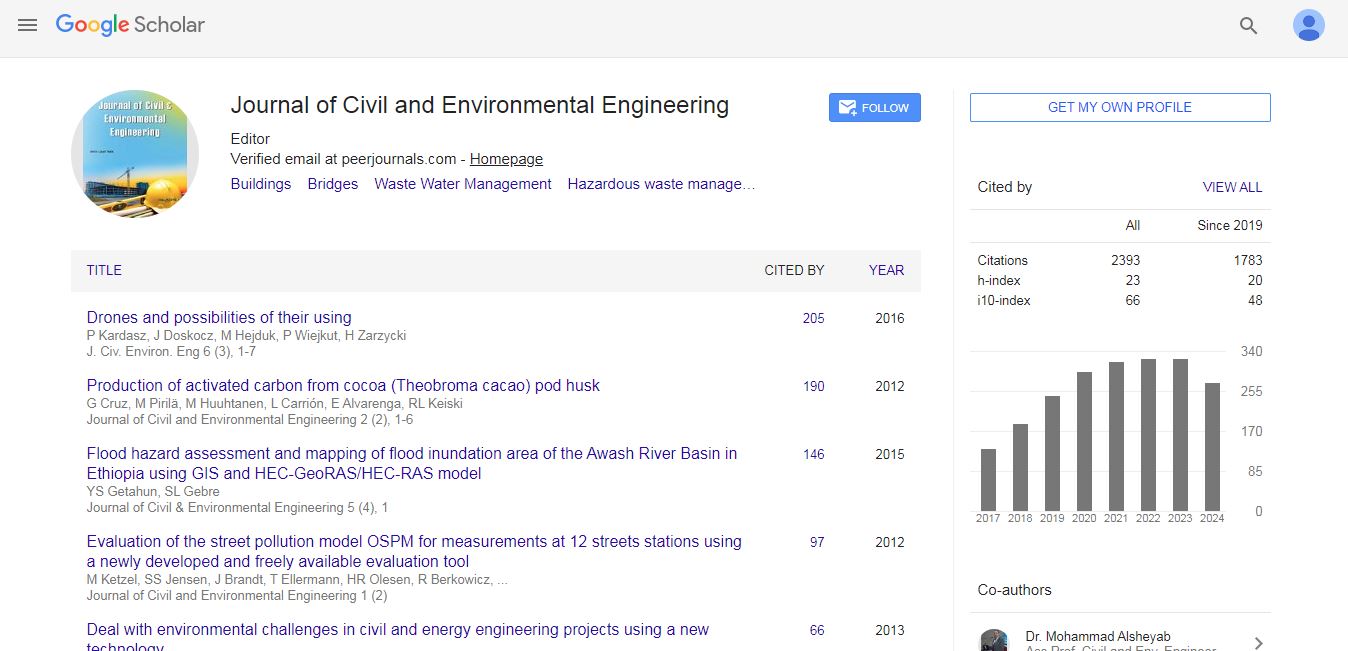
Journal of Civil and Environmental Engineering received 1798 citations as per Google Scholar report