Brief Report - (2025) Volume 18, Issue 5
Received: 31-Aug-2025, Manuscript No. jcsb-25-176445;
Editor assigned: 02-Sep-2025, Pre QC No. P-176445;
Reviewed: 16-Sep-2025, QC No. Q-176445;
Revised: 23-Sep-2025, Manuscript No. R-176445;
Published:
30-Sep-2025
, DOI: 10.37421/0974-7230.2025.18.602
Citation: Park, Sang-ho. ”Advanced Biotech Engineering Reshapes Biomedicine.” J Comput Sci Syst Biol 18 (2025): 602.
Copyright: © 2025 Park S. This is an open-access article distributed under the terms of the Creative Commons Attribution License, which permits unrestricted use, distribution and reproduction in any medium, provided the original author and source are credited.
This article delves into the core principles for designing microbial consortia, which are complex communities of microbes engineered to work in harmony. It clearly lays out how synthetic biology moves beyond simply engineering a single strain, instead focusing on creating predictable and stable multi-species systems. This approach is powerful for developing advanced biomanufacturing processes and novel therapeutic applications [1].
Here's the thing: CRISPR-Cas systems are more than just gene editing tools. This paper explores their incredible versatility in precisely controlling gene expression within mammalian cells. What this really means is bioengineers gain the ability to programmatically activate or deactivate genes, or fine-tune their activity, which opens significant pathways for sophisticated cell engineering, functional genomics, and advanced therapeutic strategies [2].
This work highlights the critical role of computational systems biology approaches for untangling complex disease mechanisms and accelerating the pace of drug discovery. It particularly emphasizes how models and simulations are used to predict disease progression, pinpoint new drug targets, and optimize therapeutic interventions. This truly shows how in-silico methods are bridging the crucial gap between vast biological data and tangible clinical impact [3].
The paper discusses the innovative engineering of synthetic biology tools to develop highly advanced biosensors. It showcases the remarkable ingenuity involved in designing biological circuits and components that can detect specific molecules with exceptional sensitivity and selectivity. This innovation is crucial, paving the way for enhanced diagnostics, comprehensive environmental monitoring, and the creation of intelligent drug delivery systems [4].
Integrating data from multiple 'omics' sources is a big deal for understanding complex diseases from a systems biology perspective. This article thoroughly explains various methods for combining genomics, proteomics, metabolomics, and other types of data. The goal is to construct a holistic view of biological systems, ultimately revealing intricate disease mechanisms and pointing towards more effective, personalized treatments [5].
This paper examines how systems metabolic engineering can dramatically improve the microbial production of valuable chemicals. Essentially, it's about designing and optimizing microbial cell factories by applying deep systems-level insights. This leads directly to more efficient and sustainable bioproduction of a wide array of substances, ranging from essential biofuels to crucial pharmaceuticals [6].
Microfluidic systems, often referred to as 'lab-on-a-chip' technology, are truly revolutionizing biomedical applications. This article explores their profound impact, discussing the creation of tiny devices that precisely control fluid flow at the micro-scale. This capability enables high-throughput screening, reliable point-of-care diagnostics, and detailed single-cell analysis, all with unparalleled efficiency and significantly reduced sample volume [7].
This paper specifically focuses on optogenetic tools, which utilize light to control genetically modified cells with exquisite precision. This represents a true game-changer for neuroscience, as it allows researchers to accurately activate or inhibit specific neurons and neural circuits. What this really means is we can now dissect the workings of complex brain functions and even engineer innovative therapeutic strategies for various neurological disorders [8].
Let's break down how machine learning is rapidly transforming the field of systems biology. This article thoroughly explores the immense opportunities that machine learning offers for making sense of vast biological datasets, accurately predicting complex cellular behaviors, and discovering entirely new biological rules. It also candidly discusses the current challenges researchers encounter when striving to effectively integrate these powerful computational methods into biological research [9].
Finally, this paper highlights the immense power of single-cell multi-omics technologies for unraveling cellular heterogeneity and understanding its critical implications for therapy. By meticulously analyzing individual cells at multiple molecular levels, researchers can dissect subtle differences that are often masked in traditional bulk analyses. This capability is absolutely crucial for precision medicine and for developing highly targeted treatments for complex diseases, such as cancer [10].
Research into synthetic biology provides essential design principles for building robust and finely tunable microbial consortia. These are complex communities of microbes engineered to work together, highlighting how synthetic biology moves beyond single-strain engineering to create predictable, stable multi-species systems [1]. This powerful approach is crucial for developing advanced biomanufacturing processes and novel therapeutic applications. Following this trend, the engineering of synthetic biology tools is actively creating highly advanced biosensors. This involves an impressive ingenuity in designing biological circuits and components that can detect specific molecules with unprecedented sensitivity and selectivity. This work is paving the way for significantly better diagnostics, more comprehensive environmental monitoring, and the development of intelligent drug delivery systems [4].
Here's the thing: CRISPR-Cas systems are not just for gene editing anymore. This paper explores their use as versatile tools for precisely controlling gene expression in mammalian cells [2]. What this really means is bioengineers can programmatically turn genes on or off, or modulate their activity with fine precision, which opens significant doors for sophisticated cell engineering, functional genomics studies, and advanced therapeutic strategies. In a similar vein, optogenetic tools are proving to be a true game-changer for neuroscience [8]. These tools use light to control genetically modified cells, allowing researchers to precisely activate or inhibit specific neurons and neural circuits. The profound implication is that we can now dissect how complex brain functions operate and even engineer entirely new therapeutic strategies for a range of neurological disorders.
This work delves into how computational systems biology approaches are absolutely essential for untangling the complexities of disease mechanisms and accelerating drug discovery [3]. It emphasizes using sophisticated models and simulations to accurately predict disease progression, identify novel drug targets, and optimize therapeutic interventions. This truly shows how in-silico methods are bridging the critical gap between vast biological data and tangible clinical impact. Furthermore, integrating data from multiple 'omics' sources is a big deal for understanding complex diseases from a comprehensive systems biology perspective. This involves methods for combining genomics, proteomics, and metabolomics data to construct a holistic view of biological systems, thereby revealing intricate disease mechanisms and pointing towards more effective, personalized treatments [5].
This paper examines how systems metabolic engineering can dramatically improve microbial production of valuable chemicals [6]. It is fundamentally about designing and optimizing microbial cell factories by applying systems-level insights, which ultimately leads to more efficient and sustainable bioproduction. This spans a wide array of products, from essential biofuels to critical pharmaceuticals. Concurrently, microfluidic systems, often referred to as 'lab-on-a-chip' technologies, are revolutionizing biomedical applications [7]. This involves creating tiny devices that precisely control fluid flow at the micro-scale, enabling high-throughput screening, accurate point-of-care diagnostics, and detailed single-cell analysis with unparalleled efficiency and significantly reduced sample volumes.
Let's break down how machine learning is profoundly transforming systems biology. This article explores the immense opportunities that machine learning offers for making coherent sense of vast biological datasets, accurately predicting complex cellular behaviors, and discovering entirely new biological rules [9]. It also candidly discusses the current challenges researchers face in effectively integrating these powerful computational methods into ongoing biological research. Finally, this paper highlights the immense power of single-cell multi-omics technologies for unraveling cellular heterogeneity and understanding its critical implications for therapy [10]. By meticulously analyzing individual cells at multiple molecular levels, researchers can dissect subtle, individual differences that are often masked in traditional bulk analyses. This capability is absolutely crucial for advancing precision medicine and for developing highly targeted treatments for complex diseases, such as cancer.
The landscape of biotechnology and biomedical applications is rapidly evolving, driven by advancements in synthetic and systems biology. Researchers are designing principles for robust microbial consortia to create stable multi-species systems for biomanufacturing and therapeutics. CRISPR-Cas systems are proving to be powerful tools for precise gene expression control in mammalian cells, allowing bioengineers to modulate gene activity for cell engineering and advanced therapies. At the same time, computational systems biology is crucial for unraveling disease mechanisms and accelerating drug discovery through models and simulations. The engineering of synthetic biology tools is enabling advanced biosensors that detect specific molecules with high sensitivity, leading to improved diagnostics and environmental monitoring. Another important area is the integration of multi-omics data, which provides a holistic view of biological systems to understand complex diseases and develop personalized treatments. Systems metabolic engineering is enhancing microbial production of valuable chemicals, optimizing cell factories for sustainable bioproduction. Microfluidic systems, often called 'lab-on-a-chip,' are revolutionizing biomedical applications by enabling high-throughput screening and single-cell analysis. Optogenetic tools, which use light to control genetically modified cells, are a game-changer for neuroscience, helping dissect neural circuits and develop new therapeutic strategies. Finally, machine learning is transforming systems biology by interpreting vast biological datasets and predicting cellular behaviors, despite existing integration challenges. Complementing this, single-cell multi-omics technologies are key to dissecting cellular heterogeneity, which is vital for precision medicine and targeted treatments.
None
None
Xu L, Di L, Yang Z. "Design principles for robust and tunable microbial consortia in synthetic biology".Nat Chem Biol 19 (2023):1052-1061.
Indexed at, Google Scholar, Crossref
Shaohui W, Meng D, Pei Z. "CRISPR-Cas systems for programmable control of gene expression in mammalian cells".Curr Opin Biotechnol 80 (2023):102905.
Indexed at, Google Scholar, Crossref
Ying Z, Wei W, Yang L. "Computational systems biology approaches for understanding disease mechanisms and drug discovery".Front Genet 13 (2022):955030.
Indexed at, Google Scholar, Crossref
Xin W, Jie L, Ling C. "Engineering synthetic biology tools for advanced biosensors".Biosens Bioelectron 190 (2021):113405.
Indexed at, Google Scholar, Crossref
Shan L, Yanan Z, Lei W. "Integrating multi-omics data for systems biology understanding of complex diseases".Comput Struct Biotechnol J 22 (2024):153-164.
Indexed at, Google Scholar, Crossref
Shang L, Chunxia Z, Yan W. "Systems metabolic engineering for enhanced microbial production of valuable chemicals".Trends Biotechnol 41 (2023):355-371.
Indexed at, Google Scholar, Crossref
Sejin K, Sangwoo L, Jooyeon P. "Microfluidic systems for advanced biomedical applications".Sensors (Basel) 22 (2022):2417.
Indexed at, Google Scholar, Crossref
Feng Z, Li W, Yang L. "Optogenetic tools for dissecting and engineering neural circuits".Curr Opin Neurobiol 67 (2021):23-31.
Indexed at, Google Scholar, Crossref
Jin C, Xiaojie L, Yan W. "Machine learning in systems biology: opportunities and challenges".Mol Syst Biol 20 (2024):e11943.
Indexed at, Google Scholar, Crossref
Jing W, Li Z, Yong L. "Single-cell multi-omics for dissecting cellular heterogeneity and therapeutic implications".Cell Res 33 (2023):731-748.
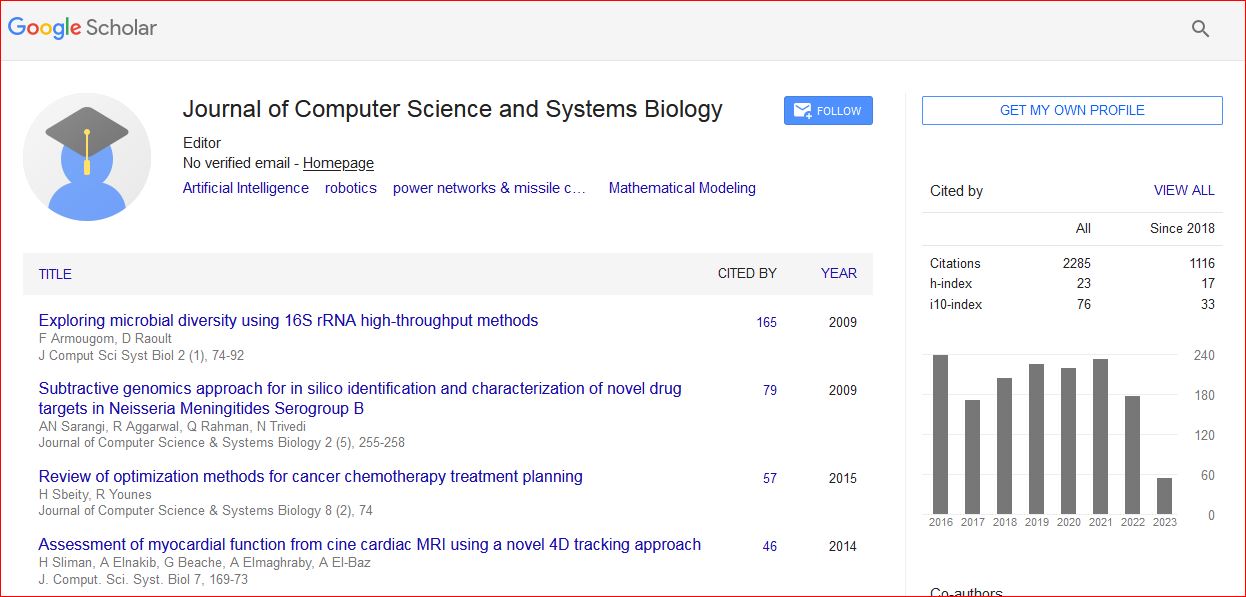
Journal of Computer Science & Systems Biology received 2279 citations as per Google Scholar report