Perspective - (127) Volume 15, Issue 6
Received: 31-Oct-2025, Manuscript No. jtese-26-184261;
Editor assigned: 03-Nov-2025, Pre QC No. P-184261;
Reviewed: 17-Nov-2025, QC No. Q-184261;
Revised: 21-Nov-2025, Manuscript No. R-184261;
Published:
28-Nov-2025
, DOI: 10.37421/2165-8064.2025.15.684
Citation: Lewandowski, Tomasz. ”Advanced Ballistic Textile Structures: Material and Design.” J Textile Sci Eng 15 (2025):684.
Copyright: © 2025 Lewandowski T. This is an open-access article distributed under the terms of the Creative Commons Attribution License, which permits unrestricted use, distribution and reproduction in any medium, provided the original author and source are credited.
The field of ballistic and impact-resistant textile structures is undergoing rapid advancement, driven by the necessity for enhanced protection across various applications, from military armor to sports safety equipment. Recent research has significantly expanded our understanding of how material properties and structural design contribute to performance under extreme conditions. Innovations in fiber technology, fabric construction, and composite layering are leading to the development of advanced materials capable of withstanding high-velocity threats and impact forces. Key to these developments is a deeper comprehension of energy absorption mechanisms such as fiber breakage and plastic deformation, which play a crucial role in dissipating impact energy and mitigating damage [1].
Furthermore, the integration of high-performance fibers within polymer matrices has opened new avenues for creating novel composite materials tailored for ballistic protection. The synergistic effects observed between different fiber types and weaving patterns are instrumental in improving ballistic limits and enhancing impact energy absorption. These advanced composite textiles offer superior resistance to penetration and blunt trauma compared to conventional monolithic materials, paving the way for lighter and more effective protective gear [2].
Predicting the ballistic performance of woven fabrics is a complex challenge that has been addressed through sophisticated numerical modeling approaches. The development of multi-scale finite element models that accurately capture the intricate behavior of yarns and their interactions during high-velocity impacts provides invaluable insights. These simulations help in understanding failure mechanisms like yarn breakage and frictional effects, which are critical for optimizing armor design and ensuring predicted performance aligns with experimental validation [3].
The experimental characterization of novel polymeric fibers is fundamental to advancing ballistic applications. Evaluating the tensile properties, energy absorption capabilities, and thermal stability of fibers like ultra-high molecular weight polyethylene (UHMWPE) and aramid variants is essential. Understanding how variations in molecular structure and processing conditions influence fiber performance under impact allows material scientists and engineers to select optimal fibers for lightweight armor systems [4].
Beyond ballistic threats, the development of textiles for blunt impact protection is also a significant area of research, particularly for sports and industrial safety. The incorporation of shear-thickening fluids (STFs) within fabric layers has shown promise in enhancing impact energy dissipation. The effectiveness of these STF-impregnated fabrics in improving stiffness and reducing force transmission is a critical consideration for enhancing safety in various impact scenarios [5].
Addressing the need for multi-functional protective textiles, research is exploring hybrid structures that combine ballistic resistance with other desirable properties, such as thermal insulation. Integrating materials like aerogels or phase change materials within ballistic fabric layers allows for the development of advanced textiles offering both safety and comfort. This approach necessitates a careful evaluation of trade-offs between ballistic protection, thermal performance, and overall weight [6].
The fundamental architecture of textile structures plays a direct role in their ballistic performance. A systematic investigation into the influence of fabric weaving parameters, such as weave structures (plain, twill, satin) and yarn interlacing densities, reveals their impact on the resistance to ballistic impacts. Optimizing weave architectures that enhance yarn confinement and reduce shear is crucial for maximizing the ballistic limit and improving overall fabric performance [7].
Hybrid ceramic-textile composites represent another frontier in ballistic protection, particularly for body armor inserts. The interaction between ceramic strike faces and textile backing layers is vital for dissipating projectile energy. Research into different ceramic materials, bonding techniques, and the role of the textile backing in preventing spalling and secondary fragmentation contributes to the design of more effective hard armor systems [8].
Environmental factors can significantly influence the ballistic performance of protective textiles, necessitating a comprehensive understanding of their impact. Evaluating how moisture, elevated temperatures, and UV radiation affect the mechanical properties of fibers and fabric structures is critical. This knowledge is essential for material selection and the development of protective coatings to ensure sustained performance in harsh operational environments, which is paramount for military and law enforcement applications [9].
Finally, the development of multi-component textile systems offers a pathway to enhanced ballistic and stab resistance. By combining different fabric types with rigid inserts and flexible gel layers, researchers are exploring synergistic effects to improve protection. Understanding the energy absorption mechanisms and failure modes of these complex structures through dynamic impact testing is key to optimizing multi-layer armor designs for comprehensive defense [10].
The critical aspects of ballistic and impact-resistant textile structures are being systematically explored, with a focus on the intricate relationship between material properties, structural design, and performance under severe conditions. Recent advancements in fiber technology, fabric construction, and composite layering are enabling the creation of enhanced protection against ballistic threats and impact forces. Significant insights have been gained into the fundamental energy absorption mechanisms, including fiber breakage, plastic deformation, and delamination, which are vital for dissipating impact energy. A key challenge remains in balancing robust protection with the need for flexibility, comfort, and cost-effectiveness in textile armor systems [1].
Novel composite materials are being developed to elevate ballistic protection, primarily through the integration of high-performance fibers within polymer matrices. This research scrutinizes the synergistic outcomes of various fiber types and weaving patterns on the ballistic limit and the capacity for impact energy absorption. Findings indicate that specific composite architectures can substantially improve resistance to penetration and blunt trauma when contrasted with conventional monolithic materials. Furthermore, the exploration extends to incorporating multi-functional attributes, such as flame retardancy and chemical resistance, into these sophisticated textile structures [2].
A comprehensive numerical modeling methodology is being employed to accurately predict the ballistic performance of woven fabrics. The creation of a multi-scale finite element model, capable of capturing the complex behavior of yarns and their interrelationships under high-velocity impact, offers significant advantages. The simulations yield valuable perspectives on the failure mechanisms inherent to textiles, including yarn breakage and frictional effects, which are indispensable for refining armor design. Validation against empirical data confirms the model's precision in forecasting the ballistic limit and deformation patterns [3].
The experimental characterization of new polymeric fibers designed for ballistic applications is a focal point of current research. This work involves an in-depth evaluation of the tensile properties, energy absorption potential, and thermal stability of newly engineered fibers, such as advanced variants of ultra-high molecular weight polyethylene (UHMWPE) and aramid. The study emphasizes how modifications in molecular structure and processing conditions directly influence the fiber's performance when subjected to impact. These findings are of paramount importance for material scientists and engineers tasked with selecting the most suitable fibers for lightweight armor systems [4].
Challenges associated with designing textile structures for effective blunt impact protection, particularly relevant for sports and industrial safety applications, are being directly addressed. The research investigates the utility of shear-thickening fluids (STFs) when impregnated into fabric layers to enhance the dissipation of impact energy. This study examines how varying STF concentrations and fabric architectures influence the material's response to low-velocity impacts, demonstrating notable improvements in stiffness and reductions in force transmission [5].
The pursuit of multi-functional capabilities in advanced textiles, specifically combining ballistic resistance with thermal insulation, is a key research direction. This involves the investigation of hybrid structures that integrate materials like aerogels or phase change materials within ballistic fabric layers. The study focuses on assessing the trade-offs between ballistic protection, thermal performance, and the overall weight of these composite systems, aiming to provide a framework for developing next-generation protective textiles that balance safety and comfort across diverse environmental conditions [6].
The influence of fabric weaving parameters on ballistic performance is being systematically analyzed. This research meticulously examines how different weave structures, such as plain, twill, and satin weaves, along with variations in yarn interlacing densities, impact the resistance of ballistic fabrics to projectile impacts. Experimental outcomes indicate that weaves promoting enhanced yarn confinement and reduced shear can markedly improve the ballistic limit. This body of work provides practical directives for fabric manufacturers and armor designers focused on optimizing textile structures for superior ballistic protection [7].
The development and testing of body armor inserts that incorporate ceramic tiles and a textile backing are being explored. This research concentrates on the critical interaction between the ceramic strike face and the underlying fabric layers in the process of dissipating projectile energy. It investigates various ceramic materials and their associated bonding techniques, as well as the essential role of the textile backing in preventing spalling and mitigating secondary fragmentation. The insights derived are fundamental to the design of highly effective hard armor systems [8].
This paper systematically studies the impact of environmental factors on the ballistic performance of protective textiles. The research evaluates how exposure to conditions such as moisture, elevated temperatures, and UV radiation affects the crucial mechanical properties of high-performance fibers and fabric structures. The findings underscore the significance of judicious material selection and the application of protective coatings to maintain performance integrity, especially in demanding operational environments relevant to military and law enforcement applications [9].
Finally, the exploration of multi-component textile systems for enhanced ballistic and stab resistance is a notable area of development. This research investigates the synergistic benefits derived from combining different fabric types, including aramids and UHMWPE, with rigid inserts and flexible gel layers. The study incorporates dynamic impact testing to rigorously assess the energy absorption mechanisms and failure modes of these intricate structures, thereby contributing to a better understanding of how to optimize multi-layer armor designs for comprehensive protective capabilities [10].
This collection of research explores advancements in ballistic and impact-resistant textile structures, focusing on material science and structural design. Studies investigate novel composite materials, the integration of high-performance fibers, and the effectiveness of shear-thickening fluids for enhanced protection. Numerical modeling techniques are employed to predict fabric performance, while experimental characterization of fibers and fabrics is crucial for material selection. Research also addresses multi-functional textiles combining ballistic resistance with thermal insulation, the influence of weaving architecture, and hybrid ceramic-textile composites. The impact of environmental factors on performance and the development of multi-component systems for comprehensive protection are also highlighted. Key themes include energy absorption mechanisms, balancing protection with comfort, and optimizing designs for various applications.
None
None
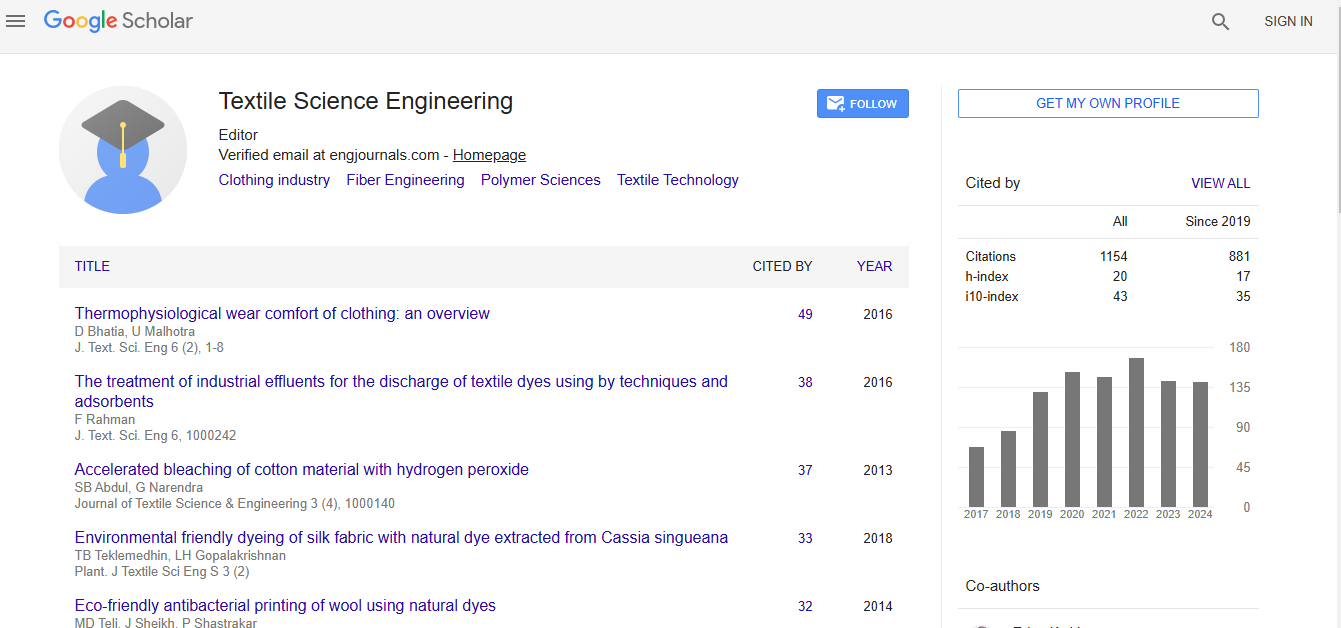
Journal of Textile Science & Engineering received 1008 citations as per Google Scholar report