Brief Report - (2025) Volume 16, Issue 6
Received: 01-Nov-2025, Manuscript No. jpm-26-179469;
Editor assigned: 03-Nov-2025, Pre QC No. P-179469;
Reviewed: 17-Nov-2025, QC No. Q-179469;
Revised: 24-Nov-2025, Manuscript No. R-179469;
Published:
29-Nov-2025
, DOI: 10.37421/2090-0902.2025.16.562
Citation: Schultz, Hannah. ”Advanced Acoustics and Vibrations: Modeling and Control.” J Phys Math 16 (2025):562.
Copyright: © 2025 Schultz H. This is an open-access article distributed under the terms of the Creative Commons Attribution License, which permits unrestricted use, distribution and reproduction in any medium, provided the original author and source are credited.
The analysis of acoustic phenomena and vibrational systems necessitates sophisticated mathematical frameworks. Techniques such as Fourier analysis, modal analysis, and finite element methods are fundamental for understanding wave propagation, resonance, and damping in these systems. These mathematical tools are crucial for practical applications including the design of quieter environments, the enhancement of structural integrity, and the development of advanced sensing technologies. Spectral decomposition offers powerful insights into identifying dominant frequencies, while numerical simulations are essential for handling complex geometries and boundary conditions [1].
The field of acoustics and vibrations is continually advancing with the development of sophisticated numerical methods. These methods are designed to solve the complex governing equations, particularly in scenarios exhibiting nonlinear behavior or intricate material properties. Techniques like spectral element methods and discontinuous Galerkin methods have demonstrated high accuracy and computational efficiency. Furthermore, the integration of error estimation and adaptive meshing strategies is vital for ensuring the reliability of simulations, providing a robust approach for addressing challenging engineering problems [2].
Uncertainty in loading conditions presents a significant challenge in structural analysis. Stochastic processes and random vibration theory are employed to analyze the dynamic response of structures under such conditions. Statistical models can provide more realistic predictions of fatigue life and reliability compared to deterministic approaches. Incorporating uncertainty quantification into vibration analysis is of paramount importance for the safety-critical systems [3].
Inverse problems in acoustics, specifically the determination of source characteristics from measured sound fields, have seen significant advancements. The application of advanced optimization algorithms and regularization techniques is crucial for overcoming the inherent ill-posed nature of these problems. The implications for acoustic imaging and non-destructive testing are substantial, promising unprecedented accuracy in pinpointing acoustic sources [4].
Machine learning, particularly deep learning, is increasingly being applied to the analysis and prediction of acoustic and vibrational signals. Convolutional neural networks and recurrent neural networks are effective in learning complex patterns and correlations within data, leading to improved signal classification, anomaly detection, and predictive maintenance. The potential for real-time analysis and adaptive control systems is a key development in this area [5].
Control theory plays a vital role in mitigating unwanted vibrations and noise. The design and implementation of active control systems, which utilize feedback mechanisms to counteract disturbances, are central to this discipline. Advanced concepts include adaptive filtering, optimal control strategies, and robust control for systems with parameter uncertainties. These advancements have substantial practical implications across various engineering fields [6].
For beam and plate structures, a comprehensive understanding of vibration analysis relies on both analytical and semi-analytical techniques. Classical methods such as Rayleigh-Ritz and Galerkin, alongside more advanced approaches for complex boundary conditions and material anisotropies, provide valuable tools. These methods are essential for grasping the fundamental mathematical principles governing structural dynamics [7].
The mathematical modeling of acoustic metamaterials, which possess unique wave manipulation properties, is an active area of research. Subwavelength structures are being designed to precisely control sound propagation, opening possibilities for advanced acoustic cloaking and filtering. Techniques like homogenization and band gap analysis are central to the methodologies employed in this domain [8].
Spectral methods are proving to be highly effective for analyzing acoustic scattering from complex objects. Techniques such as plane wave expansion and spectral element methods offer high accuracy and efficiency in solving the Helmholtz equation. Rigorous mathematical formulations are critical for accurately predicting the acoustic signatures of various targets [9].
Characterizing non-stationary acoustic and vibration signals requires advanced time-frequency analysis techniques, including wavelets. These methods excel at capturing transient phenomena and localized features that traditional spectral analysis might miss. Their application is particularly beneficial in fault diagnosis and signal denoising [10].
Mathematical modeling of acoustic phenomena and vibrational systems relies on sophisticated frameworks, with Fourier analysis, modal analysis, and finite element methods being cornerstone techniques for understanding wave propagation, resonance, and damping. These mathematical tools have direct practical implications in areas such as the design of quieter environments, the enhancement of structural integrity, and the development of advanced sensing technologies. Spectral decomposition proves invaluable for identifying dominant frequencies, while numerical simulations are indispensable for analyzing systems with complex geometries and boundary conditions [1].
Advanced numerical methods are increasingly being developed to solve the governing equations in acoustics and vibrations, especially when dealing with nonlinear behaviors or complex material properties. The effectiveness of methods such as spectral element methods and discontinuous Galerkin methods has been showcased in achieving both high accuracy and computational efficiency. Furthermore, the integration of error estimation and adaptive meshing strategies is crucial for ensuring the reliability of computational simulations, offering a robust approach to tackle difficult engineering challenges [2].
The analysis of structures subjected to uncertain loading conditions necessitates the application of stochastic processes and random vibration theory. These approaches allow for a more realistic prediction of fatigue life and reliability compared to traditional deterministic methods. The incorporation of uncertainty quantification into vibration analysis is becoming increasingly critical for ensuring the safety and performance of critical systems [3].
Significant progress has been made in addressing inverse problems in acoustics, specifically in identifying acoustic source characteristics from measured sound fields. The successful application of advanced optimization algorithms and regularization techniques is key to overcoming the ill-posed nature of these problems. The implications for acoustic imaging and non-destructive testing are substantial, offering the potential for highly accurate source localization [4].
Machine learning, particularly deep learning techniques, is demonstrating considerable promise in the analysis and prediction of acoustic and vibrational signals. Methods like convolutional neural networks and recurrent neural networks are adept at learning intricate patterns and correlations within data, leading to improvements in signal classification, anomaly detection, and predictive maintenance. The potential for real-time analysis and the development of adaptive control systems are significant outcomes [5].
Control theory plays a pivotal role in the mitigation of unwanted vibrations and noise through the design and implementation of active control systems. These systems employ feedback mechanisms to effectively counteract disturbances. Key strategies include adaptive filtering, optimal control, and robust control, particularly important for systems with inherent parameter uncertainties. The practical impact of these control engineering approaches is substantial across multiple engineering disciplines [6].
For the analysis of vibrations in beam and plate structures, a combination of analytical and semi-analytical techniques is essential. Classical methods, including Rayleigh-Ritz and Galerkin, alongside more advanced approaches tailored for complex boundary conditions and material anisotropies, offer a comprehensive toolkit. These methods are fundamental for understanding the core mathematical principles governing structural dynamics [7].
The mathematical framework for acoustic metamaterials, designed to exhibit unique wave manipulation properties, is a key research focus. The design of subwavelength structures enables precise control over sound propagation, opening avenues for innovative acoustic cloaking and filtering applications. Techniques such as homogenization and band gap analysis are central to the development of these advanced materials [8].
Spectral methods are being increasingly utilized for the analysis of acoustic scattering phenomena, particularly when dealing with complex objects. Techniques like plane wave expansion and the spectral element method provide high accuracy and efficiency in solving the Helmholtz equation. The development of rigorous mathematical formulations is critical for accurately predicting the acoustic signatures of targets in various scenarios [9].
Characterizing non-stationary acoustic and vibration signals often requires advanced time-frequency analysis techniques, with wavelets being a prominent example. These methods effectively capture transient events and localized features that might be overlooked by traditional spectral analysis. Their utility is particularly evident in applications such as fault diagnosis and signal denoising [10].
This collection of research explores advanced methodologies in acoustics and vibrations. It covers mathematical modeling and numerical techniques for analyzing wave propagation, resonance, and damping in various media. The papers also delve into stochastic analysis for uncertain loading conditions, inverse problems for source localization, and machine learning for signal analysis. Furthermore, control theory for vibration and noise mitigation, analytical methods for structural dynamics, acoustic metamaterials, spectral methods for scattering, and time-frequency analysis for non-stationary signals are discussed. Collectively, these works highlight sophisticated approaches for understanding, predicting, and controlling acoustic and vibrational phenomena across diverse engineering applications.
None
None
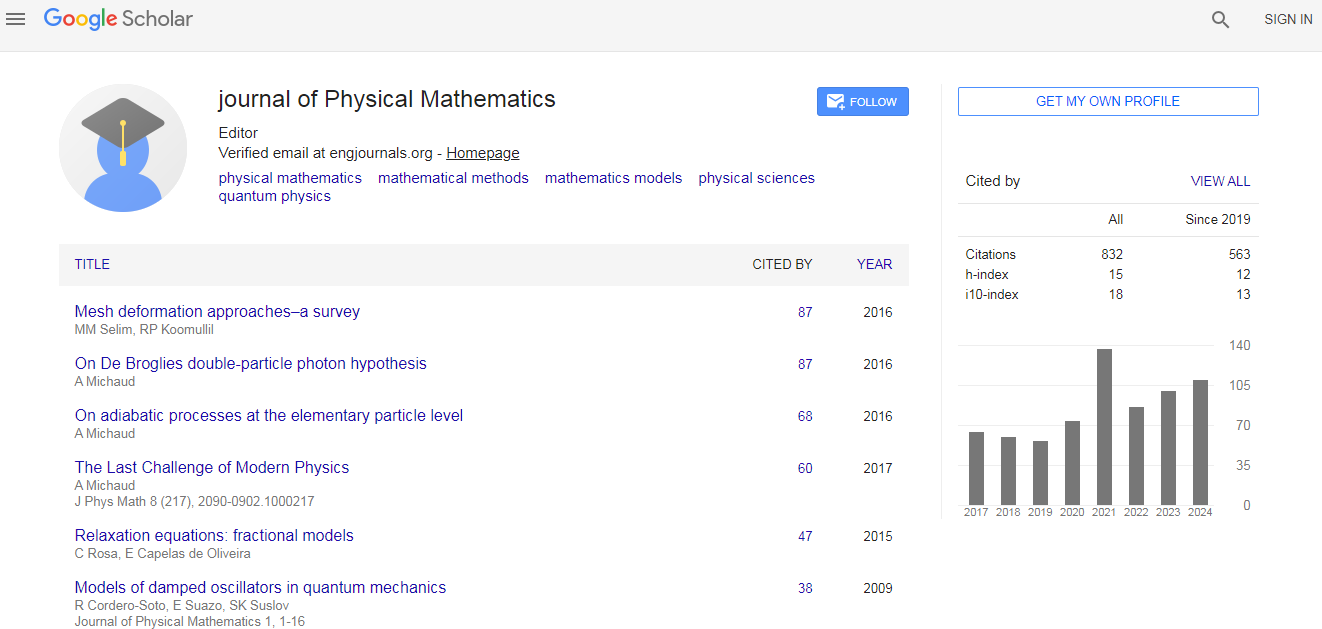
Physical Mathematics received 686 citations as per Google Scholar report