Commentary - (127) Volume 14, Issue 3
Received: 01-Sep-2025, Manuscript No. ara-25-175604;
Editor assigned: 03-Sep-2025, Pre QC No. P-175604;
Reviewed: 17-Sep-2025, QC No. Q-175604;
Revised: 22-Sep-2025, Manuscript No. R-175604;
Published:
29-Sep-2025
, DOI: 10.37421/2168-9695.2025.14.339
Citation: Brooks, Nathaniel. ”Adaptive Prosthetics: Smart Control, Natural Function.” Adv Robot Autom 14 (2025):339.
Copyright: © 2025 Brooks N. This is an open-access article distributed under the terms of the Creative Commons Attribution License, which permits unrestricted use, distribution and reproduction in any medium, provided the original author and source are credited.
Recent advancements in robotic prosthetics are fundamentally transforming how individuals interact with artificial limbs, moving towards more natural, intuitive, and efficient control. A core development involves directly integrating the user into real-time optimization loops. This 'human-in-the-loop' approach dynamically adjusts prosthesis parameters to individual needs, significantly boosting control system performance and wearer comfort. This innovative methodology ensures that the prosthetic device evolves with the user, fostering a symbiotic relationship that enhances functionality and daily life integration [1].
One of the most critical aspects of prosthetic development is restoring realistic sensory feedback, which profoundly impacts a user's ability to perceive and interact with their environment. Pioneering research demonstrates that combining proprioceptive and tactile feedback in robotic hands allows users to perceive and interact with virtual objects with greater effectiveness. This paves the way for truly intuitive and functional prosthetic control in diverse everyday situations, moving beyond mere motor control to encompass a comprehensive sensory experience [2].
Significant strides have also been made in delivering high-fidelity somatosensory feedback directly to prosthetic hand users. Through targeted stimulation of the nervous system, researchers have enabled amputees to perceive highly nuanced sensations. This directly enhances their ability to manipulate objects with precision and fosters a more natural, integrated experience with their robotic prostheses, making the artificial limb feel like a part of their own body [4].
Complementing these developments, wearable haptic feedback systems are emerging to further improve dexterity for prosthetic hand users. By providing timely and intuitive tactile cues, these systems enhance a user's capability to manipulate objects with greater precision and confidence. This effectively bridges the crucial sensory gap between the user and their artificial limb, enabling more refined control and interaction [9].
Intelligent control systems are pivotal in making robotic prostheses more adaptive and responsive to varied conditions. Machine learning is actively employed in systems that adapt to varying gait patterns in real-time for robotic prostheses. This enables users to smoothly transition between different walking conditions, substantially improving the functionality and naturalness of prosthetic limb control through continuous learning and adjustment based on the user's movements and surroundings [3].
For active prosthetic legs, researchers investigate synergistic control strategies that leverage myoelectric signals from residual limb muscles. This approach aims for more intuitive and energy-efficient control, helping users achieve natural and robust gait patterns across diverse terrains and activities by emulating human muscle coordination. The goal is to make prosthetic leg movement feel as natural and effortless as biological locomotion [5].
Further enhancing lower limb prostheses, intelligent assistive control strategies for powered ankle-foot prostheses focus on improved human-robot interaction. By adapting control based on user intent and environmental cues, these systems offer real-time assistance, thereby enhancing walking stability and lowering metabolic costs for amputees. This leads to a more intuitive and comfortable gait, allowing users to move with greater ease and confidence [6].
The development of intelligent and user-friendly control strategies for robotic lower limb prostheses emphasizes natural human-robot interaction and adaptive control. This allows the prosthesis to intuitively respond to user intent and environmental changes, ultimately enhancing gait stability and reducing the user's cognitive burden, making the use of prosthetics less mentally demanding [7].
Additionally, deep learning-based methods are significantly improving the real-time estimation of user intention for powered prosthetic legs. These advancements lead to a substantial improvement in the responsiveness and accuracy of prosthetic control, enabling more intuitive and natural movement transitions, especially across various walking tasks and terrains, by quickly interpreting complex myoelectric signals [8].
Overall, the field extensively explores shared control paradigms, where both the human user and the automated system collaborate in device control. This integrated approach tackles the challenges of seamlessly merging human intent with autonomous robotic functions, aiming to optimize overall performance, reduce the user's cognitive load, and significantly enhance satisfaction. It represents a move towards systems that are not just assistive but truly symbiotic, adapting to and learning from the userâ??s continuous interaction [10].
The integration of human users into the control mechanisms of robotic prosthetics is a primary focus for improving their efficacy. 'Human-in-the-loop' optimization dynamically adjusts prosthesis parameters in real-time based on individual needs, significantly boosting control system performance and wearer comfort, leading to more natural movement [1]. This approach fosters a symbiotic relationship where the prosthesis evolves with the user. Parallel to this, shared control paradigms explore how human intent can be seamlessly integrated with autonomous robotic functions. This method aims to optimize overall performance, reduce the user's cognitive load, and enhance satisfaction by allowing both the human and the system to contribute to device control, making interactions more intuitive and less demanding [10].
Restoring realistic sensory feedback is crucial for intuitive interaction with prosthetic limbs. Research demonstrates that combining proprioceptive and tactile feedback in robotic hands enables users to perceive and interact with virtual objects more effectively, paving the way for intuitive control in daily situations [2]. Furthermore, significant progress has been made in providing high-fidelity somatosensory feedback to prosthetic hand users. Direct stimulation of the nervous system allows amputees to perceive highly nuanced sensations, enhancing their ability to manipulate objects and fostering a more natural, integrated experience with their robotic prostheses [4].
Enhancing dexterity and fine motor control remains a vital area of advancement. Wearable haptic feedback systems are being introduced to improve precision for prosthetic hand users. By providing timely and intuitive tactile cues, these systems bridge the sensory gap, significantly enhancing the user's ability to manipulate objects with greater confidence and enabling more controlled, nuanced interactions with their artificial limb [9].
Intelligent control systems are pivotal for making lower limb prostheses more adaptive and responsive. Machine learning is employed to adapt to varying gait patterns in real-time, allowing users to smoothly transition between different walking conditions. This improves the functionality and naturalness of prosthetic limb control through continuous learning based on the user's movements and surroundings [3]. Similarly, synergistic control strategies for active prosthetic legs utilize myoelectric signals from residual limb muscles, aiming for intuitive and energy-efficient control. This helps users achieve natural and robust gait patterns across diverse terrains and activities by emulating human muscle coordination [5].
Further innovations in lower limb prosthetics include intelligent assistive control for powered ankle-foot prostheses. These systems adapt control based on user intent and environmental cues, offering real-time assistance that enhances walking stability and lowers metabolic costs for amputees, leading to a more intuitive and comfortable gait [6]. These efforts align with developing intelligent, user-friendly control strategies for robotic lower limb prostheses, emphasizing natural human-robot interaction and adaptive control to respond intuitively to user intent. This ultimately boosts gait stability and reduces the user's cognitive burden [7]. To achieve this responsiveness, deep learning-based methods estimate user intention for powered prosthetic legs in real-time, significantly improving control accuracy and allowing for natural movement transitions across various tasks by interpreting complex myoelectric signals [8].
Research in robotic prosthetics focuses on enhancing user integration and natural functionality. One significant approach involves 'human-in-the-loop' optimization, dynamically adjusting prosthesis parameters in real-time based on individual needs, leading to more efficient movement and comfort. Advancements also center on providing realistic sensory feedback, including combining proprioceptive and tactile sensations for better object perception, and high-fidelity somatosensory feedback through nervous system stimulation to enable nuanced sensation. Wearable haptic systems further improve dexterity by bridging the sensory gap. Intelligent control systems use machine learning for real-time gait adaptation, allowing smooth transitions across different walking conditions. For active prosthetic legs, synergistic control strategies utilize myoelectric signals to achieve intuitive and energy-efficient gait. Similarly, intelligent assistive control for powered ankle-foot prostheses improves human-robot interaction, adapting to user intent and environmental cues to enhance stability and reduce metabolic costs. Deep learning methods are employed to estimate user intention in real-time, improving responsiveness and natural movement. Overall, the field explores intelligent, user-friendly control for lower limb prostheses, emphasizing natural human-robot interaction and adaptive responses to user intent. The integration of shared control paradigms aims to optimize performance, reduce cognitive load, and enhance overall user satisfaction by blending human intent with autonomous robotic functions.
None
None
Ziqing Z, Mohammed DEKA, Hao BJ. "Human-in-the-loop optimization of control for robotic prostheses".Sci Robot 8 (2023):eadj2953.
Indexed at, Google Scholar, Crossref
Niccolò D, Riccardo D, Silvestro M. "Perception of virtual objects with a proprioceptive-tactile robotic prosthetic hand".Sci Robot 7 (2022):eabh0485.
Indexed at, Google Scholar, Crossref
Wenguang SM, Junlong M, Xintao W. "Intelligent Control of Robotic Prostheses with Real-Time Gait Adaptation".IEEE Trans Biomed Eng 69 (2021):321-331.
Indexed at, Google Scholar, Crossref
Stanisa R, Silvia V, Francesco C. "High-fidelity somatosensory feedback for prosthetic hands".Nat Biomed Eng 7 (2023):113-125.
Indexed at, Google Scholar, Crossref
Junwen H, Mingli C, Xinyu L. "Synergistic Control of Active Prosthetic Legs Based on Myoelectric Signals".IEEE Trans Neural Syst Rehabil Eng 28 (2020):2364-2374.
Indexed at, Google Scholar, Crossref
Zhenqiang L, Hong G, Xiaozhen W. "Intelligent assistive control for powered ankle-foot prostheses based on humanâ??robot interaction".J Neuroeng Rehabil 19 (2022):85.
Indexed at, Google Scholar, Crossref
Seongeun K, Yongwoo L, Seok KH. "Intelligent and Human-Friendly Control of Robotic Lower Limb Prostheses".IEEE Robot Autom Lett 7 (2022):3217-3224.
Indexed at, Google Scholar, Crossref
Shaohua H, Cheng W, Peng L. "Real-time estimation of user intention for powered prosthetic legs using deep learning".IEEE Trans Ind Inform 18 (2021):3409-3418.
Indexed at, Google Scholar, Crossref
Yu Z, Qian Z, Bo W. "A Wearable Haptic Feedback System for Enhancing Dexterity in Prosthetic Hand Users".IEEE Trans Haptics 13 (2020):666-675.
Indexed at, Google Scholar, Crossref
Mohaned AA, Muthanna MJA, Hameed MJA. "Shared control for robotic prosthetics: A review of approaches and challenges".Sensors (Basel) 23 (2023):2605.
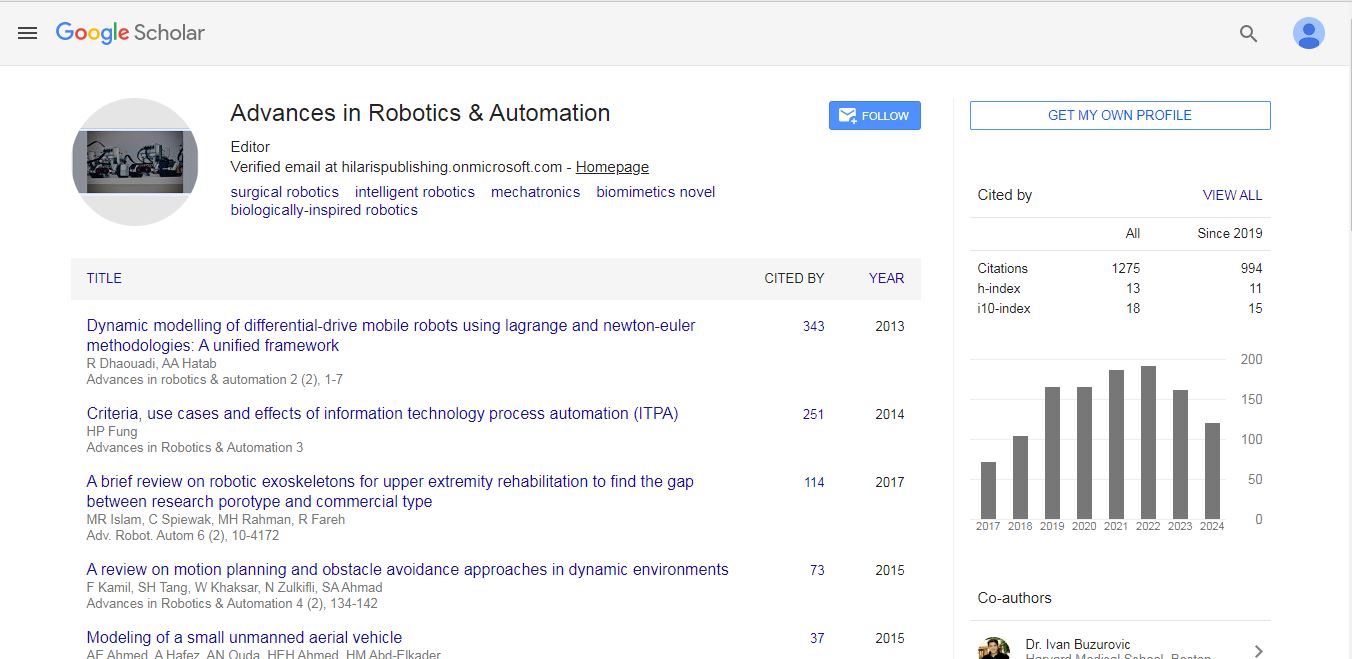
Advances in Robotics & Automation received 1275 citations as per Google Scholar report