Perspective - (2025) Volume 14, Issue 2
Received: 01-Mar-2025, Manuscript No. aim-25-177343;
Editor assigned: 03-Mar-2025, Pre QC No. P-177343;
Reviewed: 17-Mar-2025, QC No. Q-177343;
Revised: 24-Mar-2025, Manuscript No. R-177343;
Published:
31-Mar-2025
, DOI: 10.37421/2427-5162.2025.14.563
Citation: Laurent, Sophie. ”Acupuncture: Effective and Safe for Diverse Conditions.” Alt Integr Med 14 (2025):564.
Copyright: © 2025 Laurent S. This is an open-access article distributed under the terms of the Creative Commons Attribution License, which permits unrestricted use, distribution and reproduction in any medium, provided the original author and source are credited.
A comprehensive overview of systematic reviews confirms the efficacy of acupuncture in managing various chronic pain conditions, including musculoskeletal pain, headaches, and osteoarthritis. This evidence consistently positions acupuncture as a valuable treatment option, often demonstrating superiority over sham acupuncture or no treatment, thus solidifying its role in pain management strategies [1].
Delving beyond simplistic placebo explanations, a detailed review explores the multifaceted neurobiological mechanisms underpinning acupuncture's therapeutic effects. This research elucidates pathways such as the modulation of endogenous opioid systems, the release of key neurotransmitters, and significant anti-inflammatory responses, thereby providing a robust scientific foundation for its diverse clinical applications [2].
An extensive overview of systematic reviews synthesizes evidence on acupuncture's efficacy in addressing a spectrum of cancer-related symptoms. These include pain, nausea, fatigue, and anxiety, suggesting that acupuncture can function as a valuable adjunctive therapy to enhance the quality of life for cancer patients, generally exhibiting favorable safety profiles [3].
A comprehensive overview meticulously synthesizes findings from multiple systematic reviews concerning acupuncture's role in treating both depression and anxiety. The available evidence indicates that acupuncture, whether used independently or as a complementary intervention, can substantially alleviate symptoms of these conditions, presenting a promising non-pharmacological treatment option, though further high-quality trials are still warranted [4].
This narrative review investigates the application and supporting evidence for acupuncture in managing various gastrointestinal disorders. Conditions such as irritable bowel syndrome (IBS), functional dyspepsia, and inflammatory bowel disease are discussed, alongside proposed mechanisms of action including the modulation of gut motility and visceral sensitivity, highlighting acupuncture as a beneficial complementary therapy [5].
A systematic review and meta-analysis of randomized controlled trials rigorously assessed the safety profile of acupuncture, meticulously quantifying the incidence of adverse events. The findings conclude that acupuncture is generally a safe procedure when administered by qualified practitioners, with most reported adverse events being mild and transient, such as minor bleeding or localized pain [6].
An umbrella review comprehensively evaluates the efficacy and safety of acupuncture for knee osteoarthritis by integrating evidence from numerous systematic reviews and meta-analyses. It reaffirms that acupuncture can significantly reduce pain and improve physical function in affected patients, establishing it as a safe and effective non-pharmacological treatment option for this prevalent condition [7].
This umbrella review systematically assesses existing evidence from various systematic reviews and meta-analyses regarding acupuncture's effectiveness in both preventing and treating migraine. It conclusively demonstrates that acupuncture exerts a beneficial effect by reducing migraine frequency and intensity, thus serving as a valuable complementary therapy for individuals suffering from migraines [8].
An updated narrative review explores the current scientific evidence supporting acupuncture's role in enhancing fertility, encompassing conditions such as polycystic ovary syndrome (PCOS) and its application in assisted reproductive technology (ART). It discusses potential mechanisms, including improved ovarian function, hormonal regulation, and stress reduction, positioning acupuncture as a supportive therapy in reproductive health [9].
This narrative review examines the therapeutic potential of acupuncture across a diverse array of neurological disorders, including its application in stroke recovery, Parkinson's disease, and restless legs syndrome. It elucidates how acupuncture modulates neural pathways, enhances neurological function, and alleviates symptoms, underscoring its promise as a complementary treatment in neurorehabilitation [10].
Research indicates that acupuncture is highly effective for chronic pain management, as demonstrated by a broad overview of systematic reviews. It consistently proves its value for conditions like chronic musculoskeletal pain, headaches, and osteoarthritis, often outperforming sham or no-treatment controls, providing robust support for its therapeutic inclusion [1]. The therapeutic actions of acupuncture are not merely placebo effects but are rooted in complex neurobiological mechanisms, as elucidated by a detailed review. These mechanisms involve modulating endogenous opioid systems, influencing neurotransmitter release, and eliciting significant anti-inflammatory responses, thereby offering a scientific underpinning for its wide-ranging clinical applications [2]. For cancer patients, acupuncture provides notable benefits in managing various symptoms, including pain, nausea, fatigue, and anxiety, according to a comprehensive overview of systematic reviews. This suggests its utility as an important adjunctive therapy to enhance patient quality of life, alongside its generally favorable safety profile [3]. Evidence from multiple systematic reviews highlights acupuncture's potential in treating depression and anxiety. It can substantially reduce symptoms, either as a standalone treatment or when integrated with other therapies, presenting a viable non-pharmacological approach, though further high-quality studies are still required to strengthen these findings [4]. A narrative review discusses the utility of acupuncture in managing gastrointestinal disorders, such as irritable bowel syndrome, functional dyspepsia, and inflammatory bowel disease. Proposed mechanisms include the modulation of gut motility and visceral sensitivity, positioning acupuncture as a beneficial complementary intervention in gastroenterology [5]. The safety of acupuncture has been rigorously assessed through a systematic review and meta-analysis of randomized controlled trials. This extensive analysis concludes that acupuncture is largely safe when practiced by qualified professionals, with adverse events typically being mild and temporary, such as minor bleeding or localized discomfort [6]. Regarding knee osteoarthritis, an umbrella review confirms acupuncture's significant role in pain reduction and improvement of physical function. By synthesizing data from multiple reviews, it presents acupuncture as a safe and effective non-pharmacological treatment option, offering substantial benefits to patients suffering from this condition [7]. A comprehensive umbrella review on migraine prevention and treatment affirms acupuncture's beneficial effects. It effectively reduces both the frequency and intensity of migraines, establishing it as a valuable complementary therapy that can significantly improve the quality of life for migraine sufferers [8]. An updated narrative review examines the evidence supporting acupuncture's role in fertility, covering conditions like polycystic ovary syndrome (PCOS) and its use in assisted reproductive technology (ART). It suggests that acupuncture can support reproductive health by improving ovarian function, regulating hormones, and reducing stress levels [9]. Acupuncture demonstrates therapeutic potential across several neurological disorders, including stroke recovery, Parkinson's disease, and restless legs syndrome, as explored in a narrative review. It is posited to modulate neural pathways, improve neurological function, and alleviate various symptoms, underscoring its promise as a complementary treatment in neurorehabilitation contexts [10].
Acupuncture has emerged as a well-supported complementary therapy for a wide array of medical conditions, with robust evidence detailing its efficacy and safety. It is particularly effective in managing various chronic pain conditions, including musculoskeletal pain, headaches, and osteoarthritis, often proving superior to control interventions. Beyond pain, acupuncture shows promise in alleviating cancer-related symptoms such as nausea, fatigue, and anxiety, and significantly reduces symptoms of depression and anxiety. Its therapeutic benefits extend to gastrointestinal disorders like IBS and functional dyspepsia, by modulating gut motility and visceral sensitivity. Furthermore, acupuncture supports reproductive health, particularly in conditions like PCOS and during ART, and demonstrates potential in improving outcomes for neurological disorders such as stroke recovery and Parkinson's disease. Mechanistically, acupuncture's effects are attributed to neurobiological pathways involving endogenous opioid systems, neurotransmitter release, and anti-inflammatory responses. Overall, acupuncture is considered a generally safe procedure when performed by qualified practitioners, with most adverse events being mild and transient.
None
None
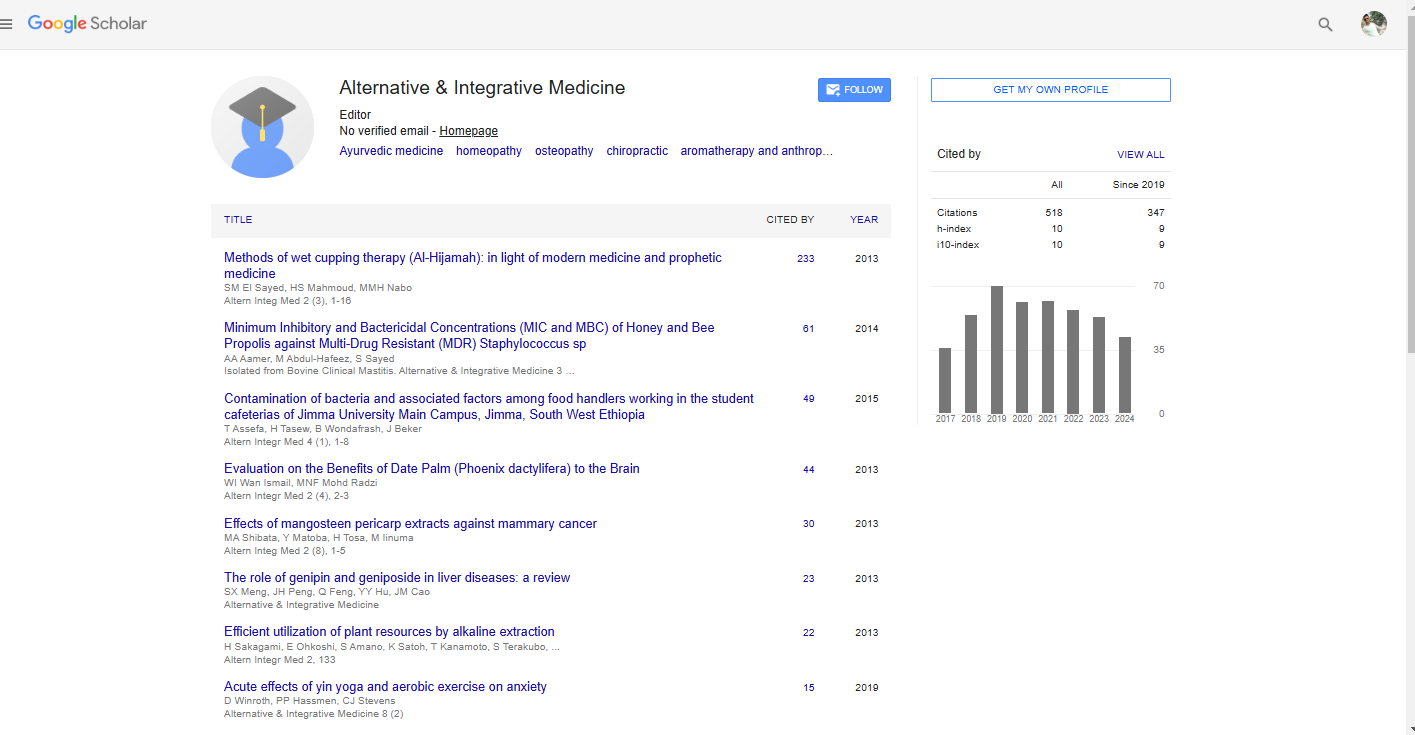
Alternative & Integrative Medicine received 476 citations as per Google Scholar report