Opinion - (127) Volume 8, Issue 5
Received: 01-Oct-2024, Manuscript No. jgge-24-156828;
Editor assigned: 03-Oct-2024, Pre QC No. P-156828;
Reviewed: 14-Oct-2024, QC No. Q-156828;
Revised: 21-Oct-2024, Manuscript No. R-156828;
Published:
29-Oct-2024
Citation: Weber, Sven. “Exploring the Human Genome: From DNA Sequencing to Understanding Gene Function and Regulation.” J Genet Genom 8 (2024): 140.
Copyright: © 2024 Weber S. This is an open-access article distributed under the terms of the Creative Commons Attribution License, which permits unrestricted use, distribution, and reproduction in any medium, provided the original author and source are credited.
The advent of genome sequencing represents a pivotal moment in the history of biological sciences, marking a transformative leap in our ability to unravel the intricate blueprint of life. From the initial deciphering of the human genome to the ongoing exploration of diverse organisms across the tree of life, genome sequencing technologies have fundamentally reshaped our understanding of genetics and molecular biology. This paper embarks on a journey through the landscape of genome sequencing, tracing its evolution and highlighting its profound implications for deciphering genetic function. Genome sequencing, the process of determining the complete DNA sequence of an organism's genome, has advanced significantly since the landmark completion of the Human Genome Project in 2003. Early methodologies, such as Sanger sequencing, laid the foundation for our understanding of genetic information but were limited in scale and efficiency. Genome sequencing has revolutionized biology by providing insights into the genetic makeup of organisms. Understanding how sequences relate to function is crucial for deciphering biological processes and improving medical treatments.
This paper explores the evolution of sequencing technologies and their impact on our understanding of genetic function. This introduction sets the stage by providing context, outlining the significance of genome sequencing, discussing technological advancements, and highlighting the broad impact of genomic research across various disciplines. It prepares the reader for the comprehensive exploration of genome sequencing and its implications for understanding genetic function that will follow in your paper [1].
Genome sequencing technologies have rapidly advanced, allowing researchers to decode entire genomes efficiently. diversity within species, track evolutionary changes over time, and uncover the genetic underpinnings of complex traits and diseases. This paper aims to explore the continuum from genome sequencing technologies to the elucidation of genetic function, emphasizing the transformative impact of genomic insights on our understanding of life's complexity. By delving into the methodologies, applications, and future directions of genome research, this review seeks to illuminate the evolving landscape of genetics and molecular biology in the 21st century. Beyond the technological advancements, the interpretation of genomic data has been propelled by the parallel growth of bioinformatics tools and computational methodologies. These tools play a crucial role in annotating genomes, predicting gene functions, identifying regulatory elements, and reconstructing evolutionary histories. The integration of multi-omics approaches, including transcriptomics, epigenomics, and metagenomics, has further enriched our understanding of genome function by capturing dynamic molecular interactions and environmental influences. This review examines how these technologies have expanded our understanding of genetic function, including gene expression, regulation, and variation. It explores case studies where genomic data have been applied to personalized medicine and agricultural improvements [2,3].
This section discusses the methodologies behind genome sequencing, such as Sanger sequencing and next-generation sequencing. It explores how bioinformatics tools are used to analyze genomic data and infer biological function. In parallel, genome sequencing has transcended the boundaries of basic research to impact diverse fields, from personalized medicine and agriculture to conservation biology and forensic science. The ability to sequence individual genomes has revolutionized medical diagnostics and treatment strategies, enabling personalized therapies tailored to an individual's genetic profile. In agriculture, genomic insights have accelerated crop improvement efforts, enhancing yield, resilience to pests and diseases, and nutritional content. Furthermore, genomic studies of endangered species have informed conservation strategies, guiding efforts to preserve biodiversity and mitigate the effects of habitat loss and climate change. The subsequent development of Next-Generation Sequencing (NGS) technologies revolutionized the field, enabling rapid, high-throughput sequencing at reduced costs. The insights gained from genome sequencing have illuminated fundamental aspects of genetic function, shedding light on gene regulation, expression dynamics, and evolutionary adaptations across species. Bioinformatics tools and computational approaches have played a pivotal role in deciphering the complexities of genomic data, enabling researchers to annotate genomes, predict gene functions, and reconstruct evolutionary histories with unprecedented accuracy and granularity. The application of genomic insights in personalized medicine exemplifies the transformative potential of genome sequencing. By elucidating the genetic basis of diseases and individualizing treatment strategies, genomic medicine has ushered in a new era of precision healthcare, where therapies are tailored to an individual's genetic profile. Similarly, in agriculture, genomic technologies have accelerated breeding programs, enhancing crop yield, resilience, and nutritional quality to address global food security challenges [4].
Looking forward, the integration of multi-omics approaches, including transcriptomics, epigenomics, and metagenomics, holds promise for unraveling the intricate networks of molecular interactions that underpin biological processes. Advances in single-cell sequencing technologies and spatial transcriptomics are poised to further enhance our understanding of cellular heterogeneity and tissue-specific gene expression patterns, providing deeper insights into developmental biology, disease mechanisms, and organismal complexity. Despite these advancements, challenges remain on the horizon. The interpretation of non-coding regions, understanding the functional implications of genetic variation, and addressing ethical considerations surrounding genomic data privacy and accessibility will require ongoing interdisciplinary collaboration and ethical scrutiny. In summary, exploring the genome from sequencing to function represents a paradigm shift in our approach to understanding life's complexity. As we continue to push the boundaries of genomic research, embracing technological innovations and integrating multi-omics approaches, we are poised to unlock new frontiers in biology, medicine, and beyond. By harnessing the power of genomic insights, we can aspire to a future where personalized therapies are commonplace, agricultural productivity is enhanced sustainably, and biodiversity is safeguarded for generations to come [5].
Moreover, genomic research has played a crucial role in biodiversity conservation, guiding efforts to preserve endangered species and mitigate the impacts of environmental change. By understanding the genetic diversity within and between populations, researchers can inform conservation strategies that promote genetic resilience and adaptability in the face of habitat loss and climate change. These technological innovations have democratized access to genomic data, empowering researchers worldwide to explore the genetic. Despite these remarkable advances, challenges persist in the field of genome research. The interpretation of non-coding regions, understanding the functional implications of genetic variation, and addressing ethical considerations surrounding genomic data privacy and accessibility are ongoing areas of exploration and debate. Case studies highlight breakthroughs in understanding genetic diseases, evolutionary processes, and environmental adaptations through genome analysis.
In conclusion, the journey from genome sequencing to understanding genetic function has profoundly reshaped our comprehension of biology and medicine. The evolution of sequencing technologies, from the pioneering efforts of Sanger sequencing to the high-throughput capabilities of next-generation sequencing platforms, has accelerated our ability to decode the genetic information encoded within genomes. These technological advancements have not only democratized access to genomic data but have also catalyzed breakthroughs in diverse fields, ranging from personalized medicine and agriculture to conservation biology and beyond. Genome sequencing has transformed biology by uncovering the intricacies of genetic function. Advances in technology continue to drive new discoveries, paving the way for personalized medicine and sustainable agriculture. Future research should focus on integrating multi-omics data to gain a comprehensive understanding of genome function and regulation. Ultimately, exploring the genome from sequencing to function promises to unlock new insights into life's complexities. This structured outline covers the essential components of your paper, providing a clear and organized framework for discussing the journey from genome sequencing to understanding genetic function. This conclusion summarizes the key findings and implications discussed throughout your paper, highlighting the transformative impact of genome sequencing on various fields and emphasizing the ongoing potential for future discoveries and advancements in genomic research.
None.
None.
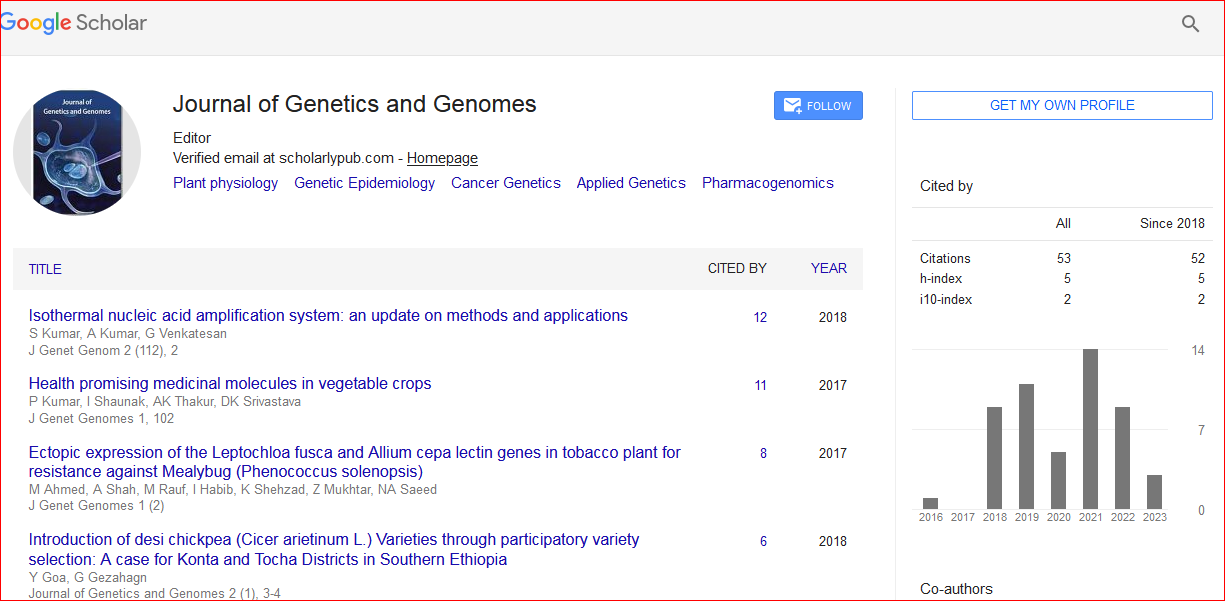
Journal of Genetics and Genomes received 65 citations as per Google Scholar report