Opinion - (2025) Volume 11, Issue 2
Received: 01-Apr-2025
Editor assigned: 03-Apr-2025
Reviewed: 17-Apr-2025
Revised: 22-Apr-2025
Published:
29-Apr-2025
, DOI: 10.37421/2471-9544.2025.11.297
Citation: Khan, Aisha. "Gut-Immune Axis: Vasculiti's Silent Architect." J Vasc 11 (2025):295.
Copyright: © 2025 Khan A. This is an open-access article distributed under the terms of the Creative Commons Attribution License, which permits unrestricted use, distribution and reproduction in any medium, provided the original author and source are credited.
The intricate relationship between luminal antigens, their processing within the gastrointestinal tract, and the subsequent development of systemic autoimmune responses, with a specific focus on vasculitis, is a rapidly evolving area of research [1].
Investigating the role of specific bacterial species and their metabolites in driving autoimmune reactions against endothelial cells, a key feature of vasculitis, offers novel insights into disease pathogenesis [2].
Mechanisms by which dietary components and food antigens influence gut permeability and immune tolerance, and how this relates to the pathogenesis of autoimmune diseases including vasculitis, are being closely examined [3].
The focus on specific T cell subsets, particularly those activated by luminal antigens, in driving the autoimmune inflammation characteristic of vasculitis, highlights the critical role of adaptive immunity [4].
The concept of 'molecular mimicry' between bacterial antigens in the gut lumen and self-antigens expressed on vascular endothelium provides a plausible explanation for the initiation of autoimmune responses [5].
The influence of the gut microbiome on the differentiation and function of regulatory T cells (Tregs), which are crucial for maintaining immune tolerance, is fundamental to understanding the breakdown of self-recognition [6].
Exploring the role of B cells and autoantibody production in vasculitis, with a focus on how gut-derived antigens might prime B cells to produce autoantibodies that target endothelial cells, sheds light on humoral immunity's contribution [7].
The impact of intestinal permeability, often referred to as 'leaky gut,' on systemic inflammation and autoimmunity is a central theme, with implications for understanding antigen translocation [8].
Reviews discussing the therapeutic potential of targeting the gut microbiome or restoring intestinal barrier function in patients with autoimmune diseases suggest promising avenues for intervention [9].
Investigating the specific immune cell populations and inflammatory mediators involved in the response to gut-derived antigens in the context of vasculitis aims to identify key molecular pathways that perpetuate the autoimmune process [10].
This article explores the intricate relationship between luminal antigens, their processing within the gastrointestinal tract, and the subsequent development of systemic autoimmune responses, with a specific focus on vasculitis. It highlights how dysregulation in the gut microbiome and epithelial barrier function can lead to the translocation of luminal antigens, triggering aberrant immune activation and the formation of autoantibodies that target vascular structures. The review emphasizes the importance of understanding these 'autoimmune currents' originating from the gut lumen to develop targeted therapies for autoimmune vasculitis [1].
Investigating the role of specific bacterial species and their metabolites in driving autoimmune reactions against endothelial cells, a key feature of vasculitis, is crucial. The study identifies certain gut microbial products that can mimic self-antigens or directly activate immune cells, contributing to the inflammatory cascade within blood vessels. This research points towards microbiome modulation as a potential therapeutic avenue [2].
This paper examines the mechanisms by which dietary components and food antigens influence gut permeability and immune tolerance, and how this relates to the pathogenesis of autoimmune diseases, including vasculitis. It details how breaches in the intestinal barrier allow undigested food particles and microbial products to enter the circulation, potentially initiating or exacerbating autoimmune responses [3].
Focusing on the role of specific T cell subsets, particularly those activated by luminal antigens, in driving the autoimmune inflammation characteristic of vasculitis, is essential. It discusses how aberrant T cell responses, influenced by the gut microenvironment, can lead to targeted attacks on blood vessels [4].
This research explores the concept of 'molecular mimicry' between bacterial antigens in the gut lumen and self-antigens expressed on vascular endothelium. It provides evidence that infections or dysbiosis can initiate autoimmune responses by triggering antibodies or T cells that cross-react with host tissues [5].
This study investigates how the gut microbiome influences the differentiation and function of regulatory T cells (Tregs), which are crucial for maintaining immune tolerance. Dysbiosis can impair Treg function, leading to the breakdown of tolerance and the emergence of autoimmune responses, including those targeting blood vessels [6].
This review examines the role of B cells and autoantibody production in vasculitis, with a focus on how gut-derived antigens might prime B cells to produce autoantibodies that target endothelial cells. It explores the possibility of gut-specific B cell activation contributing to the systemic autoimmune process [7].
This review discusses the impact of intestinal permeability ('leaky gut') on systemic inflammation and autoimmunity. It highlights how increased intestinal permeability allows luminal contents, including microbial products and antigens, to translocate into the bloodstream, activating immune cells and contributing to conditions like vasculitis [8].
This work explores the therapeutic potential of targeting the gut microbiome or restoring intestinal barrier function in patients with autoimmune diseases. It discusses how interventions like probiotics, prebiotics, and fecal microbiota transplantation might modulate the 'autoimmune currents' originating from the gut [9].
This study investigates the specific immune cell populations and inflammatory mediators involved in the response to gut-derived antigens in the context of vasculitis. It aims to identify key molecular pathways that perpetuate the autoimmune process, offering targets for novel therapies [10].
The gut-immune axis plays a critical role in the pathogenesis of systemic autoimmune diseases, particularly vasculitis. Luminal antigens, processed in the gastrointestinal tract, can trigger aberrant immune responses due to dysregulation in the gut microbiome and epithelial barrier function. This can lead to the translocation of antigens, activation of immune cells, and the development of autoantibodies targeting vascular structures. Mechanisms such as molecular mimicry between microbial and self-antigens, and altered T cell and B cell responses originating from the gut, contribute to vasculitis. Intestinal permeability, or 'leaky gut,' exacerbates these processes by allowing luminal contents to enter the circulation. Strategies targeting the gut microbiome and restoring intestinal barrier integrity show therapeutic promise for autoimmune diseases.
None
None
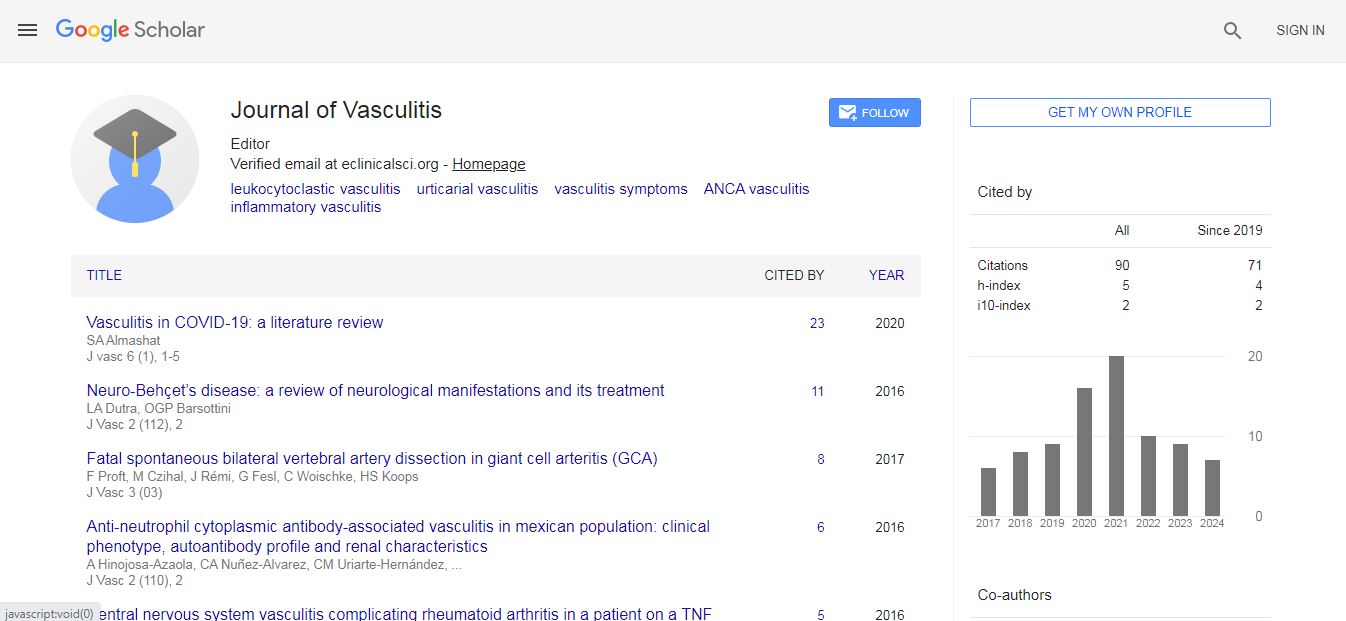
Journal of Vasculitis received 83 citations as per Google Scholar report