Commentry - (2025) Volume 11, Issue 2
Received: 01-Apr-2025
Editor assigned: 03-Apr-2025
Reviewed: 17-Apr-2025
Revised: 22-Apr-2025
Published:
29-Apr-2025
, DOI: 10.37421/2471-9544.2025.11.295
Citation: Rossi, Sofia. ”Temporal Pulses in Endothelial Cells: Vasculitis Insights.” J Vasc 11 (2025):293.
Copyright: © 2025 Rossi S. This is an open-access article distributed under the terms of the Creative Commons Attribution License, which permits unrestricted use, distribution and reproduction in any medium, provided the original author and source are credited.
This study delves into the intricate nature of temporal pulses within the endothelium, specifically in the context of vasculitis. These transient fluctuations in endothelial cell behavior are crucial for understanding the progression of vascular inflammation and damage, offering a novel perspective on micro-environmental changes that drive endothelial dysfunction in autoimmune diseases. The research highlights how dynamic events, often triggered by inflammation, contribute significantly to the pathogenesis of vasculitis. Investigating the molecular signals that orchestrate these temporal endothelial pulses in vasculitis reveals a complex interplay of pro-inflammatory cytokines and shear stress. The findings suggest that specific temporal patterns of these signals are predictive of disease flares and endothelial barrier disruption, laying the groundwork for chronotherapeutic strategies targeting these pulsatile events. The role of mechanotransduction in generating temporal pulses within the endothelium of compromised vascular areas, such as those with reduced blood flow or inflammation, is thoroughly examined. The study demonstrates how altered mechanical forces, in concert with inflammatory signals, induce transient periods of increased endothelial permeability and leukocyte adhesion, which are critical for the formation of vasculitic lesions. This paper elucidates the temporal profile of micro-RNA (miRNA) expression changes occurring in endothelial cells during vasculitis, which are instrumental in driving pulsatile behavior. Specific miRNAs are identified that transiently regulate endothelial barrier function and inflammatory gene expression, thus presenting potential targets for modulating these critical pulses. The study investigates how oscillatory shear stress, a specific manifestation of temporal pulse, impacts endothelial cell signaling pathways pertinent to vasculitis. It reveals that distinct frequencies of shear stress can transiently enhance endothelial permeability and the expression of adhesion molecules, thereby mimicking the early stages of vascular inflammation. This research concentrates on the dynamic nature of vascular endothelial growth factor (VEGF) signaling and its pulsatile release during inflammatory processes, which profoundly influences endothelial cell behavior in vasculitis. The temporal dimension of VEGF signaling is demonstrated to be indispensable for transient angiogenesis and the occurrence of vascular leakage. The study explores the critical role of extracellular vesicles (EVs) in mediating temporal communication between endothelial cells within the complex milieu of vasculitis. Specific EV cargo is identified that undergoes pulsatile release, thereby influencing endothelial activation and the subsequent recruitment of immune cells. This paper critically examines the temporal changes observed in endothelial cell stiffness and its consequential impact on leukocyte adhesion in the context of vasculitis. The findings indicate that transient alterations in endothelial mechanics, often referred to as 'pulses' of stiffness, effectively facilitate immune cell transmigration. The study characterizes the pulsatile release of inflammatory mediators from endothelial cells in response to immune complexes, a pivotal event in the pathogenesis of vasculitis. This transient release mechanism serves to amplify the inflammatory cascade and attract additional immune cells to the site of vascular injury. This work systematically investigates the temporal patterns of reactive oxygen species (ROS) production by endothelial cells in vasculitic conditions. The findings suggest that transient bursts, or 'pulses,' of ROS significantly contribute to endothelial dysfunction and subsequent damage, underscoring ROS signaling as a promising therapeutic target.
The significance of temporal pulses, defined as transient fluctuations in endothelial cell behavior, within the context of vasculitis is explored. These dynamic events, often occurring in response to inflammatory triggers, contribute to the pathogenesis of vascular inflammation and damage, offering a novel perspective on the micro-environmental changes that precipitate and perpetuate endothelial dysfunction in autoimmune diseases. Molecular signals driving temporal endothelial pulses in vasculitis reveal a complex interplay of pro-inflammatory cytokines and shear stress. Specific temporal patterns of these signals can predict disease flares and endothelial barrier disruption, laying the groundwork for chronotherapeutic strategies targeting these pulsatile events. Mechanotransduction's role in generating temporal pulses within the endothelium of shadowed areas (regions with reduced blood flow or inflammation) is examined. Altered mechanical forces, in conjunction with inflammatory signals, create transient periods of increased endothelial permeability and leukocyte adhesion, critical for vasculitic lesion formation. The temporal profile of micro-RNA (miRNA) expression changes in endothelial cells during vasculitis, which contribute to pulsatile behavior, is elucidated. Specific miRNAs are identified that transiently regulate endothelial barrier function and inflammatory gene expression, offering potential targets for modulating these pulses. The impact of oscillatory shear stress, a form of temporal pulse, on endothelial cell signaling pathways relevant to vasculitis is investigated. Specific frequencies of shear stress can transiently increase endothelial permeability and adhesion molecule expression, mimicking early stages of vascular inflammation. The dynamic nature of vascular endothelial growth factor (VEGF) signaling and its pulsatile release during inflammation, which influences endothelial cell behavior in vasculitis, is the focus. The temporal aspect of VEGF signaling is shown to be critical for transient angiogenesis and vascular leakage. Extracellular vesicles (EVs) mediate temporal communication between endothelial cells in the context of vasculitis. Specific EV cargo released in a pulsatile manner influences endothelial activation and immune cell recruitment. Temporal changes in endothelial cell stiffness and their impact on leukocyte adhesion in vasculitis are investigated. Transient alterations in endothelial mechanics, or 'pulses' of stiffness, facilitate immune cell transmigration. The pulsatile release of inflammatory mediators from endothelial cells in response to immune complexes, a key event in vasculitis, is characterized. This transient release amplifies the inflammatory cascade and recruits more immune cells to the site of vascular injury. Temporal patterns of reactive oxygen species (ROS) production by endothelial cells in vasculitis are examined. Transient bursts of ROS, or 'pulses,' contribute to endothelial dysfunction and damage, highlighting ROS signaling as a potential therapeutic target.
This collection of research explores the critical role of temporal pulses in endothelial cells during vasculitis. Studies highlight how transient fluctuations in endothelial behavior, driven by factors like inflammatory cytokines, shear stress, and mechanotransduction, contribute to vascular inflammation and damage. The research also identifies molecular regulators such as microRNAs and signaling molecules like VEGF, along with extracellular vesicles, that mediate these pulsatile events. Changes in endothelial cell mechanics and reactive oxygen species production are also implicated. Understanding these temporal dynamics offers potential avenues for developing targeted therapeutic strategies for vasculitis.
None
None
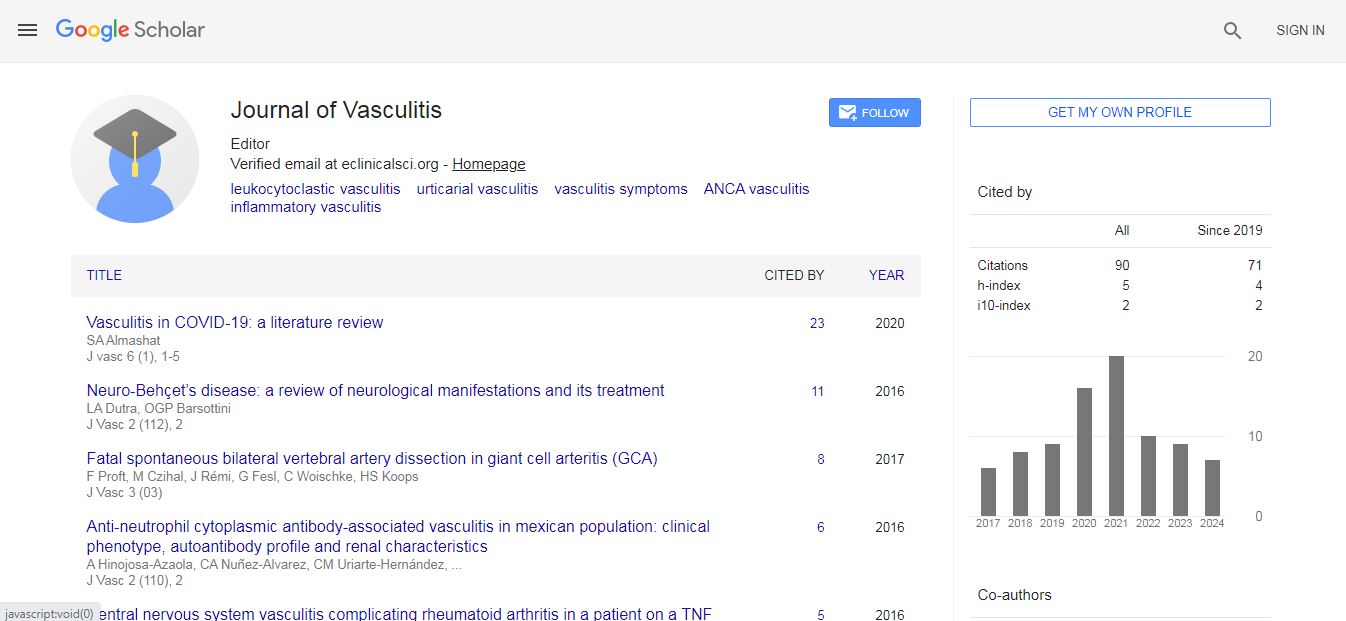
Journal of Vasculitis received 83 citations as per Google Scholar report