Short Communication - (2025) Volume 16, Issue 5
Received: 01-Oct-2025
Editor assigned: 03-Oct-2025
Reviewed: 17-Oct-2025
Revised: 22-Oct-2025
Published:
29-Oct-2025
, DOI: 10.37421/2155-6180.2025.16.300
Citation: Liu, Katherine. ”Biometric Continuous Authentication: Enhancing Security Through Traits.” J Biom Biosta 16 (2025):300.
Copyright: © 2025 Liu K. This is an open-access article distributed under the terms of the Creative Commons Attribution License, which permits unrestricted use, distribution and reproduction in any medium, provided the original author and source are credited.
Biometric-based continuous authentication systems represent a significant advancement in cybersecurity, moving beyond traditional one-time logins to provide ongoing verification of user identity through physiological or behavioral traits. These systems are increasingly vital for safeguarding sensitive information during extended online sessions, offering a more robust security posture compared to static password-based methods [1].
The ongoing development in this field is marked by the creation of adaptive algorithms capable of learning and responding to user patterns, fostering a more dynamic and secure environment. Furthermore, the integration of multiple biometric modalities is a key trend, enhancing accuracy and resilience against sophisticated spoofing techniques, thereby strengthening overall system security [1].
The exploration of unobtrusive authentication methods, such as analyzing keystroke dynamics and gait patterns, aims to balance security requirements with user experience, making continuous authentication less intrusive [1].
However, the implementation of these advanced systems faces considerable challenges, including the critical need to manage data privacy effectively and ensure that user information is protected throughout the authentication process [1].
System efficiency is another paramount concern, as continuous monitoring and analysis demand substantial computational resources without negatively impacting user performance or system responsiveness [1].
Mitigating the impact of environmental variations on biometric readings is also a complex task, as external factors can alter physiological and behavioral signals, potentially leading to false rejections or acceptances [1].
Research into multimodal fusion, combining different biometric traits, is actively pursued to overcome the limitations of single-modality systems and improve overall robustness and accuracy [2, 5]. The application of deep learning techniques, particularly in areas like gait recognition, is revolutionizing the field by enabling the development of highly accurate models capable of handling real-world complexities [3].
Physiological signals, such as ECG and EEG, are emerging as promising biometrics due to their inherent uniqueness and stability, offering a secure basis for continuous verification [4].
The integration of wearable sensors is also gaining traction, leveraging devices like smartwatches to unobtrusively monitor user behavior for authentication purposes [8].
Continuous authentication in specialized environments like virtual reality is also being explored, utilizing head and gaze patterns to maintain secure access [9].
Finally, the deployment of these systems in enterprise settings requires careful consideration of trade-offs between security, user experience, and administrative overhead, often leading to hybrid approaches for optimal results [10].
Biometric-based continuous authentication systems are designed to provide a perpetual layer of security by continuously verifying a user's identity through a range of physiological and behavioral characteristics. Unlike traditional authentication methods that rely on a single login event, these systems operate throughout a user's session, offering enhanced protection for sensitive data and long-running applications [1].
A significant area of research involves the development of adaptive algorithms that learn and evolve with user behavior, ensuring that the system remains accurate and effective over time, even as user patterns naturally change [7].
The integration of multiple biometric modalities, such as combining facial recognition with voice analysis or keystroke dynamics with mouse movements, is a crucial strategy to increase accuracy and resilience against spoofing attacks [2, 5]. These multimodal approaches leverage the unique strengths of different biometrics to create a more robust and reliable authentication framework [2, 5]. Unobtrusive methods, including keystroke dynamics, gait analysis, and even subtle physiological signals like heartbeats (ECG) and brainwaves (EEG), are being explored to minimize user inconvenience while maintaining high security levels [1, 3, 4]. Deep learning techniques, particularly Convolutional Neural Networks (CNNs) and Recurrent Neural Networks (RNNs), are instrumental in processing and analyzing complex biometric data, such as walking patterns for gait recognition, leading to highly accurate identification models [3].
The use of physiological signals like ECG and EEG is appealing due to their inherent stability and uniqueness, providing a secure foundation for continuous verification, with ongoing research focusing on fusion mechanisms to enhance reliability [4].
In the realm of mobile and Internet of Things (IoT) environments, wearable sensors integrated into devices like smartwatches are being utilized to capture behavioral patterns from accelerometers and gyroscopes for unobtrusive authentication [8].
Furthermore, specialized environments like virtual reality (VR) are seeing the development of continuous authentication methods based on head movements and gaze patterns, addressing the unique challenges of immersive digital spaces [9].
For enterprise environments, a key consideration is balancing stringent security requirements with user experience and administrative manageability, often leading to hybrid authentication frameworks that combine biometrics with conventional methods [10].
A critical aspect across all these applications is the management of data privacy, with techniques like differential privacy and homomorphic encryption being employed to protect sensitive biometric data while enabling continuous verification [6].
Biometric-based continuous authentication systems continuously verify user identity through physiological or behavioral traits, enhancing security beyond traditional logins. Key developments include adaptive algorithms, multimodal biometric integration for improved accuracy and spoofing resistance, and unobtrusive methods like keystroke dynamics and gait analysis. Challenges involve data privacy management, system efficiency, and mitigating environmental variations. Deep learning is applied to areas like gait recognition, while physiological signals (ECG, EEG) and wearable sensors offer new authentication avenues. Specialized environments like VR are also incorporating head and gaze biometrics. Enterprise deployments often utilize hybrid approaches combining various methods. Privacy-preserving techniques are crucial for protecting sensitive biometric data.
None
None
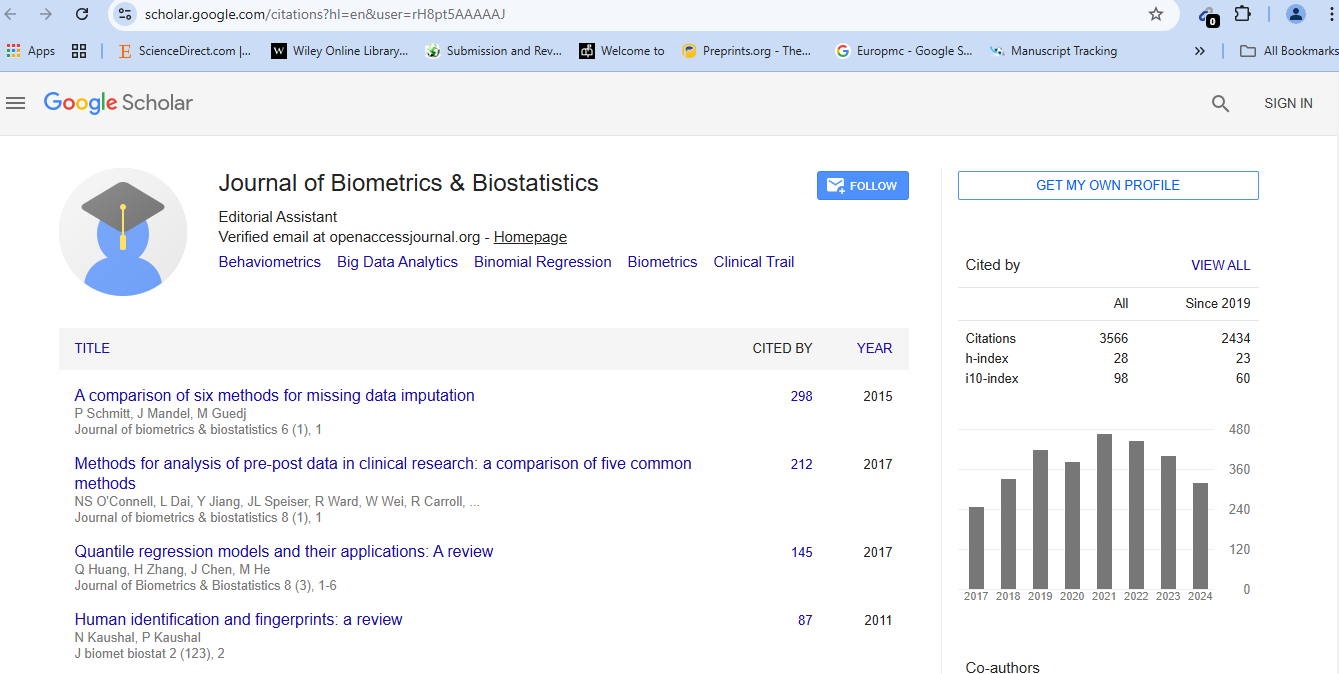
Journal of Biometrics & Biostatistics received 3496 citations as per Google Scholar report