Short Communication - (2025) Volume 17, Issue 4
Received: 01-Aug-2025
Editor assigned: 03-Aug-2025
Reviewed: 17-Aug-2025
Revised: 24-Aug-2025
Published:
31-Aug-2025
, DOI: 10.37421/1948-593X.2025.17.509
Citation: Kostina, Elena M.. ”Advances and Challenges in Hormone and Metabolic Biomarker Analysis.” J Bioanal Biomed 17 (2025):509.
Copyright: © 2025 Kostina M. Elena This is an open-access article distributed under the terms of the Creative Commons Attribution License, which permits unrestricted use, distribution and reproduction in any medium, provided the original author and source are credited.
The accurate and precise bioanalysis of hormones and metabolic biomarkers is fundamental to modern clinical diagnostics and patient management. Recent advancements have significantly improved assay sensitivity, specificity, and throughput, which are critical for diagnosing and monitoring a wide range of endocrine and metabolic disorders. These sophisticated methodologies enable a deeper understanding of disease mechanisms and the effectiveness of therapeutic interventions. The field is continuously evolving to meet the increasing demands for reliable and efficient analytical techniques in healthcare settings. One significant area of advancement involves the application of mass spectrometry, particularly liquid chromatography-tandem mass spectrometry (LC-MS/MS), for the quantitative analysis of steroid hormones. This technique offers high accuracy and a broad dynamic range, addressing many of the limitations of older methods, especially when dealing with complex biological matrices such as blood and urine. Another crucial aspect of hormone analysis is the development and validation of immunoassays, which are widely used for measuring peptide hormones like insulin and glucagon. The reliability of these assays hinges on careful epitope mapping and judicious antibody selection to ensure specificity and minimize cross-reactivity, which is paramount for accurate diagnosis and management, particularly in diabetes. The accurate measurement of thyroid hormones, including T3, T4, and TSH, presents its own set of analytical challenges. Pre-analytical variables can significantly impact results, and standardization across different laboratories is essential for ensuring comparability and facilitating effective diagnosis and management of thyroid dysfunction. Beyond traditional hormones, the identification and quantification of novel biomarkers for metabolic syndrome are gaining prominence. This includes specific lipid profiles and inflammatory markers, for which validated bioanalytical assays are needed to integrate them into routine clinical practice for early detection and prevention of associated diseases like cardiovascular disease. The evolution of point-of-care testing (POCT) devices has also impacted hormone and metabolic biomarker analysis. These devices offer the advantage of rapid results and decentralized testing, but challenges remain in ensuring assay accuracy and regulatory compliance comparable to laboratory-based methods. In the realm of reproductive health, the bioanalysis of sex hormones requires specialized methodologies. Addressing diurnal variations and inter-individual differences is key to developing sensitive and precise assays that can effectively guide fertility treatments and manage hormonal imbalances. Adrenal hormones, such as cortisol, play a critical role in stress-related disorders. The accurate quantification of these hormones in various biological samples like saliva, urine, and blood is essential for diagnosing conditions such as Cushing's syndrome and Addison's disease. The measurement of vitamin D metabolites is vital for assessing bone health and immune function. Accurately quantifying 25-hydroxyvitamin D, considering its various isoforms and potential matrix effects, remains a focus of bioanalytical method development. Finally, the burgeoning field of metabolomics is revolutionizing clinical diagnostics by analyzing comprehensive metabolic profiles. High-throughput analytical platforms and sophisticated data analysis strategies are being employed to uncover new biomarkers for early disease detection and to pave the way for personalized medicine.
The clinical bioanalysis of hormones and metabolic biomarkers involves sophisticated methodologies aimed at achieving high sensitivity, specificity, and throughput. These advancements are crucial for accurate patient diagnosis and monitoring, particularly in the context of endocrine and metabolic disorders, and for assessing therapeutic responses. The field is characterized by continuous innovation, driven by the need for more precise and reliable diagnostic tools in healthcare. Mass spectrometry-based techniques, especially LC-MS/MS, have revolutionized the quantification of steroid hormones in complex biological matrices. These methods overcome challenges related to sample preparation and ionization efficiency, offering improved accuracy and a wider dynamic range for clinical applications. Immunoassays remain a cornerstone for measuring peptide hormones such as insulin and glucagon. Significant effort is dedicated to assay development and validation, focusing on epitope mapping and antibody selection to ensure reliability and minimize cross-reactivity, which is vital for managing conditions like diabetes. Thyroid hormone measurements, including T3, T4, and TSH, are subject to analytical challenges stemming from pre-analytical variables. Standardization of assays across laboratories is a key area of focus to ensure comparable results for effective diagnosis and management of thyroid dysfunction. Novel biomarkers for metabolic syndrome are being explored, necessitating robust bioanalytical quantification. The utility of specific lipid profiles and inflammatory markers depends on the availability of validated assays that can be integrated into routine clinical practice for early disease detection. Point-of-care testing (POCT) devices for hormone and metabolic biomarker analysis offer rapid results and decentralization. However, maintaining analytical accuracy and regulatory compliance remains a challenge compared to traditional laboratory-based methods. Bioanalytical methodologies for sex hormones are critical in reproductive health. Addressing diurnal variations and inter-individual differences requires sensitive and precise assays to guide fertility treatments and manage hormonal imbalances. The clinical bioanalysis of adrenal hormones, such as cortisol, is essential for understanding stress-related disorders. Quantifying these hormones in saliva, urine, and blood accurately aids in the diagnosis of conditions like Cushing's syndrome and Addison's disease. Analytical techniques for vitamin D metabolites are crucial for assessing bone health and immune function. Accurately quantifying 25-hydroxyvitamin D, considering different isoforms and matrix effects, is an ongoing area of research. Metabolomics is emerging as a powerful tool in clinical diagnostics, focusing on metabolic biomarkers. High-throughput analytical platforms and advanced data analysis strategies hold significant potential for personalized medicine and early disease detection.
This collection of research highlights significant advancements and ongoing challenges in the clinical bioanalysis of hormones and metabolic biomarkers. Key areas of focus include the improved accuracy of mass spectrometry for steroid hormone analysis, the development and validation of immunoassays for peptide hormones, and the analytical considerations for thyroid hormone measurement. Emerging topics include the identification of novel biomarkers for metabolic syndrome, the performance of point-of-care testing devices, the bioanalysis of sex hormones in reproductive health, and the quantification of adrenal hormones related to stress. The field also addresses the challenges in measuring vitamin D metabolites and the growing potential of metabolomics for personalized medicine and early disease detection. Overall, the research emphasizes the critical role of sophisticated analytical techniques in providing accurate diagnostic information for a wide range of health conditions.
None
None
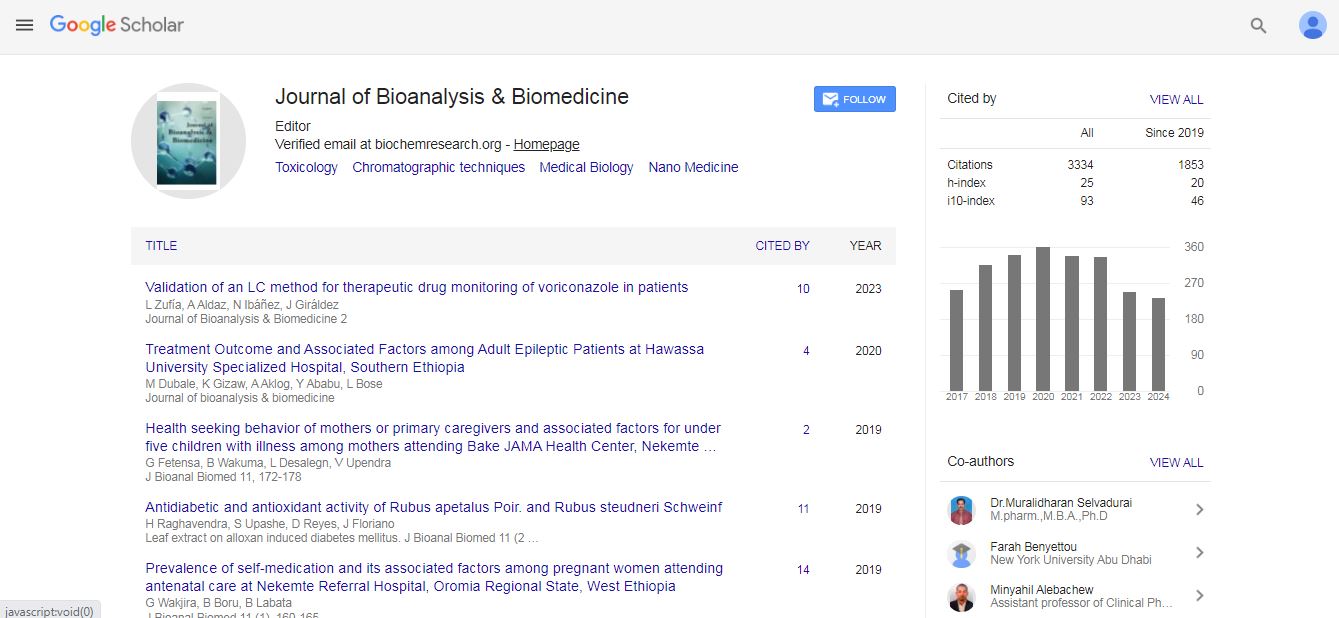
Journal of Bioanalysis & Biomedicine received 3099 citations as per Google Scholar report