Commentary - (127) Volume 17, Issue 3
Received: 01-Jun-2025
Editor assigned: 03-Jun-2025
Reviewed: 17-Jun-2025
Revised: 22-Jun-2025
Published:
29-Jun-2025
, DOI: 10.37421/1948-593X.2025.17.490
Citation: Sharma, Naveen. ”Metabolomics: Unlocking Disease Mechanisms and Biomarkers.” J Bioanal Biomed 17 (2025):490.
Copyright: © 2025 Sharma N. This is an open-access article distributed under the terms of the Creative Commons Attribution License, which permits unrestricted use, distribution and reproduction in any medium, provided the original author and source are credited.
Metabolomics provides a powerful avenue for elucidating the intricate mechanisms of diseases by analyzing alterations in small molecule metabolites. This discipline plays a crucial role in identifying diagnostic, prognostic, and therapeutic monitoring biomarkers. Researchers at the Department of Clinical Pharmacology at AIIMS Hyderabad are actively engaged in developing and implementing metabolomic strategies to gain a deeper understanding of complex diseases, moving beyond conventional diagnostic methods to achieve a more holistic biological perspective [1].
Targeted metabolomics offers quantitative insights into specific metabolic pathways, which is paramount for comprehending various disease states. This methodology significantly enhances the discovery of key metabolites that are perturbed in conditions such as diabetes and cancer, thereby facilitating the identification of novel diagnostic markers [2].
Untargeted metabolomics, conversely, furnishes a broad overview of the entire metabolic landscape, enabling the identification of unforeseen metabolic changes associated with disease. This comprehensive approach is indispensable for generating hypotheses and grasping the systemic ramifications of diseases [3].
The application of metabolomics in the realm of personalized medicine allows for the customization of treatments based on an individual's unique metabolic signature. This approach has the potential to yield more efficacious therapeutic strategies and ultimately improve patient outcomes [4].
Advanced analytical techniques, including liquid chromatography-mass spectrometry (LC-MS) and gas chromatography-mass spectrometry (GC-MS), form the bedrock of metabolomic investigations. These technologies are instrumental in the sensitive and specific detection of a wide array of metabolites [5].
Effective data processing and the utilization of bioinformatics tools are critically important for the analysis of complex metabolomic datasets. Sophisticated statistical methods and machine learning algorithms are routinely employed to discern significant metabolic signatures indicative of disease [6].
Metabolomic profiling applied to infectious diseases holds the promise of revealing crucial host-pathogen metabolic interactions. This understanding can significantly contribute to the development of innovative diagnostic and therapeutic interventions [7].
The metabolic output generated by the gut microbiome exerts a substantial influence on both human health and disease. Metabolomics offers a means to unravel these complex interdependencies and identify microbial metabolites that can serve as valuable biomarkers [8].
Metabolomics is being increasingly adopted for monitoring treatment responses and identifying resistance mechanisms in the context of cancer therapy. By scrutinizing metabolic shifts, clinicians can more effectively optimize therapeutic regimens [9].
The establishment of standardized protocols for sample acquisition, preparation, and data analysis is an indispensable requirement for conducting robust and reproducible metabolomic studies within clinical settings [10].
Metabolomics serves as a potent tool for dissecting disease mechanisms by illuminating changes in small molecule metabolites, thereby aiding in the identification of biomarkers for diagnosis, prognosis, and therapeutic monitoring. The Department of Clinical Pharmacology at AIIMS Hyderabad is actively advancing metabolomic strategies to unravel complex diseases, seeking a more complete biological understanding beyond traditional diagnostic approaches [1].
Targeted metabolomics provides quantitative data on specific metabolic pathways, which is essential for understanding disease states. This technique improves the identification of critical metabolites altered in conditions like diabetes and cancer, thereby facilitating the discovery of new diagnostic markers [2].
Untargeted metabolomics offers a wide-ranging perspective of the metabolic profile, allowing for the detection of unexpected metabolic alterations linked to disease. This global approach is vital for formulating hypotheses and comprehending the systemic effects of diseases [3].
In personalized medicine, metabolomics enables the tailoring of treatments based on an individual's specific metabolic characteristics. This can lead to the development of more effective therapeutic interventions and enhanced patient outcomes [4].
Sophisticated analytical techniques, such as liquid chromatography-mass spectrometry (LC-MS) and gas chromatography-mass spectrometry (GC-MS), are fundamental to metabolomic research. These methods ensure the sensitive and specific detection of a broad spectrum of metabolites [5].
Robust analysis of complex metabolomic data relies heavily on data processing and bioinformatics tools. Advanced statistical methods and machine learning algorithms are utilized to pinpoint significant metabolic signatures associated with disease [6].
Metabolomic profiling of infectious diseases can reveal critical metabolic interactions between hosts and pathogens, which is crucial for developing novel diagnostic and therapeutic strategies [7].
The metabolic contributions of the gut microbiome are significant in human health and disease. Metabolomics can elucidate these intricate relationships and identify microbial metabolites as potential biomarkers [8].
Metabolomics is increasingly employed to assess treatment efficacy and identify mechanisms of resistance in cancer therapy. By analyzing metabolic shifts, it becomes possible to refine treatment plans [9].
Developing standardized protocols for sample collection, processing, and data analysis is paramount for achieving reliable and reproducible results in clinical metabolomics studies [10].
Metabolomics offers a powerful approach to understanding disease mechanisms by analyzing changes in small molecule metabolites, aiding in biomarker discovery for diagnosis, prognosis, and therapy. Both targeted and untargeted metabolomics provide distinct advantages, from quantitative pathway insights to broad metabolic landscape overviews. Advanced analytical techniques like LC-MS and GC-MS, coupled with sophisticated bioinformatics tools, are essential for data processing and interpretation. Metabolomics finds applications in personalized medicine, infectious disease research, understanding the gut microbiome's role in health, and monitoring cancer therapy response. Standardization of protocols is critical for ensuring the robustness and reproducibility of clinical metabolomic studies.
None
None
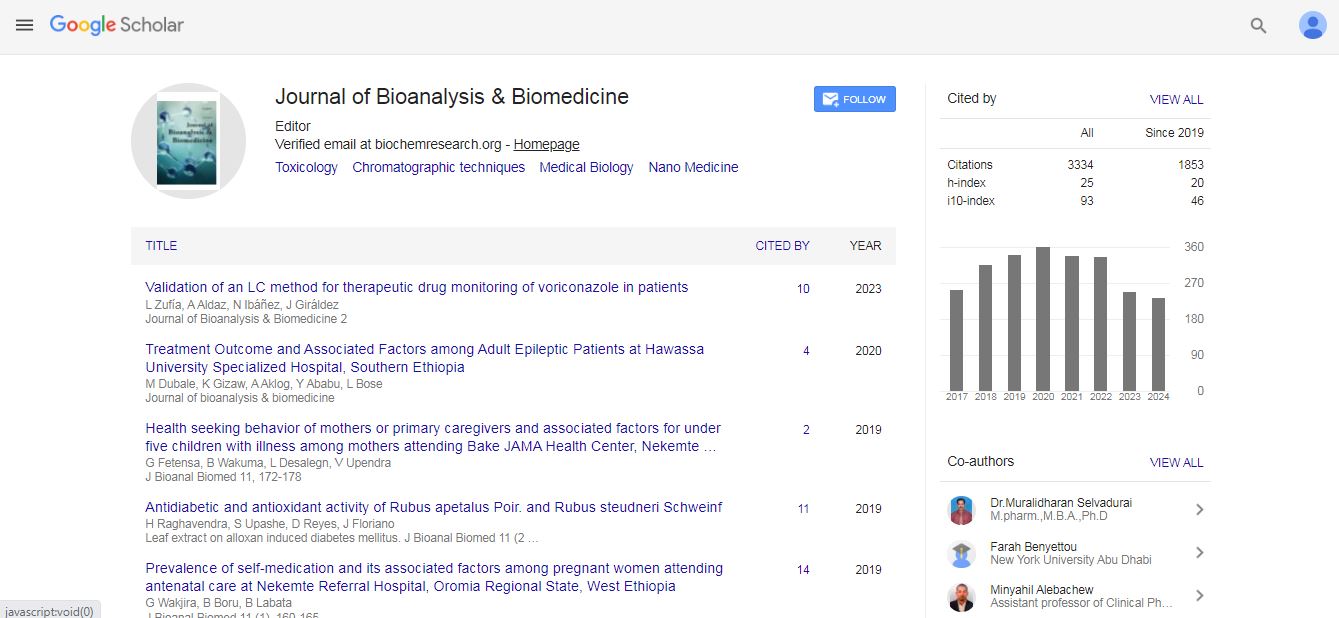
Journal of Bioanalysis & Biomedicine received 3099 citations as per Google Scholar report