Dopamine (DA) dysfunction, glutamate, neurodevelopmental deficits or neural stem cell dysfunction (NSC) are well known hypotheses for the etiology of schizophrenia. The AD dysfunction hypothesis suggested that mesolimbic AD hyperactivity provoked positive symptoms such as paranoid-hallucinatory schizophrenic status [1,2]. It is also explained by the effectiveness of DA D2 blockers for the paranoid hallucinatory state and also by the hallucinogenic acts of DA stimulants, including methamphetamine or amphetamine. The theory of glutamate dysfunction has been induced by the fact that intake of phencyclidine (PCP), an N-methyl-D-aspartate receptor antagonist (NMDA), produces symptoms equivalent to the negative symptoms of schizophrenia, such as withdrawal or flattened affection, as well as positive symptoms. The hypothesis of neurodevelopmental deficits implies that schizophrenia is the consequence of prenatal anomalies resulting from the interaction of genetic and environmental factors. NSC dysfunction has also been shown to cause schizophrenia. Although DA mesolimbic hyperactivity has been well documented in the pathogenesis of schizophrenia, the molecular basis of this mechanism has not yet been detailed. In this article, the author shows the rational for the reduction of putative amino trace producer (TA) neurons (D neurons), i.e. the ligand neurons of the receptor associated with TA, type 1 (TAAR1). , in the striatum the pathogenesis of DA mesolimbic hyperactivity of schizophrenia. The new hypothesis, "the D cell hypothesis of schizophrenia", is a critical theory for linking the hypothesis of NSC dysfunction to the hypothesis of DA in the etiology of schizophrenia.
Image Article: Journal of Cytology & Histology
Image Article: Journal of Cytology & Histology
Case Report: Journal of Cytology & Histology
Case Report: Journal of Cytology & Histology
Review Article: Journal of Cytology & Histology
Review Article: Journal of Cytology & Histology
Research Article: Journal of Cytology & Histology
Research Article: Journal of Cytology & Histology
Research Article: Journal of Cytology & Histology
Research Article: Journal of Cytology & Histology
Case Report: Journal of Cytology & Histology
Case Report: Journal of Cytology & Histology
Research Article: Journal of Cytology & Histology
Research Article: Journal of Cytology & Histology
Research Article: Journal of Cytology & Histology
Research Article: Journal of Cytology & Histology
Review Article: Journal of Cytology & Histology
Review Article: Journal of Cytology & Histology
Review Article: Journal of Cytology & Histology
Review Article: Journal of Cytology & Histology
Posters & Accepted Abstracts: Molecular and Genetic Medicine
Posters & Accepted Abstracts: Molecular and Genetic Medicine
Scientific Tracks Abstracts: Molecular and Genetic Medicine
Scientific Tracks Abstracts: Molecular and Genetic Medicine
Keynote: Molecular and Genetic Medicine
Keynote: Molecular and Genetic Medicine
Scientific Tracks Abstracts: Journal of Molecular Biomarkers & Diagnosis
Scientific Tracks Abstracts: Molecular Biomarkers & Diagnosis
Accepted Abstracts: Molecular and Genetic Medicine
Accepted Abstracts: Molecular and Genetic Medicine
Accepted Abstracts: Journal of Molecular Biomarkers & Diagnosis
Accepted Abstracts: Molecular Biomarkers & Diagnosis
Posters & Accepted Abstracts: Journal of Tissue Science and Engineering
Posters & Accepted Abstracts: Journal of Tissue Science and Engineering
Posters & Accepted Abstracts: Journal of Tissue Science and Engineering
Posters & Accepted Abstracts: Journal of Tissue Science and Engineering
Scientific Tracks Abstracts: Journal of Tissue Science and Engineering
Scientific Tracks Abstracts: Journal of Tissue Science and Engineering
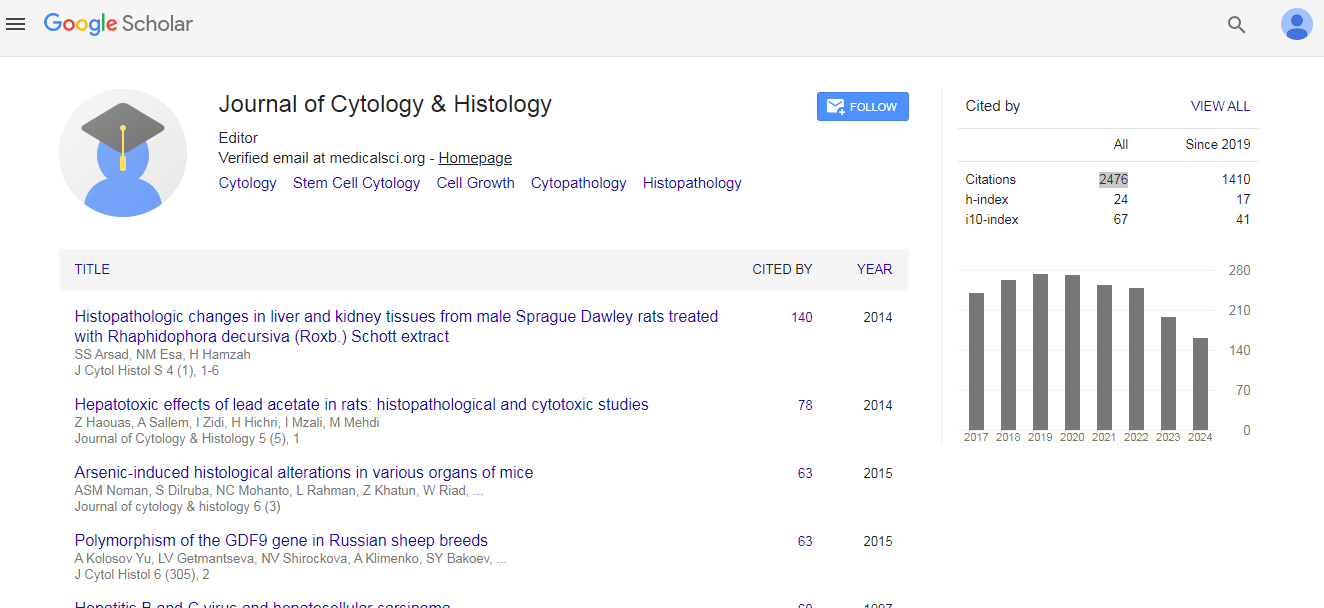
Journal of Cytology & Histology received 2476 citations as per Google Scholar report


 Spanish
  Chinese
  Russian
  German
  French
  Japanese
  Portuguese
  Hindi
Hindi 