The fate of environmental pollutants--the various isotopes of elements, and inorganic or organic compounds--is a fundamental aspect of ecology and ecotoxicology, and bioaccumulation is a phenomenon often discussed in this context. Human activities have drastically altered natural concentrations of many substances in the environment and added numerous new chemicals. An understanding of the processes of bioaccumulation is important for several reasons. 1) Bioaccumulation in organisms may enhance the persistence of industrial chemicals in the ecosystem as a whole, since they can be fixed in the tissues of organisms. 2) Stored chemicals are not exposed to direct physical, chemical, or biochemical degradation. 3) Stored chemicals can directly affect an individual's health. 4) Predators of those organisms that have bioaccumulated harmful substances may be endangered by food chain effects. While former theories on the processes of bioaccumulation focused on single aspects that affect the extent of accumulation (such as the trophic level within the food chain or the lipophilicity of the chemical), modern theories are based on compartmental kinetics and the integration of various environmental interactions. Concepts include results from quantitative structure-activity relationships (QSAR), pharmacokinetics, ecophysiology and general biology, molecular genetic aspects and selection, and finally the structure of communities and man-made alterations in them.
Research Article: Environmental & Analytical Toxicology
Research Article: Environmental & Analytical Toxicology
Research Article: Environmental & Analytical Toxicology
Research Article: Environmental & Analytical Toxicology
Short Communication: Environmental & Analytical Toxicology
Short Communication: Environmental & Analytical Toxicology
Research Article: Environmental & Analytical Toxicology
Research Article: Environmental & Analytical Toxicology
Research Article: Environmental & Analytical Toxicology
Research Article: Environmental & Analytical Toxicology
Accepted Abstracts: Environmental & Analytical Toxicology
Accepted Abstracts: Environmental & Analytical Toxicology
Accepted Abstracts: Environmental & Analytical Toxicology
Accepted Abstracts: Environmental & Analytical Toxicology
Scientific Tracks Abstracts: Hydrology: Current Research
Scientific Tracks Abstracts: Hydrology: Current Research
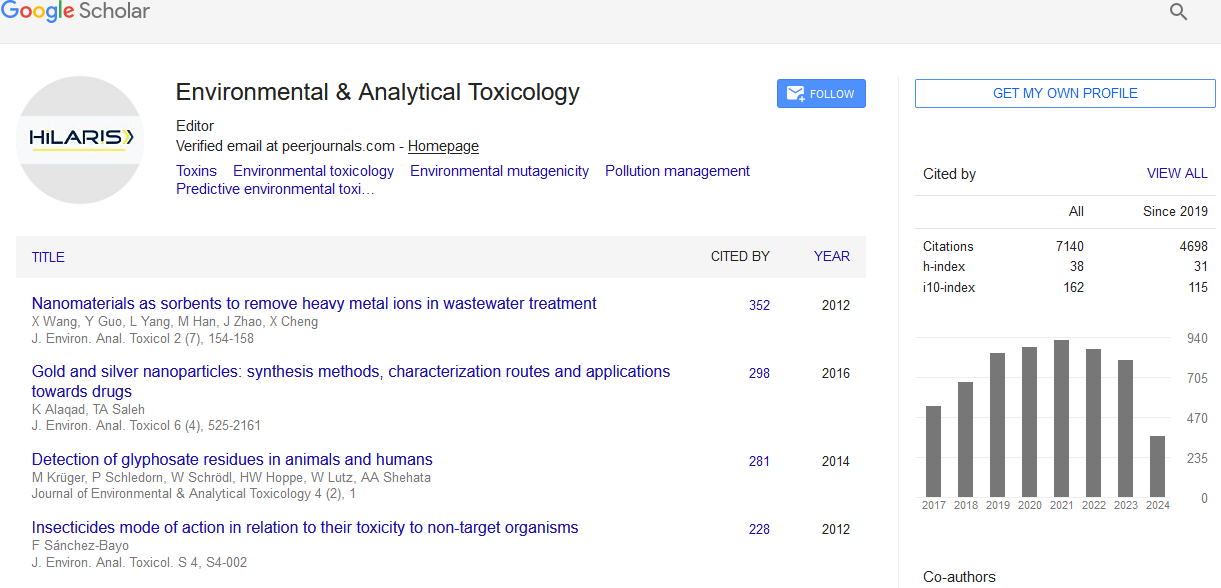
Environmental & Analytical Toxicology received 6818 citations as per Google Scholar report
 Spanish
  Chinese
  Russian
  German
  French
  Japanese
  Portuguese
  Hindi
Hindi 