Theodros Getachew Zemedu, Alemayehu Bayray and Berhe Weldearegay
Ethiopian Public Health Institute, Ethiopia
Mekelle University, Ethiopia
Posters & Accepted Abstracts: Pharm Regul Aff
Statement of the Problem: Multi-drug resistance tuberculosis (MDR-TB) is an increasing global problem. The extent and burden of MDR-TB varies significantly from country to country. Survival of MDR-TB treatment is not described in Ethiopia. Therefore, examining a cohort who received second-line therapy for MDR-TB to determine overall survival has a great importance. The main purpose of this study was to assess survival and predictors of mortality among patients under MDR-TB treatment in Ethiopia: St. PeterâÂ?Â?s Specialized TB Hospital, Addis Ababa, Ethiopia. Methodology & Theoretical Orientation: A retrospective analysis of records was conducted from Oct, 2011 to May, 2012 among cohorts of MDR-TB patients in St. PeterâÂ?Â?s Specialized TB Hospital that starts treatment from February 2009. Data were collected using checklist from 188 patientsâÂ?Â? record that is determined and analyzed using the STATA Statistical package, Version 11.0. Risk was estimated for the entire follow-up time corresponding to each event occurrence using Kaplan-Meier method and the covariates are fitted to Cox proportional hazard regression model. Findings: The 188 patients were followed for a total of 79,600 person-days. Median follow up time was 466.5 days or 1.28 years. Among the total subjects, 87 (46.28%) are male and the rest 101 (53.72%) are female with a median age of 27 years. There were 29 (15.43%) known deaths (incidence rate: 3.6 per 10,000 person-days). Survival rate at 6, 12, 18 and 24 months of treatment were 88.53%, 85.83%, 82.71% and 78.95% respectively. The mean survival time for patients under MDR-TB was 9.7 years. Comparison of the groups showed that there is a significant difference in the probability of surviving between HIV status, smoking status, therapeutic delay, number of first line resistant drugs at initiation, co-morbidities, region and clinical complication. In multivariate Cox proportional hazard regression, factors independently associated with mortality of patients were smoking (HR: 4.01, 95% CI 1.42-11.37, P=0.009), therapeutic delay >1 month (HR: 3.61, 95% CI 1.41-9.20, P=0.007), HIV seropositive (HR: 5.94, 95% CI 2.40-14.72, P<0.0001) and clinical complication (HR: 1.90, 95% CI 1.52-2.39, P<0.001). Conclusion & Significance: Survival of patients was higher and higher hazard of death was noted in patients who started treatment after a month, in smoker, HIV positive and patients who develop a clinical complication. Although survival is good, reinforcing the existing treatment program will further improve patientsâÂ?Â? survival in Ethiopia.
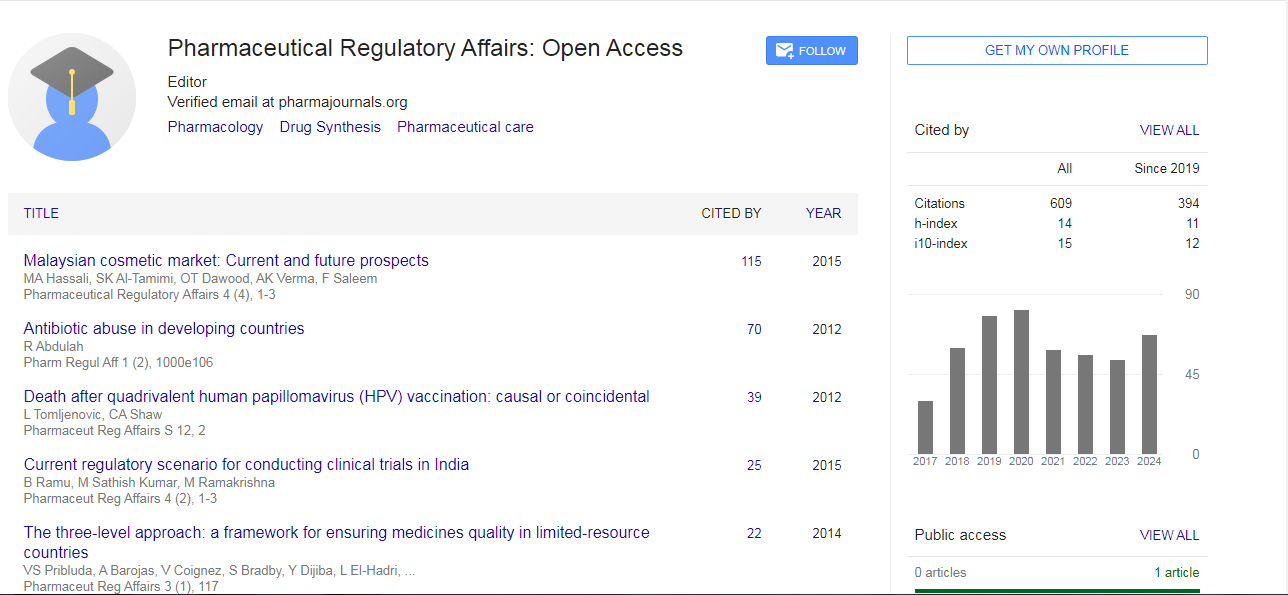
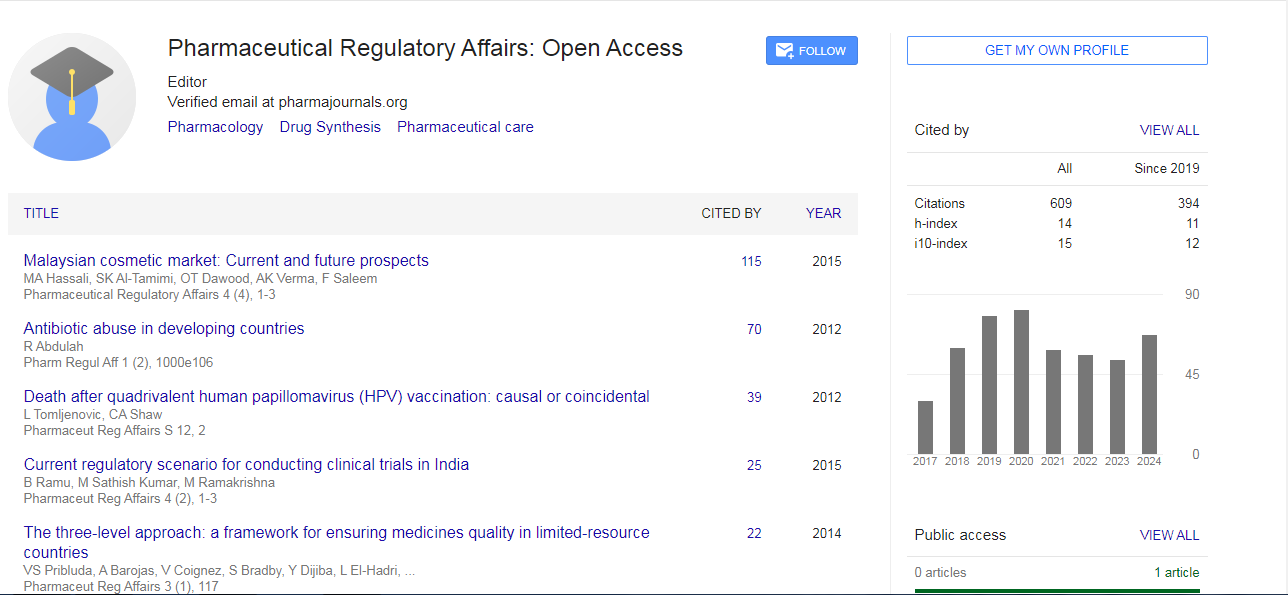
Pharmaceutical Regulatory Affairs: Open Access received 533 citations as per Google Scholar report
 Spanish
 Chinese
 Russian
 German
 French
 Japanese
 Portuguese
 Hindi
