Yong-Xiao Wang
Albany Medical College, USA
Scientific Tracks Abstracts: J Pulm Respir Med
Statement of the Problem: Pulmonary hypertension is a common devastating lung disease. It is a primary cause of death in chronic obstructive pulmonary disease (COPD) and numerous other cardiovascular and respiratory disorders. COPD is currently the fourth leading cause of mortality and may become the second leading cause of death by 2020. Currently, no specific and effective drugs are available to treat pulmonary hypertension, and the underlying molecular mechanisms are not well understood. Purposes: The current research project was to test a novel hypothesis that the reciprocal crosstalks between ion channel-mediated calcium signaling and transcriptional factor-dependent inflammatory signaling are essential for COPD. The current study also sought to determine whether specific genetic and pharmacological targets for these signaling molecules would become effective therapeutics for COPD. Methodology: Pulmonary artery vasoconstriction, remodeling and hypertension were, respectively, examined using in-situ immunohistological staining, and organ bath technique, and pressure-volume loop method; activity and Ca2+ release of ryanodine receptor/Ca2+ release channel (RyR) were determined using [3H]-ryanodine binding assay and fluorescence imaging; specific gene knockout (KO) mice were generated using standard methods, and association of RyR2 with FK506 binding protein with a molecular weight of 12.6 kDa (FKBP12.6) was determined by assessing RyR2/FKBP12.6 protein ratio using co-immunoprecipitation. Findings: Like COPD, hypoxic exposure causes significant pulmonary artery vasoconstriction and remodeling in mice, leading to pulmonary hypertension. The activity of RyR Ca2+ release channel is largely enhanced in pulmonary artery smooth muscle cells (PASMCs) from mice with pulmonary hypertension. RyR-mediated Ca2+ release is also augmented as well. Specific RyR2 channel KO abolishes hypoxia-induced pulmonary artery vasoconstriction, remodeling and hypertension. RyR2 KO also completely inhibits the enhanced RyR activity and function (Ca2+ release) in PASMCs of mice with pulmonary hypertension. Subcutaneous administration of tetracaine, a pharmacological RyR blocker, blocks hypoxia-evoked pulmonary artery vasoconstriction, remodeling and hypertension in mice as well. RyR Ca2+ release channel is physiologically associated with FKBP12.6 and thus shows a low activity. RyR2/FKBP12.6 association is significantly diminished in PASMCs of mice with pulmonary hypertension. Specific FKBP12.6 KO promotes hypoxic pulmonary artery vasoconstriction, remodeling and hypertension. Treatment with S107, a RyR2/FKBP12.6 association stabilizer, produces opposite effects. Conclusion & Significance: RyR2/FKBP12.6 complex is a primary target for pulmonary hypertension, and RyR2 channel blocker and FKBP12.6 stabilizer may become novel and effective drugs in treatment of this disease.
Yong-Xiao Wang has been a Full Professor in Albany Medical College (USA) since 2006. He has had extensive research experience in basic, translational and drug research concerning pulmonary hypertension, asthma, chronic obstructive pulmonary disease, diabetes, and cardiac arrhythmia for over 30 years. As the Principal Investigator, he has received numerous NIH R01 research awards, like AHA Established Investigator Award, and various other grants, where he holds 2–3 NIH R01 grants with other awards each year. As the Corresponding Author, First Author and Key Contributor, he has numerous publications in highly peer-reviewed journals including Antioxid. Redox Signal (Impact Factor: 8.209), Proc. Natl. Acad. Sci. USA (9.432), Nature (34.480), Circ. Res. (9.214), etc. He has been the Editor of academic books in the field including one entitled by, “Redox Signaling in Health and Disease Pulmonary Vasculature” that has been confirmed for publication by Springer (New York). He has also served as the Editorial Board Member and/or Section Editor for the Clinical and Translational Medicine, Pulmonary Circulation and several other journals.
Email: wangy@mail.amc.edu
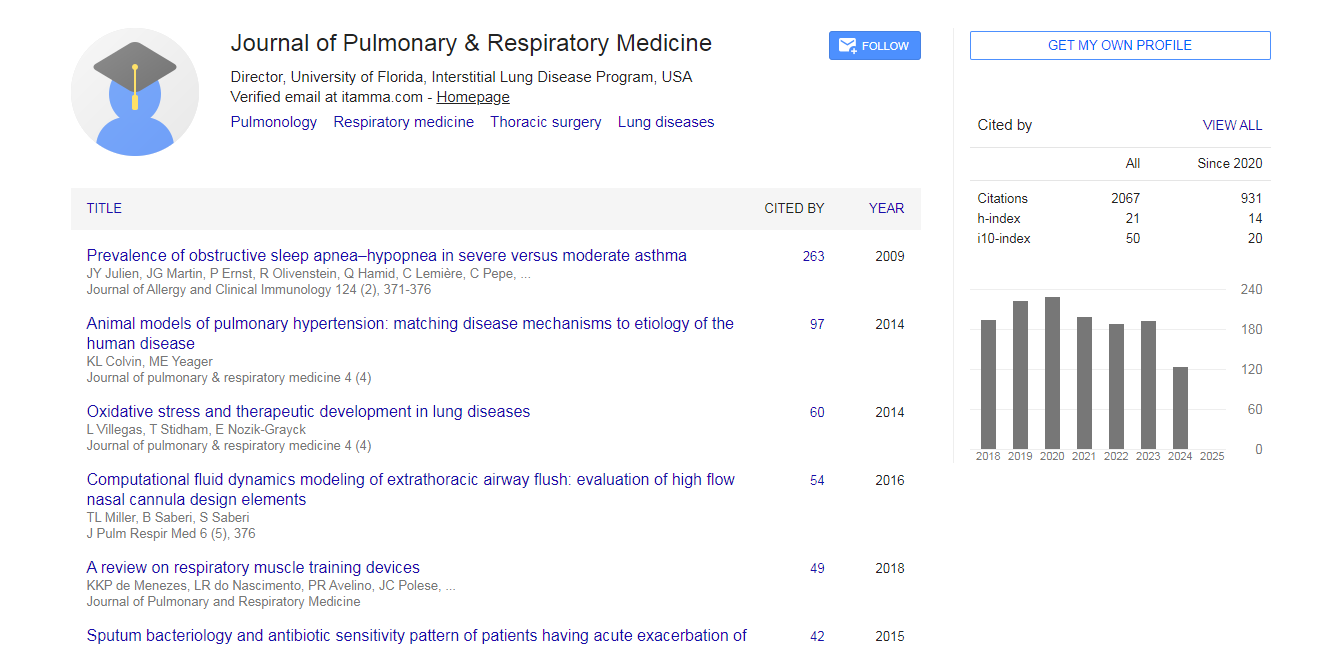
Pulmonary & Respiratory Medicine received 1690 citations as per Google Scholar report
 Spanish
  Chinese
  Russian
  German
  French
  Japanese
  Portuguese
  Hindi
Hindi 