Yoshiya Ueyama, Koji Harada and Tarannum Ferdous
Yamaguchi University, Japan
Posters & Accepted Abstracts: J Cancer Sci Ther
Background: The Cancer Stem Cells (CSCs), a small subpopulation of cells in tumor are responsible for the tumor initiation, growth, recurrence and metastasis of cancer, as well as resistance of cancers to drugs or radiotherapy. CSCs are an important target for the development of novel strategies in cancer treatment. However, CSCs-targeted new anti-cancer drug discovery is currently hindered by the lack of easy and reliable methods for isolating, collecting and maintaining sufficient number of CSCs. Here, we examined whether introduction of defined reprogramming factors (Oct4, shp53, Sox2, Klf4, l-Myc and Lin28) into HSC2 oral cancer cells could transform the HSC2 into HSC2 with CSCs properties. Methods: We introduced the defined reprogramming factors into HSC2 oral cancer cells via episomal vectors by electroporation method to generate transfectant cells. We investigated the malignant properties of the transfectant cells by cell proliferation assay, migration assay, wound healing assay, sphere formation assay, chemosensitivity and radiosensitivity assay in vitro; and also examined the tumorigenic potential of the transfectants in vivo. Results: The transfectant cells (HSC2/hOCT3/4-shp53-F, HSC2/hSK, HSC2/hUL, HSC2/hOCT3/4-shp53-F+hSK, HSC2/hOCT3/4- shp53-F+hUL, HSC2/hSK+hUL, HSC2/hOCT3/4-shp53-F+hSK+hUL) displayed a malignant phenotype in culture and form tumors on the back of nude mice more efficiently than parental HSC2 and control HSC2/EGFP transfectant cells. They exhibited increased resistance to chemotherapeutic agents; 5-fluorouracil, cisplatin, docetaxel, trifluorothymidine, zoledronic acid, cetuximab, bortezomib and radiation when compared with HSC2 and HSC2/EGFP. Among all the transfected cells, HSC2/hOCT3/4-shp53- F+hSK+hUL cell containing all of the reprogramming factors showed the most aggressive and malignant properties and presented the highest number of spheres in the culture medium containing human recombinant fibroblast Growth Factor-2 (FGF-2) and epidermal Growth Factor (EGF). Conclusion: These findings suggest that artificial cancer stem cells obtained by the induction of cellular reprogramming may be useful for investigating the acquisition of potential malignancy as well as screening the CSCs-targeting drugs.
Yoshiya Ueyama has completed his PhD from Okayama University in 1990 and works for Yamaguchi University Medical School in Oral and Maxillofacial Surgery. He is a Medical Specialist in Oral Cancer.
Email: uyoshiya@yamaguchi-u.ac.jp
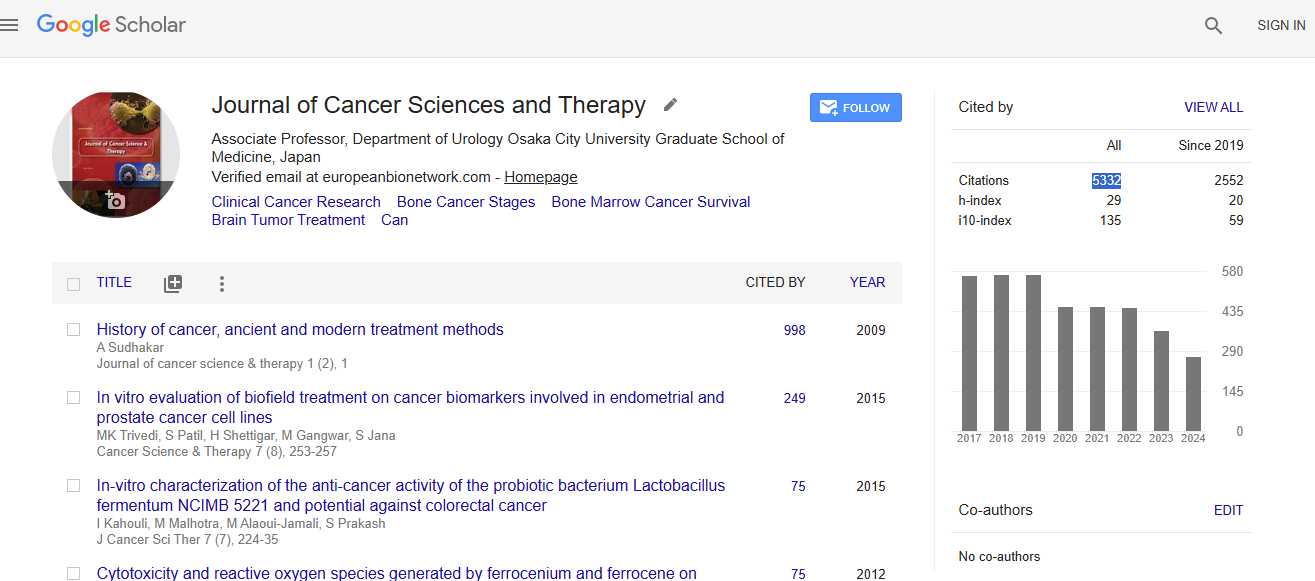
Cancer Science & Therapy received 5332 citations as per Google Scholar report
 Spanish
  Chinese
  Russian
  German
  French
  Japanese
  Portuguese
  Hindi
Hindi 