Cang-Bao Xu and Yaping Zhang
Xi'an Medical University, China
Posters & Accepted Abstracts: J Cardiovasc Dis Diagn
Endothelin-1 (ET-1) plays an important role in pulmonary hypertension (PH), via its receptors induces contraction and proliferation of pulmonary vascular smooth muscle cells as well as vascular remodeling. Chronic exposure to cigarette smoke is the major risk factor for PH associated with underlying lung pathology and/or hypoxia, due to the fact that cigarette smoke contained toxic substances result in activation of reactive oxygen species and inflammatory-oxidative stress, which cause damage and dysfunction of pulmonary vascular endothelium and smooth muscle cells. The present study used an organ culture model of isolated rat pulmonary arterial ring segments with or without exposure to dimethyl sulfoxide (DMSO)-extracted smoke particles (DSP) for 24 hrs. Thereafter, endothelin receptor-mediated contraction and mRNA expression of endothelin type A (ETA) and type B (ETB) receptors in the pulmonary arterial smooth muscles were measured by myograph and real-time PCR, respectively. Our results show that exposure to DSP for 24 hrs induced upregulation of both ETA and ETB receptors in the pulmonary arteries i.e. compared to the controls, DSP significantly enhanced endothelin receptor-mediated contraction (n=7-8, p<0.01) and the receptor mRNA expression (n=3, p<0.01). Inhibition of extracellular signal-regulated kinases 1/2 (ERK1/2) pathway by the specific inhibitor U0126 almost abolished DSP-enhanced contraction (n=4, p<0.001), demonstrating that upregulation of endothelin receptors by DSP is ERK1/2 pathway-dependent. In conclusion, cigarette smoke extracts induce ERK1/2 pathway-dependent upregulation of endothelin receptors in rat pulmonary artery. Understanding the underlying mechanisms that cigarette smoke exposure leads to PH may provide a novel strategy for the treatment.
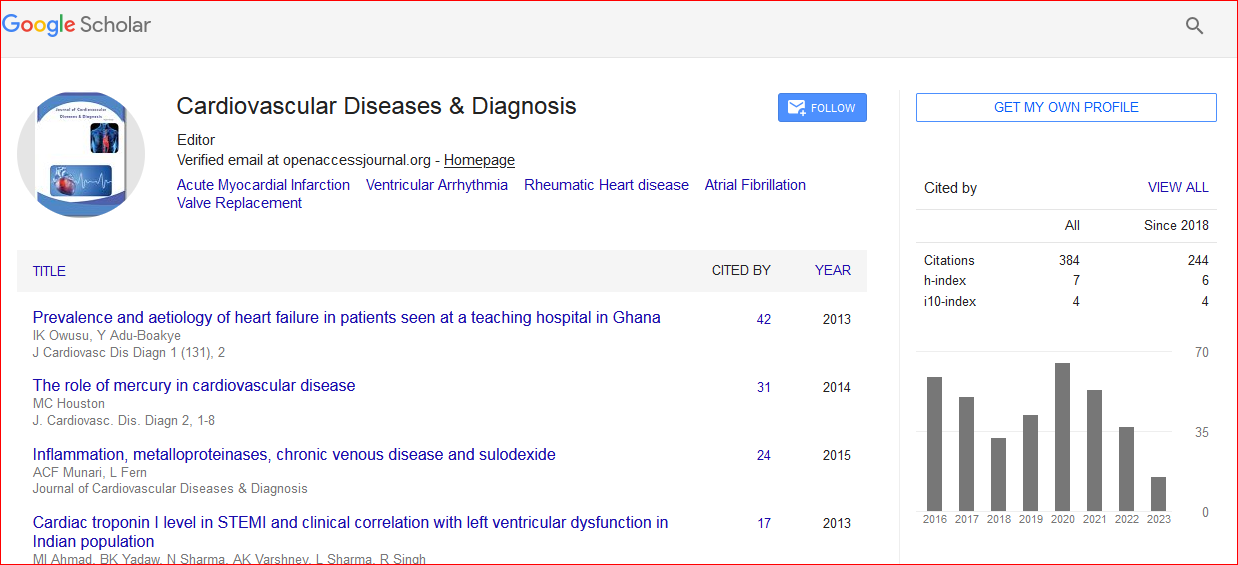
Cardiovascular Diseases & Diagnosis received 427 citations as per Google Scholar report

 Spanish
  Chinese
  Russian
  German
  French
  Japanese
  Portuguese
  Hindi
Hindi 