Kei Tomihara and Makoto Noguchi
University of Toyama, Japan
Scientific Tracks Abstracts: J Cancer Sci Ther
Gemcitabine (GEM) is a pyrimidine nucleoside analogue that is a new chemotherapeutic agent used for treating various cancers. Because accumulating evidence indicates that GEM may activate host immune responses, its potential as an immune modulator in cancer chemotherapy has generated considerable interest. In the present study, we investigated the antitumor effects of GEM using a mouse oral cancer modelusing immunological analysis. We examined apoptotic cell death of tumor cells with GEM treatment both in vitro and in vivo. We also investigated whether in vivo administration of GEM affected the distributions of immune cells, tumor-cell surface expression levels of immune accessory molecules and T cell immune responses in tumor-bearing mice. GEM induced significant oral cancer-cell apoptosis in vitro, and in vivo GEM administration markedly attenuated established mouse tumor growth. In vivo GEM administration decreased the numbers of both myeloid-derived suppressor cells (MDSCs) and B cells in tumor-bearing mice and enhanced dendritic cell maturation. Moreover, GEM treatment upregulated tumor-cell surface expressions of several immune accessory molecules and adhesion molecules, including CD80, CD86, CD40, ICAM-1, VCAM-1, and P-selectin. Remarkably, these tumor cells augmented tumor specific T-cell responses. These results suggest that GEM can induce host antitumor immune responses, which would facilitate antitumor effects in the treatment of oral cancer.
Kei Tomihara received his PhD degree in 2006 from Sapporo Medical University, working on immune gene therapy by adenovirus vector. He then moved to Cancer Therapy and Research Center (CTRC) at The University of Texas Health Science Center at San Antonio (UTHSCSA) to work with Dr. Shin as a Post-doctoral fellow. He obtained an Assistant Professor position in 2013 in the Department of Oral and Maxillofacial Surgery Graduate School of Medicine and Pharmaceutical Sciences for Research, University of Toyama, where he started independent research on cancer immunology.
Email: tomihara@med.u-toyama.ac.jp
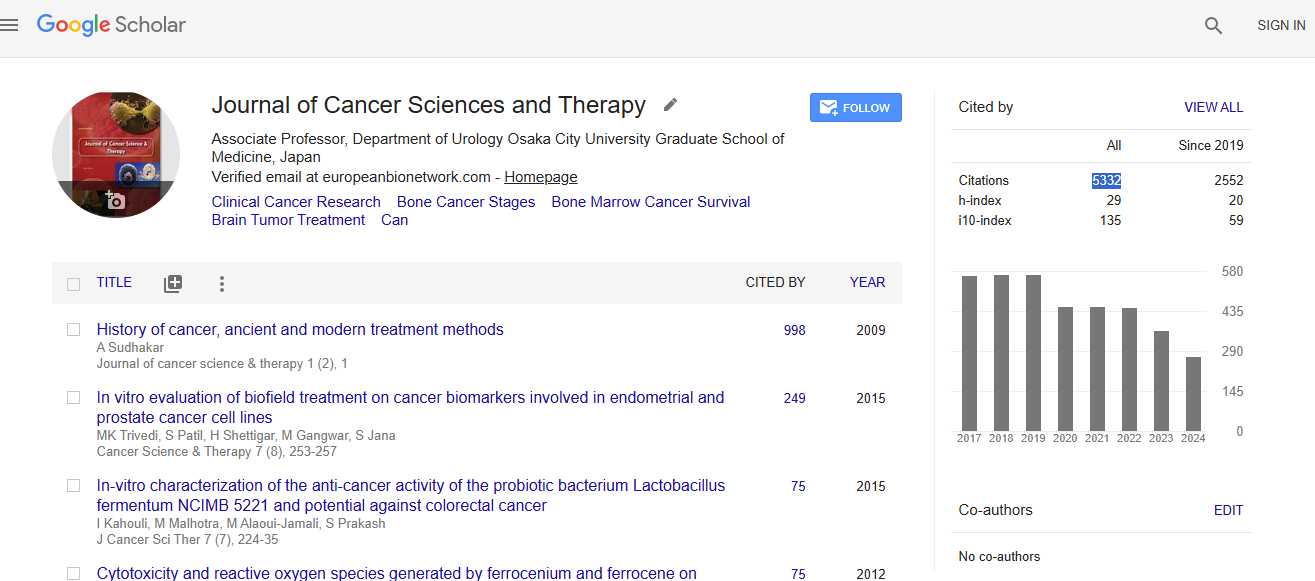
Cancer Science & Therapy received 5332 citations as per Google Scholar report
 Spanish
  Chinese
  Russian
  German
  French
  Japanese
  Portuguese
  Hindi
Hindi 