Syedah Aleena Haider
Royal Brompton Hospital, UK
Posters & Accepted Abstracts: J Cardiovasc Dis Diagn
Introduction & Aim: Adult congenital heart disease (ACHD) patients face increased burden of non-cardiac
comorbidities. Little is known about ACHD patients with sleep apnoea compared to their counterparts with
acquired cardiovascular disease. This study evaluates prevalence of sleep apnoea in ACHD patients using the
Epworth Sleepiness Scale questionnaire (ESS).
Methods: One hundred and eight ACHD patients from clinics at a tertiary center completed ESS to assess
sleep apnoea symptoms. EMRs were used for demographic and clinical data.
Results: All patients (median age 40, 51% female, median BMI 26Kg/m2) completed the ESS. About 68.5%
patients had ACHD of at least moderate complexity (Bethesda class 2 or 3); including 9.2% with Eisenmenger
syndrome and 28.7% with unrepaired CHD. Four patients had prior diagnosis of sleep disordered breathing.
Patient about 89.8% had at least one symptom of sleep apnoea, 27.8% patients had higher than normal
daytime sleepiness and 20.3% patients had excessive daytime sleepiness. Patients with complex CHD had
higher sleepiness scores (shown in Table 1). About 70% of patients with Eisenmenger syndrome reported
moderate to severe excessive daytime sleepiness.
Discussion: Nearly 50% of ACHD patients reported higher than normal or excessive daytime sleepiness.
Patients with complex CHD reported higher burden of sleep apnoea symptoms. Thus, ESS should be an
integral part of routine assessment of ACHD patients in order to identify patients for targeted sleep apnoea
investigations
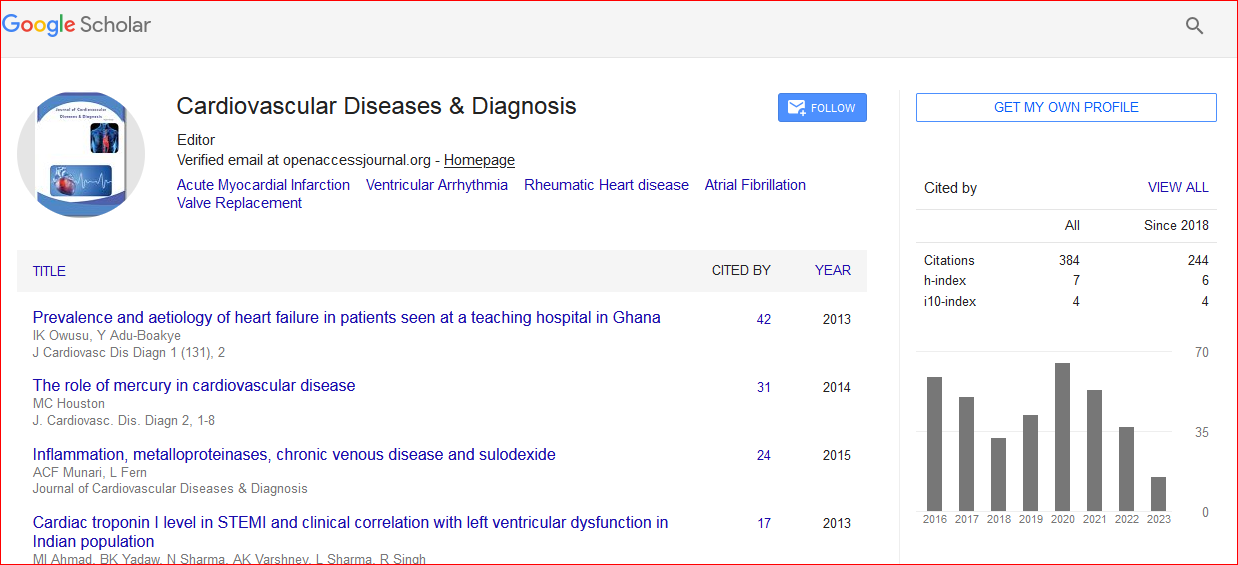
Cardiovascular Diseases & Diagnosis received 427 citations as per Google Scholar report
 Spanish
  Chinese
  Russian
  German
  French
  Japanese
  Portuguese
  Hindi
Hindi 