Short Communication - (2025) Volume 15, Issue 3
Received: 01-May-2025, Manuscript No. jtese-26-184231;
Editor assigned: 05-May-2025, Pre QC No. P-184231;
Reviewed: 19-May-2025, QC No. Q-184231;
Revised: 22-May-2025, Manuscript No. R-184231;
Published:
29-May-2025
, DOI: 10.37421/2165-8064.2025.15.656
Citation: Yilmaz, Mehmet. ”Yarn Twist: Balancing Strength and Comfort in Fabrics.” J Textile Sci Eng 15 (2025):656.
Copyright: © 2025 Yilmaz M. This is an open-access article distributed under the terms of the Creative Commons Attribution License, which permits unrestricted use, distribution and reproduction in any medium, provided the original author and source are credited.
The intricate relationship between yarn twist and fabric properties has been a cornerstone of textile science, influencing a wide array of performance characteristics. Increasing yarn twist is widely recognized for its capacity to enhance fabric strength. This phenomenon is primarily attributed to improved yarn cohesion and a reduction in the slippage that can occur between individual fibers within the yarn structure. Consequently, yarns with higher twist generally contribute to fabrics that are more robust and resistant to tensile forces [1].
However, the pursuit of enhanced strength through elevated twist levels is not without its drawbacks. Excessively high twist can adversely affect fabric comfort. It often results in a stiffer and less pliable fabric, which can diminish its drape and overall hand feel, making it less desirable for certain apparel applications [1].
Therefore, achieving an optimal twist level necessitates a careful balance between strength and comfort considerations, a balance that is intrinsically linked to the specific fiber type, the way the yarn is constructed, and the subsequent fabric construction method employed [1].
Recent investigations have delved into the nuanced effects of varying twist levels, particularly in blended yarns. For instance, studies examining polyester-cotton blended yarns have revealed that while higher twist imparts greater tensile strength, it concurrently increases fabric stiffness. This suggests a direct correlation where enhanced mechanical robustness comes at the cost of flexibility. Furthermore, these studies have indicated that comfort aspects, such as air permeability and moisture management capabilities of the fabric, can be inversely related to the twist level in some instances, highlighting a complex interplay of properties [2].
The influence of yarn twist extends to other crucial fabric attributes like dimensional stability and abrasion resistance. Research focusing on linen fabrics has demonstrated that an increase in yarn twist contributes to improved abrasion resistance, thereby enhancing the fabric's durability and lifespan. Conversely, this heightened twist can lead to a reduction in the fabric's inherent softness and may increase its propensity to wrinkle, indicating a trade-off between durability and tactile comfort [3].
Further exploration into the relationship between twist factor and fabric hand has confirmed that while higher twist levels are beneficial for tensile strength, they can negatively impact fabric flexibility and increase its rigidity. For applications where good drape and a soft feel are paramount, such as in apparel, a moderate twist level is generally considered preferable to achieve the desired aesthetic and tactile qualities [4].
The impact of yarn twist is also significant in synthetic fibers. Studies on acrylic fabrics have shown that higher twist levels can effectively reduce pilling by increasing yarn integrity. However, this increased twist can also lead to greater shrinkage after laundering, which directly affects the fabric's dimensional stability and can compromise its overall comfort [5].
In natural fibers like wool, yarn twist plays a critical role in thermal comfort properties. Investigations into wool fabrics have indicated that an increased twist can reduce the fabric's insulating capacity. This reduction is due to the creation of a denser yarn structure, which subsequently influences the fabric's warmth and breathability â?? two key components of thermal comfort [6].
Beyond strength and tactile properties, yarn twist also affects other mechanical attributes like tearing strength and crease recovery. Research on regenerated cellulosic fabrics, such as viscose, has shown that higher twist levels result in improved tear strength, suggesting enhanced resistance to tearing forces. However, this benefit often comes at the expense of crease recovery, meaning the fabric may be more prone to wrinkling [7].
Similar trade-offs are observed in synthetic materials like nylon. Examining the impact of yarn twist on nylon fabrics, studies have found that higher twist significantly enhances abrasion resistance, prolonging the fabric's useful life. Nevertheless, this increased twist can also contribute to a harsher surface feel and reduced flexibility, impacting the fabric's comfort against the skin [8].
The influence of twist is also pertinent to knitted structures. For knitted cotton fabrics, research has demonstrated that an increase in yarn twist leads to higher bursting strength, indicating greater fabric integrity. However, this enhancement in strength is often accompanied by a decrease in air permeability, which can affect breathability and, consequently, wearer comfort [9].
Finally, in blended fabrics such as polyester-wool, the role of yarn twist in balancing competing properties is evident. Findings suggest that while higher twist can improve tensile strength and modulus, it tends to negatively impact wrinkle recovery. This leads to fabrics that are stronger but may offer reduced comfort in terms of their ability to resist and recover from creasing [10].
The mechanical properties of textiles are profoundly influenced by the twist imparted to their constituent yarns. In cotton fabrics, an increase in yarn twist generally leads to enhanced fabric strength, a consequence of improved yarn cohesion and a reduction in inter-fiber slippage. However, this increase in strength is often accompanied by a decrease in comfort, as excessive twist can render the fabric stiffer and less pliable, negatively impacting its drape and hand feel. Thus, an optimal twist level is sought to balance these competing attributes, a balance that is critically dependent on factors such as fiber type, yarn construction, and fabric construction [1].
Investigating the effects of twist in blended yarns, research on polyester-cotton blends has shown that varying twist levels significantly impacts tensile strength, tear strength, and pilling tendency. Higher twist contributes to greater tensile strength but also increases stiffness. Moreover, comfort-related properties like air permeability and moisture management can be inversely affected by twist, suggesting complex interactions within the yarn structure [2].
The impact of yarn twist on durability and tactile comfort is evident in linen fabrics. Studies indicate that increased twist enhances abrasion resistance, leading to more durable textiles. However, this comes at the cost of reduced softness and an increased tendency to wrinkle, highlighting a trade-off between robustness and sensory comfort [3].
In terms of fabric hand, higher yarn twist is associated with improved tensile strength but can diminish fabric flexibility and increase rigidity. For apparel applications that prioritize drape and a soft feel, a moderate twist level is recommended to achieve the desired aesthetic and tactile qualities [4].
For synthetic fibers like acrylic, yarn twist plays a role in both pilling and shrinkage. Higher twist levels can reduce pilling by enhancing yarn integrity, but they may also lead to increased shrinkage after laundering, impacting dimensional stability and overall comfort [5].
In wool fabrics, yarn twist influences thermal comfort. Increased twist can decrease the fabric's insulating capacity by creating a denser structure, thereby affecting warmth and breathability, which are crucial for thermal comfort [6].
The relationship between yarn twist and other mechanical properties, such as tear strength and crease recovery, has also been examined. For regenerated cellulosic fabrics, higher twist levels improve tear strength but compromise crease recovery, indicating a compromise between durability and wrinkle resistance [7].
In nylon fabrics, high twist significantly enhances abrasion resistance, prolonging fabric lifespan. However, this also results in a harsher surface feel and reduced flexibility, impacting comfort against the skin [8].
For knitted structures, such as cotton knits, increased yarn twist leads to higher bursting strength, indicating improved fabric integrity. Nevertheless, this often results in decreased air permeability, affecting breathability and wearer comfort [9].
Finally, in blended fabrics like polyester-wool, yarn twist influences both strength and wrinkle recovery. Higher twist improves tensile strength and modulus but negatively impacts wrinkle recovery, resulting in fabrics that are stronger but less resistant to creasing [10].
Yarn twist significantly influences fabric properties, impacting both mechanical performance and comfort. Increasing twist generally enhances fabric strength, durability, abrasion resistance, and bursting strength. However, higher twist levels can also lead to increased stiffness, reduced drape, a harsher feel, diminished crease recovery, and reduced air permeability, negatively affecting comfort. The optimal twist level represents a balance between these competing factors, influenced by fiber type, yarn construction, and fabric construction. For applications prioritizing drape and softness, moderate twist is often preferred, while high twist may be suitable for durability-focused textiles. Specific fiber types and fabric constructions exhibit unique responses to varying twist levels, requiring tailored approaches to achieve desired performance and comfort characteristics.
None
None
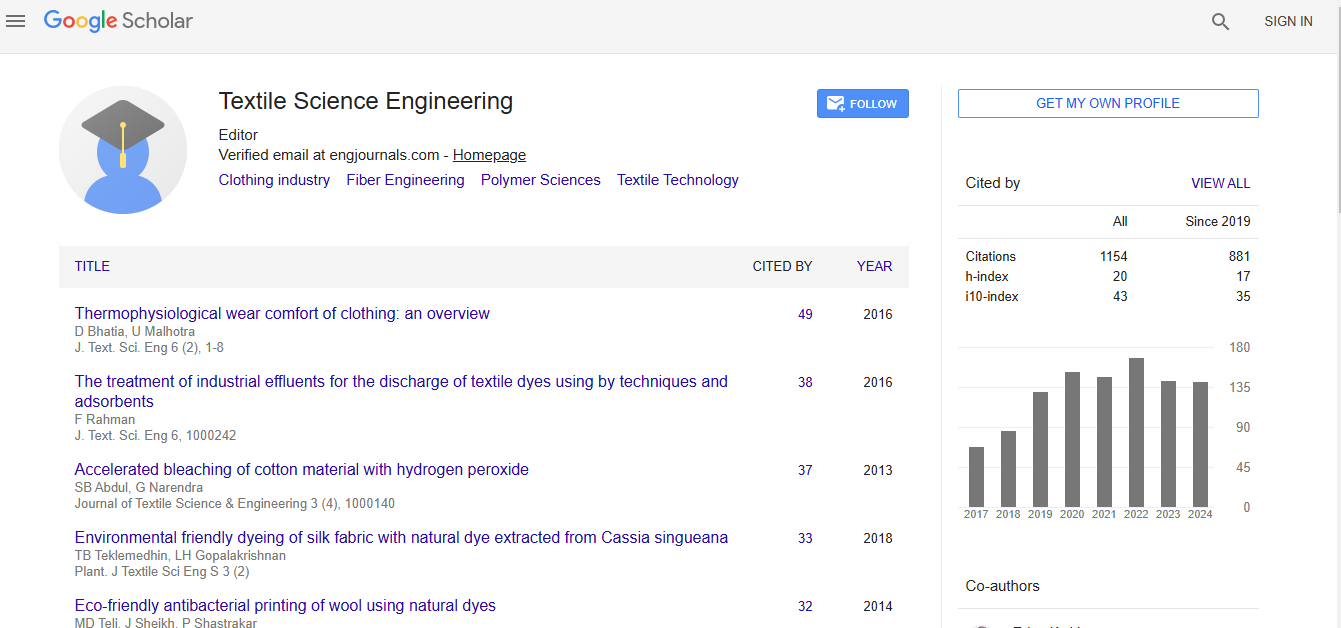
Journal of Textile Science & Engineering received 1008 citations as per Google Scholar report