Commentary - (2025) Volume 11, Issue 3
Received: 01-Jun-2025, Manuscript No. jssc-26-188278;
Editor assigned: 03-Jun-2025, Pre QC No. P-188278;
Reviewed: 17-Jun-2025, QC No. Q-188278;
Revised: 23-Jun-2025, Manuscript No. R-188278;
Published:
30-Jun-2025
, DOI: 10.37421/2472-0437.2025.11.300
Citation: Brown, Thomas. ”Welded Steel Joints: Performance,
Reliability, and Safety.” J Steel Struct Constr 11 (2025):300.
Copyright: © 2025 Brown T. This is an open-access article distributed under the terms of the Creative Commons Attribution License, which permits unrestricted use, distribution
and reproduction in any medium, provided the original author and source are credited.
The structural integrity of welded steel joints is paramount in modern engineering, forming the backbone of numerous infrastructure projects and industrial applications. These joints, crucial for load transfer and overall stability, are subjected to a wide array of stresses and environmental conditions throughout their service life. Understanding their behavior under these diverse loads is essential for ensuring safety, reliability, and longevity of structures.
This necessitates comprehensive research into the fundamental principles governing their performance, including material properties, geometric configurations, and external forces. Advanced analytical and numerical techniques play a pivotal role in predicting failure mechanisms and optimizing designs for enhanced performance. The review of existing literature highlights the multifaceted nature of welded steel joint behavior, encompassing aspects from static strength to dynamic responses and long-term durability. Early research into the fundamental mechanics of welded connections established baseline understanding of their load-carrying capacities. Significant advancements have been made in characterizing the behavior of welded steel joints, particularly concerning their ultimate strength and performance under various loading regimes. Studies have demonstrated that weld geometry, material characteristics, and the specific loading conditions are critical determinants of joint performance, influencing everything from initial deformation to ultimate failure. Analytical models and sophisticated numerical simulations have been developed to predict failure mechanisms, offering valuable insights into the complex interplay of factors that govern joint behavior. Emphasis is placed on the critical considerations of fatigue and fracture, which are indispensable for ensuring the long-term structural integrity of steel structures. These investigations contribute to the development of improved design practices, ultimately enhancing the reliability and safety of steel structures. The seismic performance of welded steel connections is a critical area of research, especially in earthquake-prone regions. Investigations into their ductility and energy dissipation capabilities under cyclic loading have identified key parameters influencing failure modes, such as welding type and joint configuration. Advanced finite element analysis has been employed to simulate hysteretic behavior, with results often validated against experimental data to inform the development of more resilient steel structures capable of withstanding earthquake-induced forces. Fatigue life prediction for welded steel joints subjected to repeated loading is another vital aspect of ensuring structural longevity. Research explores various crack initiation and propagation models, considering stress concentrations at weld discontinuities and the detrimental influence of weld defects like porosity and undercut on fatigue strength. Experimental fatigue tests are conducted to verify proposed methodologies, offering crucial insights for designing durable steel structures in environments prone to fatigue issues. The fracture behavior of welded joints in high-strength steel presents unique challenges. Studies examine the notch toughness and crack propagation resistance within the heat-affected zone (HAZ) and the weld metal, evaluating the impact of different welding consumables and procedures on fracture toughness. Applying fracture mechanics principles and experimental testing, this research assesses susceptibility to brittle fracture, providing critical data for the safe application of high-strength steels. Numerical analysis of stress distribution and deformation in welded steel joints under various loading scenarios is instrumental in design optimization. This work emphasizes the accuracy of different modeling techniques in capturing complex behaviors, including the influence of residual stresses and geometric imperfections, comparing numerical predictions with experimental results. The impact of welding residual stresses on the structural behavior of steel joints is a significant concern. Research quantifies the magnitude and distribution of these stresses in common weld configurations through experimental measurements and computational simulations, investigating their effects on load-carrying capacity, buckling behavior, and fatigue life. Insights are provided for mitigating these adverse effects in structural design. The mechanical performance of various types of welds, such as butt, fillet, and plug welds, under monotonic and cyclic loading is experimentally investigated. This research evaluates shear strength, tensile strength, and ductility, analyzing factors like weld size, length, and base metal properties to understand their influence on joint capacity. The findings contribute to a better understanding of weld behavior and inform design code provisions. The influence of weld defects on the load-bearing capacity of steel joints is thoroughly studied. Various defect types, including porosity, slag inclusions, and cracks, are experimentally introduced and numerically simulated to quantify strength and stiffness reductions and identify critical defect sizes leading to premature failure. This work provides essential guidance for quality control in welded steel construction. The buckling and strength analysis of slender welded steel members under combined axial load and bending is crucial for efficient design. This research examines the interaction of local buckling, global buckling, and yielding in determining ultimate strength, comparing code predictions with advanced simulations and experimental data to offer improvements for safe and efficient steel structures. Finally, the reliability and durability of welded steel joints in corrosive environments are assessed, investigating the combined effects of mechanical loading and environmental degradation. Corrosion-induced material degradation and its impact on fatigue life and ultimate strength are examined through accelerated tests, providing recommendations for material selection and protective measures to enhance long-term performance in challenging environments. The ongoing research and development in understanding and enhancing the performance of welded steel joints continue to be vital for advancing the safety and efficiency of civil engineering structures globally.The comprehensive assessment of welded steel joints in diverse structural systems reveals their critical role in determining overall structural performance and ultimate strength. Factors such as weld geometry, the intrinsic material properties of the steel, and the prevailing loading conditions are identified as pivotal in dictating the joint's capacity and behavior under stress. To accurately predict potential failure mechanisms, sophisticated analytical models and advanced numerical simulations are employed, providing deep insights into the complex interactions within these joints.
A significant emphasis is placed on the implications of fatigue and fracture phenomena, which are indispensable for ensuring the long-term durability and structural integrity of steel constructions. Consequently, the study offers valuable recommendations aimed at refining design practices, thereby enhancing both the reliability and safety of steel structures. Research into the seismic performance of welded steel connections delves into their ductility and energy dissipation capabilities when subjected to cyclic loading. This investigation pinpoints key parameters, including the type of welding employed and the specific joint configuration, that critically influence failure modes. Advanced finite element analysis techniques are utilized to meticulously simulate the hysteretic behavior of these connections, with the simulation results rigorously validated against empirical experimental data. The insights derived from this research are instrumental in the development of more resilient steel structures designed to effectively withstand the significant forces induced by seismic events. The prediction of fatigue life in welded steel joints under repeated loading is a crucial aspect of ensuring the longevity of steel structures. This area of study explores a variety of crack initiation and propagation models, taking into careful consideration the stress concentration factors that arise at weld discontinuities. The detrimental impact of weld defects, such as porosity and undercut, on the overall fatigue strength is systematically analyzed. Furthermore, experimental fatigue tests are conducted to substantiate the accuracy of the proposed methodologies, offering essential guidance for the design of durable steel structures in environments where fatigue is a significant concern. The fracture behavior of welded joints crafted from high-strength steel is another area of intensive investigation. This research scrutinizes the notch toughness and the resistance to crack propagation within both the heat-affected zone (HAZ) and the weld metal itself. Different welding consumables and procedures are meticulously evaluated to ascertain their specific influence on the fracture toughness of the joints. By applying fundamental principles of fracture mechanics alongside rigorous experimental testing, this study assesses the susceptibility of these joints to brittle fracture, thereby furnishing critical data essential for the safe and effective utilization of high-strength steels in structural applications. A detailed finite element analysis is undertaken to investigate the stress distribution and deformation patterns within various welded steel joints under a spectrum of loading scenarios. This analysis underscores the accuracy of different modeling techniques in capturing the intricate behavior of these joints, including the often-overlooked influences of residual stresses and geometric imperfections. A comparative evaluation is performed between the predictions generated by these numerical models and actual experimental outcomes, highlighting the efficacy of these computational tools in facilitating design optimization. The profound impact of welding residual stresses on the structural behavior of steel joints is critically examined. This research quantifies the magnitude and spatial distribution of residual stresses commonly found in typical weld configurations, employing both direct experimental measurements and sophisticated computational simulations. The study further investigates the extent to which these residual stresses affect the load-carrying capacity, the susceptibility to buckling, and the overall fatigue life of welded members. The findings from this work offer valuable insights into strategies for mitigating the adverse consequences of residual stresses in the context of structural design. An experimental investigation is conducted on the mechanical performance of a variety of welded steel connection types, including butt welds, fillet welds, and plug welds, when subjected to both monotonic and cyclic loading conditions. The study meticulously evaluates their shear strength, tensile strength, and ductility based on extensive empirical testing. Various factors, such as weld size, weld length, and the properties of the base metal, are systematically analyzed for their individual and combined influence on the overall capacity of the joints. The resulting findings contribute significantly to a more profound understanding of weld behavior and provide valuable input for the refinement of existing design code provisions. The influence of distinct weld defects on the load-bearing capacity of steel joints is thoroughly investigated. A range of defect types, including porosity, slag inclusions, and cracks, are intentionally introduced in experimental settings and also modeled through numerical simulations. The research quantifies the reduction in both strength and stiffness that results from the presence of these defects and identifies critical defect sizes that pose a risk of premature structural failure. This body of work provides essential guidance and a foundation for robust quality control measures in welded steel construction projects. Research is presented on the behavior of slender welded steel members when subjected to combined axial load and bending forces. This investigation meticulously examines the intricate interplay between local buckling, global buckling, and yielding phenomena in determining the ultimate strength of these members. The study critically compares the predictions derived from established design codes with the outcomes of advanced numerical simulations and experimental data, with the ultimate goal of proposing improvements for the design of steel structures that are both efficient and inherently safe. Finally, the reliability and long-term durability of welded steel joints within environments characterized by corrosive conditions are systematically assessed. This paper scrutinizes the synergistic effects of mechanical loading and environmental degradation on the performance characteristics of welded connections. The research examines the impact of corrosion-induced material degradation on both the fatigue life and the ultimate strength of the joints, utilizing accelerated corrosion tests coupled with mechanical testing protocols. Recommendations are put forth concerning optimal material selection and the implementation of appropriate protective measures to significantly enhance the long-term performance of steel structures operating in demanding and corrosive environments. The collective findings from these studies provide a robust foundation for the design, construction, and maintenance of safe and durable steel structures.This collection of research focuses on the behavior, strength, and durability of welded steel joints in various structural applications. Studies explore the influence of weld geometry, material properties, and loading conditions on joint performance, employing analytical models and numerical simulations to predict failure mechanisms. Key considerations include seismic performance, fatigue life prediction, fracture toughness of high-strength steels, and the impact of residual stresses and weld defects. Experimental investigations assess the mechanical properties of different weld types and the effects of corrosion. The research aims to improve design practices for enhanced reliability and safety in bridges, buildings, and other steel structures.
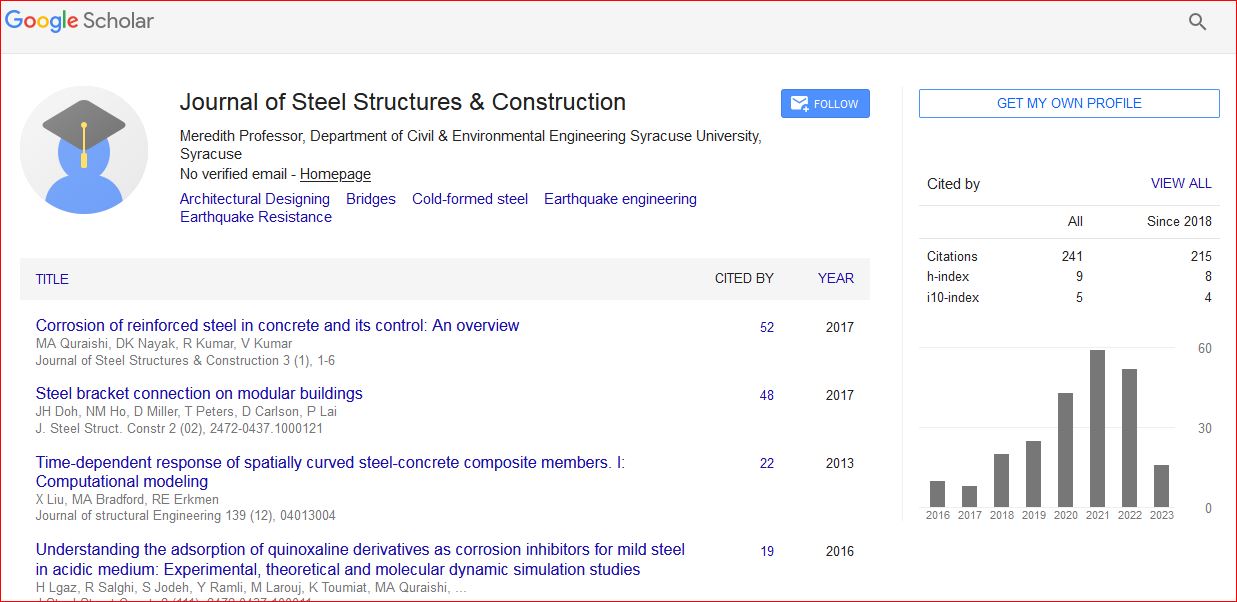
Journal of Steel Structures & Construction received 583 citations as per Google Scholar report