Opinion - (2025) Volume 16, Issue 2
Received: 01-Mar-2025, Manuscript No. jhmi-26-178823;
Editor assigned: 03-Mar-2025, Pre QC No. P-178823;
Reviewed: 17-Mar-2025, QC No. Q-178823;
Revised: 24-Mar-2025, Manuscript No. R-178823;
Published:
31-Mar-2025
, DOI: 10.37421/2157-7420.2025.16.584
Citation: Yamamoto, Kenji. ”Wearable Sensors Revolutionize Digital Health For Patients.” J Health Med Informat 16 (2025):584.
Copyright: © 2025 Yamamoto K. This is an open-access article distributed under the terms of the Creative Commons Attribution License, which permits unrestricted use, distribution and reproduction in any medium, provided the original author and source are credited.
Wearable sensors and remote patient monitoring (RPM) are fundamentally reshaping the landscape of digital health by facilitating the continuous, real-time collection of health data beyond the confines of traditional clinical settings. This paradigm shift enables the early identification of potential health issues, the tailoring of personalized interventions, and the more effective management of chronic diseases, ultimately leading to improved patient outcomes and a reduction in overall healthcare expenditures. The integration of these technologies fosters a proactive approach to healthcare, moving away from a reactive model [1].
The accuracy and reliability of the data generated by wearable sensors are of paramount importance for the successful implementation of RPM. Ongoing advancements in sensor technology and sophisticated data processing algorithms are consistently enhancing the quality of the physiological information collected, thereby empowering clinicians to make more informed and precise decisions. Despite these advancements, challenges persist in standardizing data formats and ensuring seamless interoperability between diverse devices and disparate health systems [2].
The application of wearable sensors and RPM is proving particularly transformative in the management of chronic conditions such as diabetes, hypertension, and heart failure. The continuous monitoring capabilities allow for timely and necessary adjustments to treatment plans, which can significantly reduce hospital readmissions and enhance patient engagement in their own healthcare journey. This proactive approach empowers individuals with greater understanding and control over their health status [3].
Concerns surrounding data privacy and security are critical considerations in the deployment of wearable sensors and RPM systems. The implementation of robust data protection measures, including advanced encryption techniques and secure data transmission protocols, is essential to safeguard sensitive patient information. Furthermore, ethical considerations pertaining to data ownership and informed consent require thorough and careful deliberation [4].
The integration of artificial intelligence (AI) and machine learning (ML) with data from wearable sensors is opening new avenues for predictive analytics within the healthcare sector. AI/ML algorithms possess the capability to identify subtle patterns that may indicate impending health deteriorations, thus enabling preemptive interventions. This advanced capability substantially amplifies the proactive potential inherent in RPM systems [5].
Patient acceptance and consistent adherence to using wearable sensors and actively participating in RPM programs are crucial determinants of their overall success. The design of user-friendly interfaces, clear communication of the benefits associated with these technologies, and effective patient education strategies can significantly contribute to higher adoption rates. Addressing potential concerns related to technological complexity and perceived intrusiveness is paramount to achieving widespread acceptance [6].
The economic implications stemming from the widespread adoption of wearable sensors and RPM are substantial and far-reaching. Evidence suggests potential cost savings can be realized through a reduction in hospitalizations, fewer emergency room visits, and more effective management of chronic conditions. Nevertheless, a comprehensive evaluation of the return on investment for both healthcare systems and payers remains an active area of ongoing research [7].
The regulatory framework governing digital health technologies, including wearable sensors and RPM, is continuously evolving. Ensuring strict compliance with existing healthcare regulations, such as HIPAA in the United States and GDPR in Europe, is indispensable for the ethical and legal deployment of these powerful tools. The establishment of clear guidelines for the validation and approval of such technologies is also critically needed [8].
The future trajectory of wearable sensors and RPM points towards their seamless integration into both daily life and the broader healthcare ecosystem. Ongoing advancements in miniaturization, battery longevity, and multi-modal sensing capabilities will undoubtedly expand their functional scope. Enhanced interoperability with electronic health records and sophisticated analytical platforms will be instrumental in unlocking their full potential for delivering personalized and preventative medicine [9].
The successful implementation of wearable sensors and remote patient monitoring necessitates a comprehensive, multidisciplinary strategy involving a collaborative effort among clinicians, engineers, data scientists, and policymakers. Such effective collaboration is vital to ensure that these technologies are developed and deployed in a manner that is clinically relevant, technologically robust, and ethically sound. Addressing the challenges inherent in implementation science is of critical importance for achieving widespread adoption and realizing the full benefits of these innovations [10].
Wearable sensors and remote patient monitoring (RPM) are instrumental in transforming digital health by enabling continuous, real-time data collection outside of traditional clinical environments. This shift supports early detection of health issues, facilitates personalized interventions, and improves the management of chronic diseases, ultimately enhancing patient outcomes and reducing healthcare costs through a proactive approach [1].
The accuracy and reliability of data acquired from wearable sensors are foundational for effective RPM. Significant advancements in sensor technology and data processing algorithms are continually improving the quality of collected physiological information, enabling clinicians to make more informed decisions. However, ongoing efforts are needed to standardize data formats and ensure interoperability across different devices and health systems [2].
The utilization of wearable sensors and RPM has demonstrated considerable impact in managing chronic conditions such as diabetes, hypertension, and heart failure. Continuous monitoring allows for timely adjustments to treatment plans, thereby decreasing hospital readmissions and improving patient engagement in their own care, fostering a sense of empowerment and better health control [3].
Data privacy and security are paramount concerns when deploying wearable sensors and RPM systems. The implementation of robust data protection measures, including encryption and secure data transmission protocols, is crucial for safeguarding sensitive patient information. Ethical considerations related to data ownership and patient consent must also be thoroughly addressed [4].
The integration of artificial intelligence (AI) and machine learning (ML) with data from wearable sensors is a key driver for predictive analytics in healthcare. AI/ML algorithms can identify subtle patterns indicative of impending health deterioration, enabling preemptive interventions and significantly enhancing the proactive capabilities of RPM [5].
Patient acceptance and adherence to using wearable sensors and engaging in RPM are critical for program success. User-friendly design, clear communication of benefits, and effective patient education are vital for improving adoption rates. Addressing concerns about technological complexity and perceived intrusiveness is a key factor [6].
The economic implications of widespread adoption of wearable sensors and RPM are considerable, with studies suggesting potential cost savings through reduced hospitalizations and better chronic disease management. Evaluating the return on investment for healthcare systems and payers is an ongoing area of research [7].
The regulatory landscape for digital health technologies, including wearable sensors and RPM, is continuously evolving. Compliance with healthcare regulations, such as HIPAA and GDPR, is essential for ethical and legal deployment. Clear guidelines for validation and approval are necessary [8].
The future of wearable sensors and RPM involves seamless integration into daily life and the broader healthcare ecosystem. Advances in miniaturization, battery life, and multi-modal sensing will expand capabilities, while interoperability with EHRs and analytical platforms will unlock their full potential for personalized and preventative medicine [9].
Implementing wearable sensors and RPM requires a multidisciplinary approach involving clinicians, engineers, data scientists, and policymakers. Effective collaboration ensures technologies are developed and deployed in a clinically relevant, technologically sound, and ethically responsible manner. Addressing implementation science challenges is vital for widespread adoption [10].
Wearable sensors and remote patient monitoring (RPM) are revolutionizing digital health by enabling continuous, real-time data collection outside clinical settings. This fosters early detection, personalized interventions, and improved chronic disease management, enhancing patient outcomes and reducing costs. Advancements in sensor technology improve data accuracy for informed clinical decisions, though standardization and interoperability remain challenges. RPM is particularly impactful for chronic conditions like diabetes and hypertension, leading to fewer hospital readmissions and increased patient engagement. Data privacy and security are critical, requiring robust protection measures and attention to ethical considerations. The integration of AI and ML with sensor data facilitates predictive analytics for preemptive interventions. Patient acceptance and adherence are crucial, driven by user-friendly design and effective education. Economically, RPM offers potential cost savings through reduced hospitalizations. The evolving regulatory landscape requires compliance with healthcare regulations. The future of these technologies lies in seamless integration, advanced capabilities, and interoperability with healthcare systems, paving the way for personalized and preventative medicine through multidisciplinary collaboration.
None
None
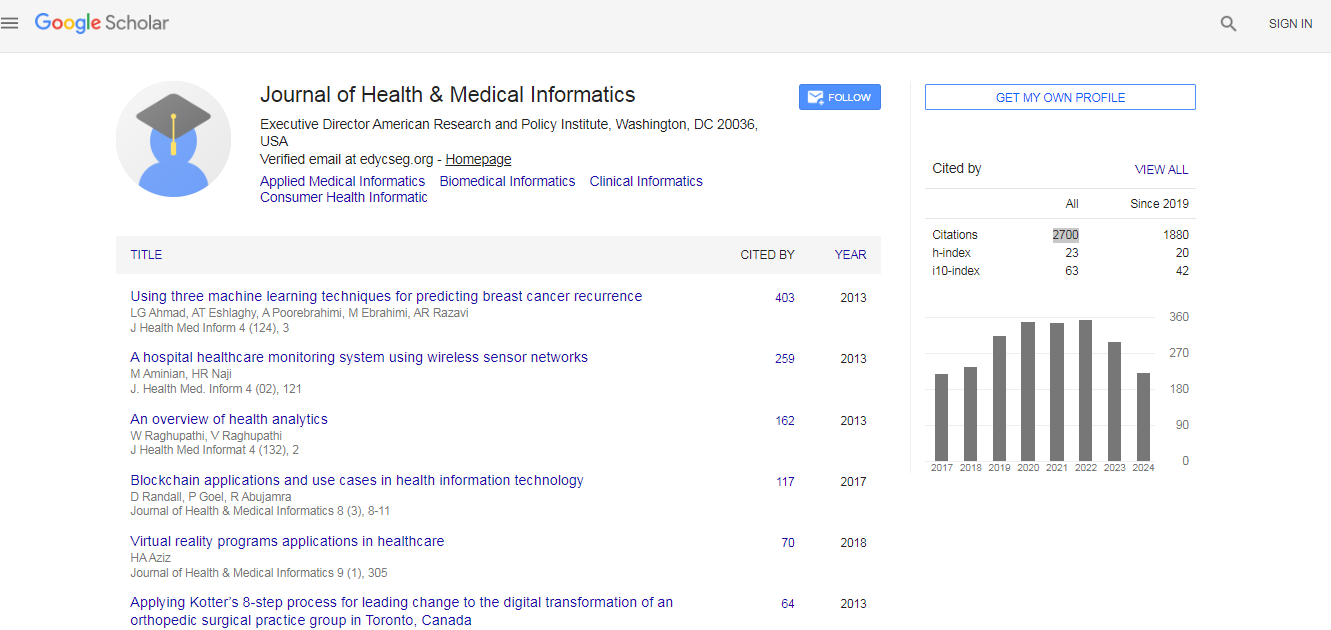
Journal of Health & Medical Informatics received 2700 citations as per Google Scholar report