Brief Report - (2025) Volume 15, Issue 3
Received: 01-May-2025, Manuscript No. jcde-25-175217;
Editor assigned: 05-May-2025, Pre QC No. P-175217;
Reviewed: 19-May-2025, QC No. Q-175217;
Revised: 22-May-2025, Manuscript No. R-175217;
Published:
29-May-2025
, DOI: 10.37421/2165-784X.2025.15.602
Citation: Rajesh Patel. ”Water Balance Across Systems: Climate,
Health, Resilience.” J Civil Environ Eng 15 (2025):602.
Copyright: © 2025 P. Rajesh This is an open-access article distributed under the terms of the Creative Commons Attribution License, which permits unrestricted use,
distribution and reproduction in any medium, provided the original author and source are credited.
This article dives into how our bodies regulate water and fluid levels, a complex process involving hormones like vasopressin and the intricate functions of our kidneys. Understanding these mechanisms is key to addressing clinical issues like dehydration and fluid overload, offering current perspectives on maintaining physiological balance. It highlights the importance of precise control for overall health, touching on how disruptions can lead to significant medical challenges [1].
Here's the thing, global cropland water balance is incredibly sensitive to climate change. This research models how changes in precipitation and temperature directly impact the water available for agriculture, which in turn affects food security worldwide. What this really means is that as our climate shifts, we face significant challenges in ensuring adequate water for crops, demanding smarter agricultural practices and resource management strategies [2].
This study examines the forest water balance and how it reacts to both climate shifts and different forest management techniques in temperate regions. It reveals that factors like thinning and harvesting significantly alter how forests capture, store, and release water, highlighting the need for sustainable forestry practices. Understanding these interactions is crucial for mitigating drought impacts and maintaining ecosystem health [3].
Let's break down urban water balance management. This review compiles various strategies, technologies, and policy implications aimed at creating more sustainable cities. It covers everything from rainwater harvesting and wastewater recycling to green infrastructure, emphasizing that integrated approaches are essential. The core message is clear: effective urban water management is key to resilience against climate change and growing population demands [4].
Plants face huge challenges under drought stress, and their ability to maintain water balance is critical for survival. This article explores the various physiological and molecular mechanisms plants employ to cope, from stomatal regulation to root architecture adjustments. Understanding these adaptations opens doors for improving crop resilience and yield in increasingly arid conditions, which is pretty important for our food supply [5].
The global terrestrial water balance is undergoing significant changes due to climate change, and this review maps out the current understanding. It synthesizes observations and modeling efforts, showing how precipitation patterns, evaporation rates, and water storage in landmasses are shifting. This helps us grasp the bigger picture of how our planet's freshwater resources are being redistributed, which has massive implications for ecosystems and human societies [6].
This paper highlights how climate change profoundly affects wetland water balance, with cascading implications for the crucial ecosystem services these areas provide. It discusses how altered precipitation and temperature regimes impact water levels, affecting biodiversity, water quality, and carbon sequestration. Protecting and restoring wetlands means understanding these hydrological shifts, as their health directly supports our environment [7].
When you exercise in the heat, your body's water balance and ability to regulate temperature become critical. This research looks at how hydration status and individual differences impact these processes, showing that adequate fluid intake isn't just about performance, it's about safety. It offers insights into optimizing hydration strategies for athletes and anyone active in challenging environments [8].
Hydrological modeling is continuously evolving, and this review highlights the latest advancements for assessing water balance, especially under a changing climate. It covers new techniques for data integration, model calibration, and uncertainty analysis, which are crucial for making accurate predictions about water availability. The bottom line is that better models mean better water resource management, especially when the climate throws us curveballs [9].
Here's the thing about remote sensing: it's a powerful tool for observing the terrestrial water balance from afar. This review delves into its applications, from tracking soil moisture and evapotranspiration to monitoring changes in surface water bodies. It also addresses the ongoing challenges, like data accuracy and integration, but ultimately shows that satellite data is indispensable for large-scale water resource assessment and understanding global hydrological cycles [10].
Our bodies intricately regulate water and fluid levels, a complex process involving hormones like vasopressin and the intricate functions of our kidneys. Understanding these precise mechanisms is absolutely key to addressing pressing clinical issues like dehydration and fluid overload, offering current perspectives on maintaining physiological balance. It genuinely highlights the importance of this precise control for overall health, touching on how any disruptions can lead to significant medical challenges [1]. Furthermore, effective urban water balance management is paramount for creating truly sustainable cities. This area compiles various strategies, innovative technologies, and crucial policy implications, encompassing everything from efficient rainwater harvesting and advanced wastewater recycling to the implementation of green infrastructure. The core message is clear: integrated approaches are essential, because effective urban water management is key to building resilience against climate change and meeting the demands of growing urban populations [4].
Here's the thing, global cropland water balance is incredibly sensitive to climate change. This research models how direct changes in precipitation and temperature specifically impact the water available for agriculture, which in turn directly affects food security worldwide. What this really means is that as our climate shifts, we face significant challenges in ensuring adequate water for crops, demanding smarter agricultural practices and more effective resource management strategies [2]. Beyond croplands, individual plants also face huge challenges under drought stress, and their ability to maintain water balance is critical for survival. This article explores the various physiological and molecular mechanisms plants employ to cope, from finely tuned stomatal regulation to architectural adjustments in their root systems. Understanding these adaptations opens crucial doors for improving crop resilience and yield in increasingly arid conditions, which is pretty important for our global food supply [5].
This study examines the forest water balance and how it reacts to both broader climate shifts and different forest management techniques, particularly in temperate regions. It reveals that specific factors like thinning and harvesting significantly alter how forests capture, store, and release water, highlighting the acute need for sustainable forestry practices. Understanding these intricate interactions is crucial for mitigating drought impacts and maintaining broader ecosystem health [3]. In a related vein, this paper highlights how climate change profoundly affects wetland water balance, with cascading implications for the crucial ecosystem services these areas provide. It discusses how altered precipitation and temperature regimes directly impact water levels, subsequently affecting biodiversity, water quality, and vital carbon sequestration. Protecting and restoring wetlands means thoroughly understanding these hydrological shifts, as their sustained health directly supports our environment [7].
The global terrestrial water balance is undergoing significant, observable changes due to climate change, and this review maps out the current scientific understanding. It synthesizes numerous observations and modeling efforts, showing how global precipitation patterns, evaporation rates, and water storage in landmasses are actively shifting. This helps us grasp the bigger picture of how our planet's freshwater resources are being redistributed, which has massive implications for ecosystems and human societies [6]. Hydrological modeling is continuously evolving, and this review highlights the latest advancements for assessing water balance, especially under a changing climate. It covers new techniques for data integration, model calibration, and uncertainty analysis, all crucial for making accurate predictions about water availability. The bottom line is that better models mean better water resource management when the climate throws us curveballs [9]. Remote sensing, it's a powerful tool for observing the terrestrial water balance from afar. This review delves into its applications, from tracking soil moisture and evapotranspiration to monitoring changes in surface water bodies. It also addresses challenges like data accuracy and integration, but ultimately shows that satellite data is indispensable for large-scale water resource assessment and understanding global hydrological cycles [10].
When you exercise in the heat, your body's water balance and its ability to regulate temperature become absolutely critical. This research specifically looks at how hydration status and inherent individual differences impact these processes, clearly showing that adequate fluid intake isn't just about optimizing performance; it's fundamentally about safety. It offers crucial insights into optimizing hydration strategies for athletes and anyone actively engaged in challenging environments [8].
The collection of research highlights the multifaceted nature of water balance across diverse systems, from human physiology to global ecosystems. It explores the intricate mechanisms by which our bodies regulate water, emphasizing the role of hormones and kidneys, and the clinical implications of imbalance like dehydration. The broader environmental context reveals how climate change profoundly impacts water balance in critical areas such as global croplands, affecting food security and demanding smarter agricultural practices. Forests and wetlands are also shown to be highly sensitive to climate shifts and management techniques, with direct consequences for ecosystem health and services. Urban environments face unique challenges, prompting reviews of integrated water management strategies, including rainwater harvesting and wastewater recycling, crucial for sustainable cities and climate resilience. On a planetary scale, changes in terrestrial water balance due to climate change are being observed and modeled, showing shifts in precipitation, evaporation, and water storage with wide-ranging implications. The advancements in hydrological modeling and the indispensable role of remote sensing are emphasized as critical tools for accurate water resource assessment and understanding global hydrological cycles amidst these changes. Even individual human responses, particularly during exercise in heat, underscore the importance of hydration for thermoregulation and safety. Collectively, these studies stress the critical need for understanding and managing water balance to ensure health, food security, environmental stability, and urban resilience in a changing world.
1. Kiana NKE, Lauren JJG, Jessica TJ. "Physiological regulation of body fluid and water balance: Current perspectives and clinical implications".J Clin Invest 133 (2023):e171440.
Indexed at, Google Scholar, Crossref
2. Kang X, Siqi W, Wenjiao S. "Global cropland water balance and its sensitivity to climate change".Nat Food 2 (2021):104-110.
Indexed at, Google Scholar, Crossref
3. Lin S, Jie T, Keiko T. "Forest water balance and its sensitivity to climate and forest management in a temperate region".Agric For Meteorol 320 (2022):108953.
Indexed at, Google Scholar, Crossref
4. Hamidreza MP, George PM, Vasileios NA. "Urban Water Balance Management: A Review of Strategies, Technologies, and Policy Implications for Sustainable Cities".Water (Basel) 15 (2023):2755.
Indexed at, Google Scholar, Crossref
5. Tariq A, Tauqeer A, Tariq B. "Plant water balance under drought stress: Mechanisms and implications for crop improvement".Front Plant Sci 13 (2022):888746.
Indexed at, Google Scholar, Crossref
6. Yongqiang G, Zhaohua S, Songchuan J. "Global Terrestrial Water Balance under Climate Change: A Review".Rev Geophys 61 (2023):e2022RG000788.
Indexed at, Google Scholar, Crossref
7. Mengyuan Z, Jianhua W, Qian Y. "Impacts of climate change on wetland water balance and its implications for ecosystem services".Sci Total Environ 906 (2024):167822.
Indexed at, Google Scholar, Crossref
8. Samuel NJC, Hirofumi T, Kenneth SO. "Water balance and thermoregulation during exercise in the heat: Effects of hydration status and individual variability".J Appl Physiol (1985) 132 (2022):885-896.
Indexed at, Google Scholar, Crossref
9. Rahul KS, Subhadeep P, Pradeep KS. "Advances in hydrological modeling for water balance assessment under changing climate: A review".J Hydrol 601 (2021):126639.
Indexed at, Google Scholar, Crossref
10. Cong L, Zhenzhong Z, Yuting Z. "Remote sensing of terrestrial water balance: A review of applications and challenges".Remote Sens Environ 247 (2020):111956.
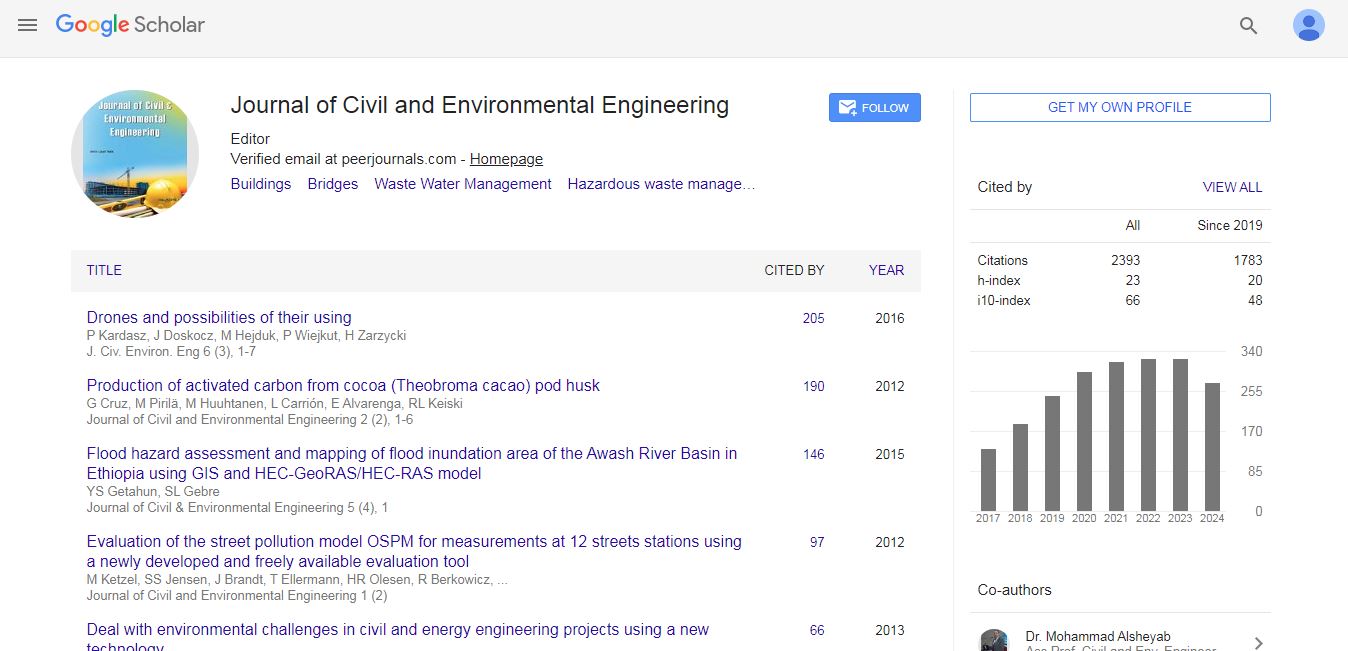
Journal of Civil and Environmental Engineering received 1798 citations as per Google Scholar report