Opinion - (2025) Volume 14, Issue 6
Received: 01-Nov-2025, Manuscript No. jtsm-26-179597;
Editor assigned: 03-Nov-2025, Pre QC No. P-179597;
Reviewed: 17-Nov-2025, QC No. Q-179597;
Revised: 24-Nov-2025, Manuscript No. R-179597;
Published:
29-Nov-2025
, DOI: 10.37421/2167-0919.2025.14.527
Citation: Fernández, Lucía. ”VoIP and Multimedia: Challenges, Solutions, and Emerging Technologies.” J Telecommun Syst Manage 14 (2025):527.
Copyright: © 2025 Fernández L. This is an open-access article distributed under the terms of the Creative Commons Attribution License, which permits unrestricted use,
distribution and reproduction in any medium, provided the original author and source are credited.
The telecommunication landscape is undergoing a significant transformation, driven by the increasing demand for sophisticated Voice over IP (VoIP) and multimedia services. These services, ranging from real-time voice and video communications to high-definition streaming, form the backbone of modern digital interaction. Ensuring their efficient and reliable delivery necessitates a deep understanding of the underlying network complexities and the development of robust management strategies. This collection of research papers offers insights into various facets of this evolving domain, addressing both the challenges and the innovative solutions being developed to meet these demands. One critical area of focus is the management of Quality of Service (QoS) for these demanding applications. Real-time traffic, such as voice and video, is particularly sensitive to network impairments like jitter, packet loss, and latency. Maintaining acceptable levels of these parameters is paramount for a satisfactory user experience. Analytical frameworks and intelligent management systems are being developed to monitor and control QoS in dynamic network conditions, adapting to fluctuations and ensuring consistent performance [1].
Beyond performance, the security of VoIP and multimedia systems is a paramount concern. These services are vulnerable to a range of threats, including denial-of-service attacks, eavesdropping, and identity spoofing. A layered security approach, incorporating authentication, encryption, and intrusion detection, is essential to safeguard these communication channels and protect user data [3].
The architectural requirements for delivering high-definition multimedia services are also a subject of ongoing research. Bandwidth allocation, latency tolerance, and effective buffering strategies are crucial for applications like video conferencing and streaming. The development of efficient codecs and adaptive streaming protocols plays a vital role in optimizing the user experience in these bandwidth-intensive scenarios [4].
Emerging technologies are further reshaping the way these services are managed and delivered. The integration of artificial intelligence (AI) and machine learning (ML) offers powerful capabilities for proactive fault detection, predictive maintenance, and intelligent resource allocation. These advancements promise to enhance network efficiency and service reliability significantly [5].
Mobile environments present unique challenges for multimedia service delivery, especially with the widespread adoption of 5G networks. Optimizing bandwidth utilization, minimizing latency, and ensuring seamless user experiences for mobile video streaming and online gaming are key considerations. The role of edge computing in bringing content closer to users is also being explored to address these challenges [6].
Furthermore, the advent of Network Function Virtualization (NFV) and Software-Defined Networking (SDN) is revolutionizing network management. These technologies enable more agile, flexible, and cost-effective service deployment and management, facilitating dynamic resource allocation and sophisticated service orchestration for VoIP and multimedia services [7].
While QoS focuses on network parameters, the ultimate goal is to ensure a superior Quality of Experience (QoE) for users. This involves considering user perception and satisfaction, going beyond traditional metrics. Service providers are increasingly focused on monitoring and optimizing network parameters to achieve this superior QoE [8].
The convergence of voice, video, and data services onto a single infrastructure presents its own set of management challenges. Effective traffic classification, prioritization, and bandwidth management are essential to ensure fair resource allocation and prevent service degradation. Specialized QoS frameworks are being developed for these converged environments [9].
Finally, the application of edge computing for real-time processing and delivery of multimedia services, including VoIP, is gaining traction. By distributing computation and storage closer to end-users, edge computing can significantly reduce latency, improve bandwidth efficiency, and enhance the overall user experience, particularly for delay-sensitive applications [10].
The evolution of Voice over IP (VoIP) and multimedia services necessitates sophisticated management approaches to ensure efficient and reliable delivery. This requires a multifaceted strategy that addresses performance, security, and user experience. The research presented in this collection highlights key challenges and innovative solutions across these critical domains. For instance, the efficient management of these services is directly tied to the provisioning of Quality of Service (QoS), a crucial aspect for real-time traffic like voice and video. The analytical framework proposed for QoS monitoring and control considers vital factors such as jitter, packet loss, and latency, emphasizing the need for intelligent systems that can adapt to dynamic network conditions [2].
Security vulnerabilities represent a significant hurdle in the widespread adoption and reliable operation of VoIP and multimedia communication systems. Threats like denial-of-service attacks, eavesdropping, and identity spoofing necessitate a robust defense. The advocated layered security approach, integrating authentication, encryption, and intrusion detection mechanisms, aims to create a secure environment for these sensitive services [3].
The demand for high-definition multimedia content, including video conferencing and streaming, places considerable strain on IP network architectures. Addressing these demands requires careful consideration of bandwidth allocation, latency tolerance, and buffering strategies. The research underscores the importance of efficient codecs and adaptive streaming protocols in achieving a superior user experience for such applications [4].
Artificial intelligence (AI) and machine learning (ML) are emerging as powerful tools for enhancing the management of VoIP and multimedia services. Their application in proactive fault detection, predictive maintenance, and intelligent resource allocation holds the promise of significantly improving network efficiency and service reliability. Case studies illustrate the tangible benefits of adopting AI-driven network management practices [5].
The proliferation of mobile devices and the advent of 5G networks have created new frontiers for multimedia service delivery. Managing these services in mobile environments involves optimizing bandwidth utilization, minimizing latency, and ensuring seamless user experiences for applications such as mobile video streaming and online gaming. Edge computing plays a crucial role in this context by bringing content and processing closer to the users, thereby reducing latency and improving efficiency [6].
Network Function Virtualization (NFV) and Software-Defined Networking (SDN) are transforming the operational paradigms of telecommunication networks. Their integration into the management of VoIP and multimedia services enables greater agility, flexibility, and cost-effectiveness in service deployment and management. These technologies facilitate dynamic resource allocation and sophisticated service orchestration, paving the way for more efficient and responsive network operations [7].
Beyond technical parameters, the ultimate measure of success for multimedia services lies in the Quality of Experience (QoE) perceived by the end-users. This requires a holistic approach that extends beyond traditional QoS metrics to encompass user satisfaction. Service providers are increasingly focusing on monitoring and optimizing network parameters to ensure a superior QoE for applications such as video conferencing and online collaboration tools [8].
Converged networks, where voice, video, and data services share a common infrastructure, present unique traffic management challenges. Strategies for traffic classification, prioritization, and bandwidth management are essential to ensure fair resource allocation and prevent service degradation. The development of specialized QoS frameworks tailored for these converged environments is critical for maintaining service quality [9].
The article discussing the evolution of VoIP and multimedia services management highlights the dynamic nature of this field. It underscores the ongoing need for innovative solutions to address challenges related to QoS provisioning, network security, and the impact of emerging technologies like 5G and edge computing. Robust management strategies are identified as indispensable for guaranteeing reliable and high-quality communication experiences in increasingly complex telecommunication networks [1].
Edge computing is proving to be a pivotal technology for real-time multimedia service delivery, particularly for VoIP. By decentralizing computation and storage closer to end-users, it effectively reduces latency, enhances bandwidth efficiency, and ultimately improves the overall user experience, especially for delay-sensitive applications. The exploration of architectural models for edge-enabled multimedia services further solidifies its importance in modern telecommunications [10].
This collection of research explores the multifaceted challenges and innovative solutions in managing Voice over IP (VoIP) and multimedia services. Key areas of focus include ensuring Quality of Service (QoS) for real-time traffic, implementing robust security measures against various threats, and optimizing network architectures for high-definition content delivery. The integration of emerging technologies like Artificial Intelligence (AI), Machine Learning (ML), 5G, and edge computing is presented as a means to enhance network efficiency, reliability, and user experience. The impact of Network Function Virtualization (NFV) and Software-Defined Networking (SDN) on agile service management is also discussed. Furthermore, the research emphasizes the importance of Quality of Experience (QoE) beyond traditional QoS metrics, traffic management in converged networks, and the role of edge computing in real-time multimedia service delivery.
None
None
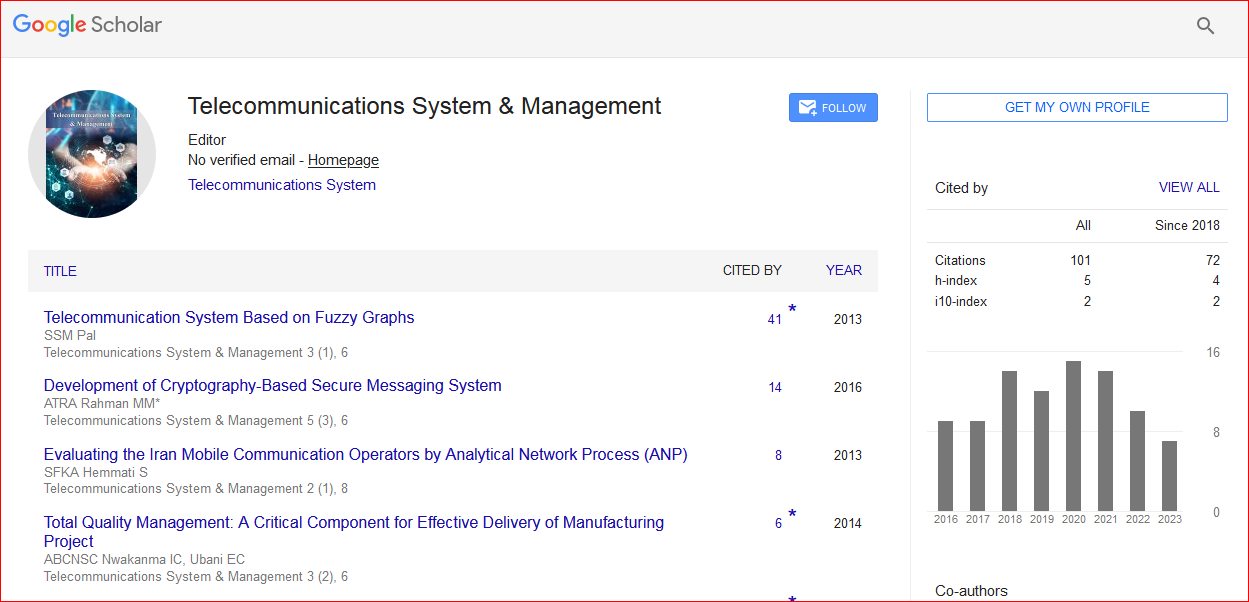
Telecommunications System & Management received 109 citations as per Google Scholar report