Commentary - (2025) Volume 16, Issue 3
Received: 02-Jun-2025, Manuscript No. jvst-26-188033;
Editor assigned: 04-Jun-2025, Pre QC No. P-188033;
Reviewed: 18-Jun-2025, QC No. Q-188033;
Revised: 23-Jun-2025, Manuscript No. R-188033;
Published:
30-Jun-2025
, DOI: 10.37421/2157-7579.2025.16.306
Citation: Costa, Beatriz. ”Veterinary Surgery: Innovations Enhancing
Animal Care.” J Vet Sci Techno 16 (2025):306.
Copyright: © 2025 Costa B. This is an open-access article distributed under the terms of the Creative Commons Attribution License, which permits unrestricted use, distribution
and reproduction in any medium, provided the original author and source are credited.
Recent advancements in veterinary surgical techniques are significantly enhancing the care of companion animals and livestock, driven by innovative approaches and technologies [1].
Minimally invasive procedures are increasingly being adopted, offering reduced patient trauma and faster recovery times across various surgical disciplines [1].
Orthopedic reconstruction has seen substantial progress, with new biomaterials and techniques improving outcomes for complex cases [1].
Oncologic surgery is also benefiting from these developments, allowing for more targeted and effective tumor removal [1].
The integration of advanced imaging technologies, such as 3D printing and virtual reality, is revolutionizing pre-surgical planning and intra-operative guidance in complex procedures [3].
These digital tools enhance surgical accuracy and reduce potential risks, particularly in intricate orthopedic and reconstructive surgeries [3].
Extracorporeal shockwave therapy (ESWT) is emerging as a valuable non-invasive therapeutic option for a range of orthopedic conditions in animals, including osteoarthritis and fractures [2].
Its application is supported by a growing body of evidence detailing its physiological mechanisms and clinical efficacy [2].
Robotic-assisted surgery, while still evolving in veterinary medicine, promises greater precision and dexterity for orthopedic and neurological procedures [6].
The potential for enhanced visualization and minimally invasive access is a key driver for its adoption [6].
Laser technology is another area of significant innovation, with applications in soft tissue surgery, dentistry, and pain management, offering benefits like reduced bleeding and pain [5].
The safe and effective use of lasers in clinical settings is a focus of ongoing research and development [5].
The landscape of veterinary surgery is being reshaped by a continuous influx of new techniques and technologies aimed at improving patient welfare and surgical outcomes. Minimally invasive surgery, a cornerstone of modern surgical practice, is being refined for a wide array of procedures in veterinary medicine, from routine interventions to complex reconstructive tasks. This approach not only minimizes tissue trauma but also contributes to accelerated patient recovery and reduced post-operative discomfort [1].
In the realm of orthopedics, advancements in biomaterials, such as bioabsorbable implants, are offering promising alternatives to traditional hardware, thereby reducing the need for secondary surgeries and minimizing the risk of infection and implant-related complications in companion animals [8].
The precise application of these implants is further supported by sophisticated imaging modalities and surgical planning tools [3].
Innovative approaches to orthopedic reconstruction are enabling more effective management of complex fractures and deformities, leading to improved long-term function and quality of life for animals [1].
Extracorporeal shockwave therapy (ESWT) presents a compelling non-invasive option for addressing various musculoskeletal ailments, including osteoarthritis, tendinopathies, and non-union fractures, offering a therapeutic modality that works through established physiological mechanisms to promote healing and reduce pain [2].
The application of ESWT in clinical veterinary practice is being guided by evidence-based protocols to ensure optimal efficacy and patient safety [2].
Robotic-assisted surgery is gradually making its way into veterinary operating rooms, offering the potential for unparalleled precision and dexterity, particularly in intricate orthopedic and neurological procedures where fine motor control and enhanced visualization are paramount [6].
While challenges related to cost and accessibility remain, the trajectory of robotic surgery in veterinary medicine points towards increased integration and expanded applications in the future [6].
Laser technology continues to offer versatile solutions across a spectrum of veterinary surgical procedures, from delicate soft tissue work to pain management and dental applications, with benefits including reduced bleeding, less pain, and faster healing times [5].
The meticulous application of lasers requires careful consideration of safety protocols and specific procedural parameters to maximize their therapeutic benefits [5].
Surgical oncology is also witnessing significant evolution, with tailored strategies for tumor debulking, limb-sparing surgeries, and the integration of multimodal therapies aiming to improve patient survival and quality of life [9].
These advancements in oncologic surgery are crucial for managing complex neoplastic conditions in animals [9].
Furthermore, the management of surgical wounds is being optimized through advanced techniques like negative pressure wound therapy (NPWT), which aids in wound contraction, promotes granulation tissue formation, and reduces the risk of infection, thereby contributing to successful surgical outcomes in challenging cases [10].
The application of NPWT spans a variety of surgical scenarios, proving particularly beneficial for contaminated or complex wounds [10].
Finally, the increasing sophistication in managing spinal diseases in small animals, encompassing advanced diagnostic imaging and refined surgical approaches, aims to minimize neurological compromise and promote functional recovery, addressing conditions such as intervertebral disc disease and spinal trauma [7].
Veterinary surgery is experiencing rapid innovation, with advancements in minimally invasive techniques, orthopedic reconstruction, and oncologic surgery transforming animal care. New technologies like robotic assistance, advanced imaging, and 3D printing are improving surgical precision and planning. Non-invasive therapies such as extracorporeal shockwave therapy (ESWT) are offering alternatives for orthopedic conditions, while laser technology is expanding its applications in various surgical fields. Bioabsorbable implants are enhancing orthopedic reconstructions, and negative pressure wound therapy (NPWT) is improving wound management. The field of spinal surgery for small animals is also seeing progress in minimizing neurological compromise and promoting recovery. These developments collectively contribute to better patient outcomes, reduced recovery times, and enhanced quality of life for animals undergoing surgical procedures.
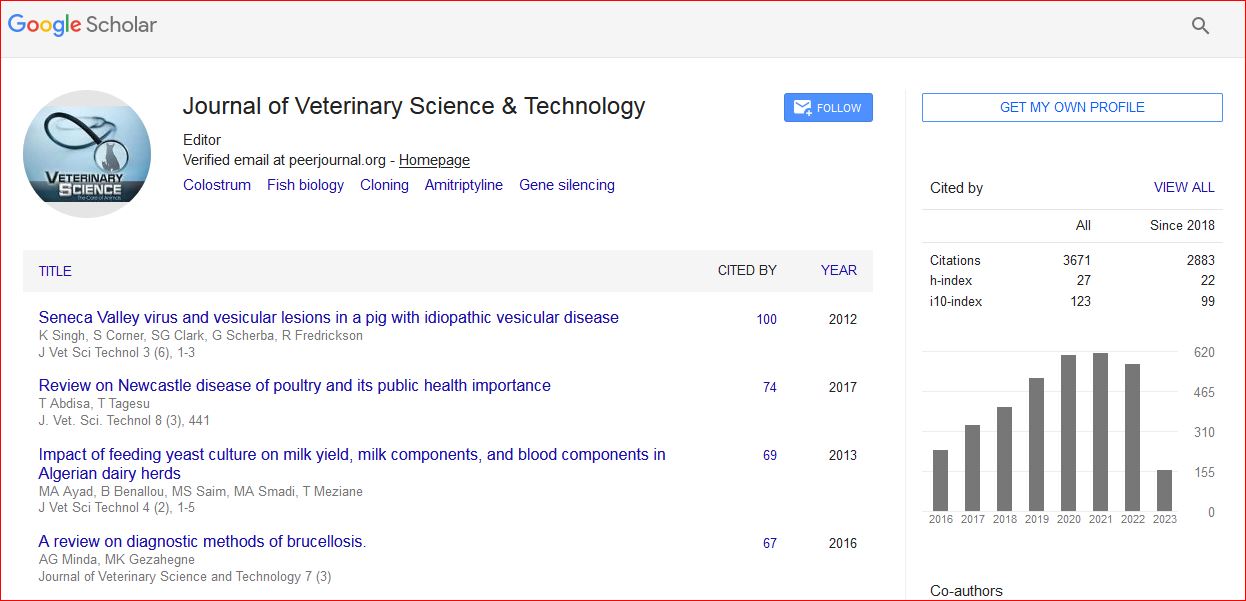
Veterinary Science & Technology received 4472 citations as per Google Scholar report