Commentary - (2025) Volume 16, Issue 6
Received: 01-Dec-2025, Manuscript No. jvst-26-188146;
Editor assigned: 03-Dec-2025, Pre QC No. P-188146;
Reviewed: 17-Dec-2025, QC No. Q-188146;
Revised: 22-Dec-2025, Manuscript No. R-188146;
Published:
29-Dec-2025
, DOI: 10.37421/2157-7579.2025.16.335
Citation: Morales, Diego. ”Veterinary Science: Advances in Diagnostics,
Therapeutics, and Welfare.” J Vet Sci Techno 16 (2025):335.
Copyright: © 2025 Morales D. This is an open-access article distributed under the terms of the Creative Commons Attribution License, which permits unrestricted use,
distribution and reproduction in any medium, provided the original author and source are credited.
The field of veterinary science is constantly evolving, with ongoing research dedicated to improving animal health, welfare, and productivity across various species. Significant advancements have been made in diagnostic techniques, enabling earlier and more accurate identification of diseases. For instance, innovative approaches are integrating molecular methods with traditional serological assays to enhance the speed and precision of avian disease detection, which is vital for safeguarding poultry farming operations.
This progress is paralleled by the critical development of new therapeutic agents to combat prevalent pathogens. Studies are investigating the efficacy of novel antimicrobial peptides as a potential alternative to conventional antibiotics, aiming to address the escalating challenge of antimicrobial resistance in livestock. Furthermore, understanding the environmental factors influencing animal health is crucial for proactive disease management. Research is examining the impact of climate change on the distribution and transmission patterns of vector-borne diseases in cattle, proposing adaptive strategies for surveillance and control in response to shifting environmental conditions. The application of cutting-edge technologies is also revolutionizing diagnostic capabilities. Artificial intelligence and machine learning are being reviewed for their potential to improve diagnostic accuracy in veterinary radiology, particularly for companion animals, by assisting in the early detection of anomalies and optimizing treatment planning. Preventive medicine remains a cornerstone of veterinary practice, with continuous efforts to develop effective vaccines. Promising vaccine candidates are being evaluated for their immunogenicity and protective efficacy against economically significant diseases in swine, offering hope for disease control. Investigating the complex interplay between host physiology and disease is also a key area of focus. Research is exploring the role of the gut microbiome in the pathogenesis of inflammatory bowel disease in dogs, identifying it as a potential target for therapeutic interventions. Beyond disease, animal welfare is an increasingly important consideration in modern agriculture. Assessments are being conducted on the welfare implications of intensive farming practices, evaluating the effects of factors like stocking density and environmental enrichment on animal well-being, with the aim of establishing improved standards. Biotechnology is also offering new avenues for addressing genetic health issues. The application of advanced gene-editing technologies, such as CRISPR-Cas9, is being explored in animal models for inherited diseases, with the goal of developing novel therapeutic strategies. The study of infectious diseases in diverse animal populations is essential for both animal and public health. Investigations into the seroprevalence and risk factors for zoonotic diseases, like leptospirosis, in working dogs highlight the importance of integrated public health measures. Finally, specialized fields within veterinary medicine are also seeing dedicated research. A review of anesthesia protocols for exotic pets addresses the unique physiological and pharmacological challenges associated with these species, aiming to enhance safety and efficacy in clinical practice.Recent breakthroughs in avian disease diagnostics are enhancing the ability to detect common ailments through a combination of molecular and serological techniques. This integration leads to improved accuracy and faster identification, which is critically important for preventing widespread outbreaks in commercial poultry farms.
The growing threat of antimicrobial resistance is being addressed by research into novel therapeutic agents, specifically antimicrobial peptides. Studies are demonstrating the effectiveness of these peptides against multidrug-resistant bacterial strains frequently encountered in livestock, offering a promising alternative to traditional antibiotics. Understanding how environmental shifts affect animal health is a growing concern. Investigations into the impact of climate change on vector-borne diseases in cattle are providing insights into altered disease distribution and transmission dynamics, prompting the development of adaptive strategies for effective surveillance and control. The integration of artificial intelligence is poised to transform veterinary diagnostics, particularly in radiology. Machine learning algorithms are being developed to assist veterinarians in companion animal diagnostics by improving the accuracy of anomaly detection and aiding in treatment planning. Significant progress is being made in vaccine development for crucial animal diseases. A new vaccine candidate for a viral hemorrhagic disease in swine has shown high immunogenicity and protective capabilities in preliminary studies, presenting a valuable tool for disease prevention. Further research is shedding light on the intricate relationship between the gut microbiome and disease development. Studies examining the canine gut microbiome in the context of inflammatory bowel disease are identifying potential therapeutic avenues that target microbial imbalances for disease management. Animal welfare is gaining prominence, with studies focusing on the welfare implications of intensive farming systems. Research evaluating the impact of stocking density and environmental enrichment on sheep well-being is generating recommendations for enhancing welfare standards in agricultural settings. Cutting-edge biotechnological tools are being explored for their therapeutic potential. The application of CRISPR-Cas9 gene editing in animal models for inherited diseases holds promise for developing innovative treatment strategies and improving the genetic health of various veterinary species. Epidemiological studies are vital for understanding disease spread and implementing effective control measures. Research on leptospirosis in working dogs has identified key risk factors and highlighted the zoonotic potential of the disease, underscoring the need for robust public health interventions. Specialized areas of veterinary medicine are also benefiting from focused research. A comprehensive review of anesthesia protocols for exotic pets is addressing the complex physiological considerations and pharmacological challenges associated with anesthetizing diverse species, aiming to ensure safer and more effective procedures.This collection of research highlights significant advancements across various facets of veterinary science. Key areas of progress include enhanced diagnostic techniques for avian diseases, the development of novel antimicrobial peptides to combat resistance, and studies on the impact of climate change on livestock health. Artificial intelligence is being explored for diagnostic improvements in radiology, while new vaccine candidates offer hope for disease prevention in swine. The role of the gut microbiome in canine inflammatory bowel disease is being investigated, and research is also focusing on improving animal welfare in intensive farming. Furthermore, gene-editing technologies like CRISPR-Cas9 are being explored for treating inherited diseases, and epidemiological studies are addressing zoonotic risks, such as leptospirosis in dogs. Finally, specialized research is improving anesthesia protocols for exotic pets.
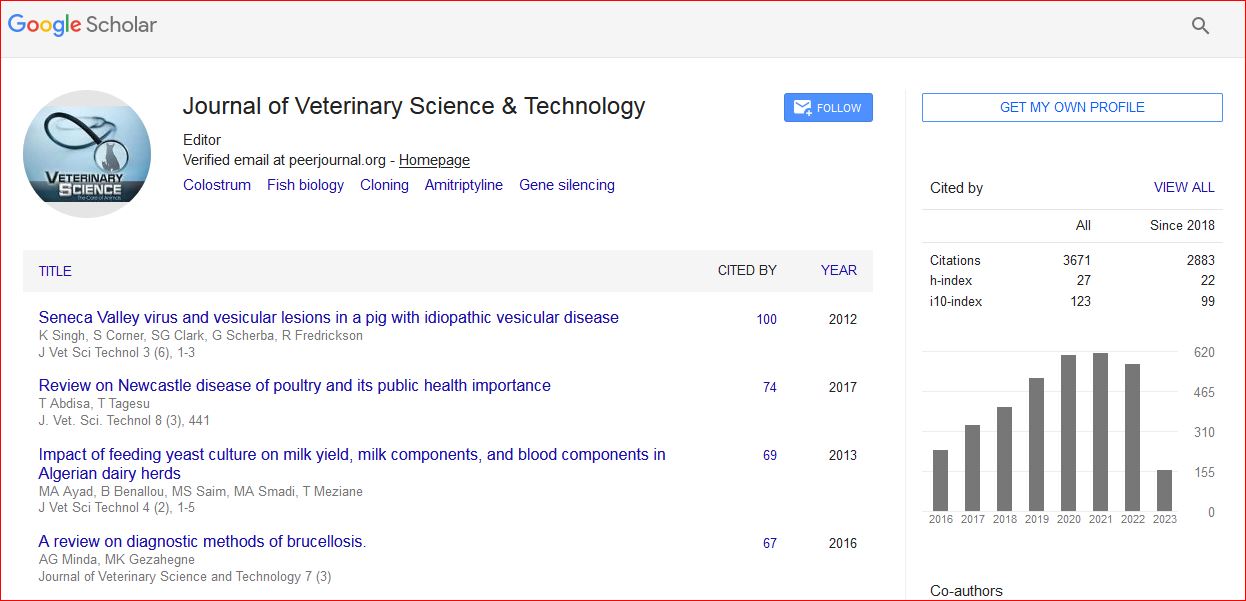
Veterinary Science & Technology received 4472 citations as per Google Scholar report