Perspective - (2025) Volume 11, Issue 4
Received: 01-Aug-2025, Manuscript No. JOV-26-186430;
Editor assigned: 04-Jan-2025, Pre QC No. P-186430;
Reviewed: 18-Aug-2025, QC No. Q-186430;
Revised: 23-Aug-2025, Manuscript No. R-186430;
Published:
29-Aug-2025
, DOI: 10.37421/2471-9544.2025.11.317
Citation: Sato, Kenji. ”Vasculitis Research: Novel Diagnosis And Treatment Frontiers.” J Vasc 11 (2025):317.
Copyright: © 2025 Sato K. This is an open-access article distributed under the terms of the Creative Commons Attribution License, which permits unrestricted use, distribution and reproduction in any medium, provided the original author and source are credited.
The field of vasculitis is undergoing a significant transformation, moving beyond established classifications to embrace novel diagnostic and therapeutic paradigms. Emerging patterns are being identified, revealing subtle clinical presentations that were previously overlooked. Advanced imaging techniques and genetic markers are playing an increasingly crucial role in the early detection and personalized treatment strategies for various forms of this complex group of diseases [1].
Identifying specific subtypes of small vessel vasculitis, particularly those presenting with atypical symptoms, is a critical challenge. Recent investigations into novel autoantibodies show promise in improving diagnostic accuracy and guiding targeted immunosuppressive therapies, offering a more refined approach to patient management [2].
The diagnosis of large vessel vasculitis (LVV) is also evolving, with a greater emphasis on integrating advanced imaging modalities like PET-CT and MRI. Combining these powerful tools with clinical and laboratory findings is essential for recognizing subtle inflammatory patterns in the aorta and its branches, leading to earlier and more effective intervention [3].
A deeper understanding of the genetic factors contributing to vasculitis is emerging. Systematic reviews and meta-analyses of genome-wide association studies are identifying novel genetic loci and pathways implicated in disease pathogenesis, opening avenues for the development of future targeted therapies [4].
Vasculitis exhibits diverse manifestations across different age groups. Research highlights age-specific differences in presentation, diagnosis, and treatment response, underscoring the necessity for tailored management approaches in both pediatric and elderly populations [5].
The impact of global health events, such as the COVID-19 pandemic, on vasculitis is an area of active investigation. Studies are exploring potential mechanisms, including viral-induced autoimmunity, and assessing the implications for patient management and therapeutic strategies in the post-pandemic era [6].
The intricate relationship between the gut microbiome and vasculitis is also gaining attention. Research suggests that alterations in microbial composition, or dysbiosis, may trigger or perpetuate inflammatory responses, pointing towards the modulation of gut microbiota as a potential therapeutic target [7].
Significant advancements have been made in targeted therapies for ANCA-associated vasculitis. The development of biologics that selectively inhibit inflammatory pathways offers a new era of treatment, with ongoing evaluation of their efficacy and safety profiles compared to conventional immunosuppressants [8].
Early detection of subclinical inflammation is paramount in systemic vasculitis. Novel imaging biomarkers, particularly advanced MRI sequences, are showing potential in identifying vascular lesions in conditions like Behçet's disease before overt clinical manifestations appear [9].
The heterogeneous nature of inflammatory patterns in conditions such as Takayasu's arteritis is becoming increasingly apparent. Recognizing distinct phenotypes is crucial for optimizing treatment, and advanced immunological profiling is proving valuable in understanding disease subsets and guiding personalized therapeutic decisions [10].
The examination of vasculitis is expanding beyond traditional classifications to uncover emerging patterns that inform novel diagnostic and therapeutic approaches. This exploration highlights subtle, often overlooked, clinical presentations and underscores the critical role of advanced imaging and genetic markers in achieving early detection and implementing personalized treatment strategies for a spectrum of vasculitis forms [1].
Within the realm of small vessel vasculitis, particularly concerning atypical presentations, the utility of novel autoantibodies is being investigated. These markers are showing potential to enhance diagnostic accuracy and facilitate the delivery of targeted immunosuppressive therapy, leading to more precise patient management [2].
Significant progress is being made in the diagnosis of large vessel vasculitis (LVV). The integration of advanced imaging modalities, including PET-CT and MRI, with clinical and laboratory findings is proving instrumental. This approach emphasizes the importance of identifying subtle inflammatory patterns within the aorta and its arterial branches for timely and effective intervention [3].
Research into the genetic architecture of vasculitis is revealing its predispositions. Systematic reviews and meta-analyses of genome-wide association studies are identifying novel genetic loci and pathways that are likely contributors to disease pathogenesis, presenting potential targets for future therapeutic development [4].
Understanding vasculitis across the lifespan is crucial, as age-specific differences in presentation, diagnosis, and response to treatment are evident. This necessitates the development and application of tailored management strategies for both pediatric and elderly patients afflicted by the condition [5].
The intersection of COVID-19 and vasculitis is an area of growing concern. Investigations are delving into potential mechanisms, such as viral-induced autoimmunity, and assessing the implications for patient care and therapeutic interventions in the aftermath of the pandemic [6].
The influence of the gut microbiome on vasculitis pathogenesis is an emerging focus of research. Studies are exploring how alterations in microbial communities, termed dysbiosis, may initiate or perpetuate inflammatory processes, suggesting that modulating the gut microbiota could offer new therapeutic avenues [7].
For ANCA-associated vasculitis, a new era of treatment is dawning with advancements in targeted therapies. Biologics designed to selectively inhibit inflammatory pathways are being evaluated for their efficacy and safety compared to conventional immunosuppressive regimens [8].
In conditions like Behçet's disease, a form of systemic vasculitis, the development of novel imaging biomarkers for the early detection of subclinical inflammation is a priority. Advanced MRI sequences are demonstrating promise in identifying vascular lesions prior to the emergence of overt clinical symptoms [9].
The phenotypic diversity observed in Takayasu's arteritis is of significant therapeutic importance. Recognizing distinct inflammatory patterns and disease subsets, potentially aided by advanced immunological profiling, is essential for optimizing personalized treatment approaches [10].
Recent advancements in vasculitis research are shifting focus towards novel diagnostic and therapeutic strategies, moving beyond traditional classifications. Subtle clinical presentations are being identified, aided by sophisticated imaging and genetic markers for early detection and personalized treatment. New autoantibodies are showing promise in improving diagnostic accuracy for small vessel vasculitis, while integrated imaging and clinical data are enhancing large vessel vasculitis diagnosis. Genetic studies are uncovering predispositions and potential therapeutic targets. Age-specific management is emphasized, and the impact of COVID-19 and the gut microbiome on vasculitis is under investigation. Targeted therapies, particularly biologics for ANCA-associated vasculitis, represent a significant step forward. Novel imaging biomarkers are aiding early detection in conditions like Behçet's disease, and understanding phenotypic diversity is crucial for personalized treatment in Takayasu's arteritis.
None
None
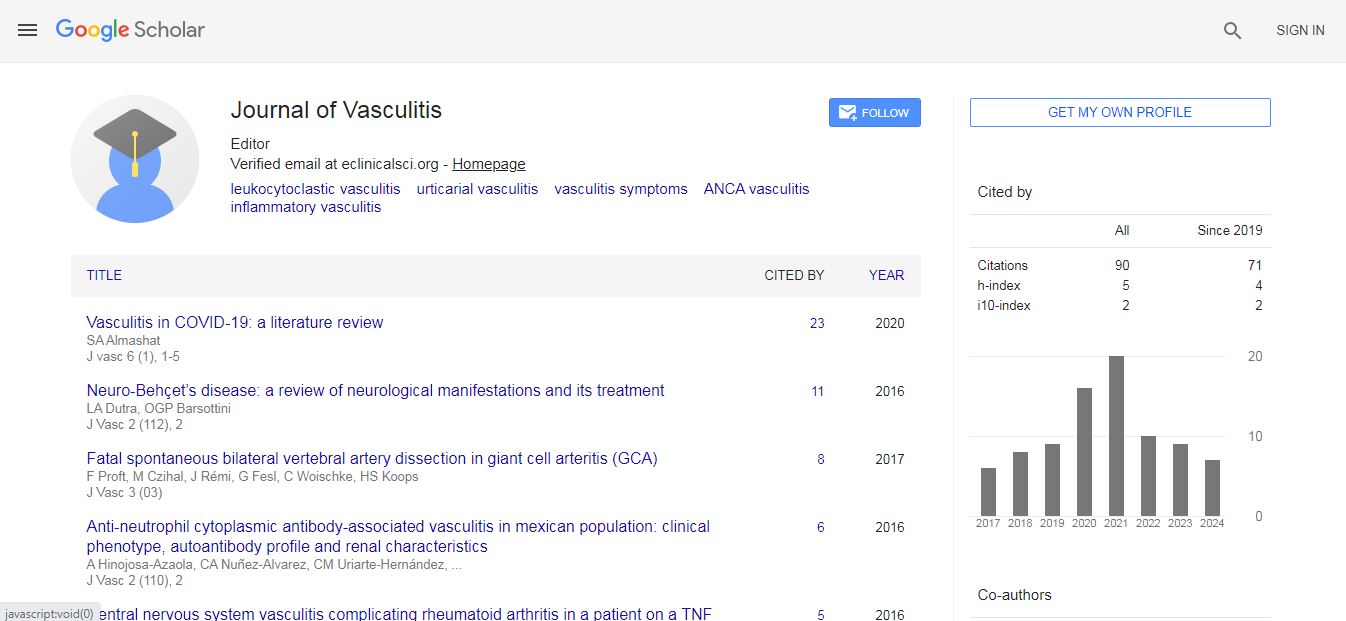
Journal of Vasculitis received 83 citations as per Google Scholar report